

Natural Australian gold nuggets
Browse genuine Australian gold nuggets, each weighed, photographed and sold as the exact piece you receive.
Shop gold nuggets →Table of Contents
- Why Verifying Authentic Gold Nuggets Matters
- Understanding Gold Properties and Geological Context
- Visual Inspection and Colour Analysis
- The Ceramic Plate Streak Test
- Gold Nugget Density Test: A Scientific Approach
- Identifying Raw Gold vs Pyrite and Other Imposters
- Acid Testing Kits and Safety Considerations
- Natural Gold Nuggets and Jewellery: Professional Appraisal vs DIY Methods
- Frequently Asked Questions
Last Updated: September 23, 2026
Why Verifying Authentic Gold Nuggets Matters
How to verify authentic gold nuggets is a critical skill for collectors, investors, and prospectors. Counterfeit gold and misidentified mineral specimens cost buyers thousands of pounds every year. The difference between a genuine natural nugget and a fake can mean the difference between a sound investment and a complete loss.
Gold2u specialises in sourcing authentic natural Australian gold nuggets for discerning collectors and investors. Understanding how to spot a genuine nugget protects your portfolio and ensures you're acquiring real wealth, not fool's gold or artificially enhanced specimens.
Understanding Gold Properties and Geological Context
Gold occurs naturally in the earth over millions of years, forming under specific geological conditions. When water, heat, and pressure work on quartz-rich rock formations, gold particles migrate and concentrate into nuggets. This natural process creates nuggets with distinctive characteristics that differ fundamentally from refined bullion or artificially created specimens.

Natural Formation and Purity Ranges
Natural gold nuggets are rarely pure gold. Most authentic Australian nuggets contain between 92-98% gold, with the remainder comprising other elements like silver, copper, and trace minerals. This natural alloy composition is actually a hallmark of authenticity, pure 99.9% gold nuggets are extremely rare in nature.
The geological environment shapes purity levels. Nuggets formed in quartz veins tend toward higher purity. Those found in alluvial deposits (washed down from parent rock) often contain more base metal impurities. Understanding this variation helps you evaluate whether a nugget's composition is realistic for its claimed origin.
Common Impurities and Quartz Inclusions
Real nuggets frequently contain visible quartz inclusions. These white or translucent mineral fragments embedded in the gold are not defects, they're proof of natural formation. Quartz forms alongside gold in hydrothermal environments, so its presence actually signals authenticity.
Other common impurities include:
- Iron oxides (create rust-coloured staining)
- Silver (lightens the colour slightly)
- Copper (adds reddish tones)
- Tellurium compounds (rare but naturally occurring)
Artificially treated nuggets may have quartz removed or surface coatings applied. Genuine specimens retain their natural quartz and mineral associations exactly as they formed underground.
Visual Inspection and Colour Analysis
Your eyes are your first verification tool. Authentic gold nuggets display specific visual characteristics that fakes struggle to replicate convincingly.
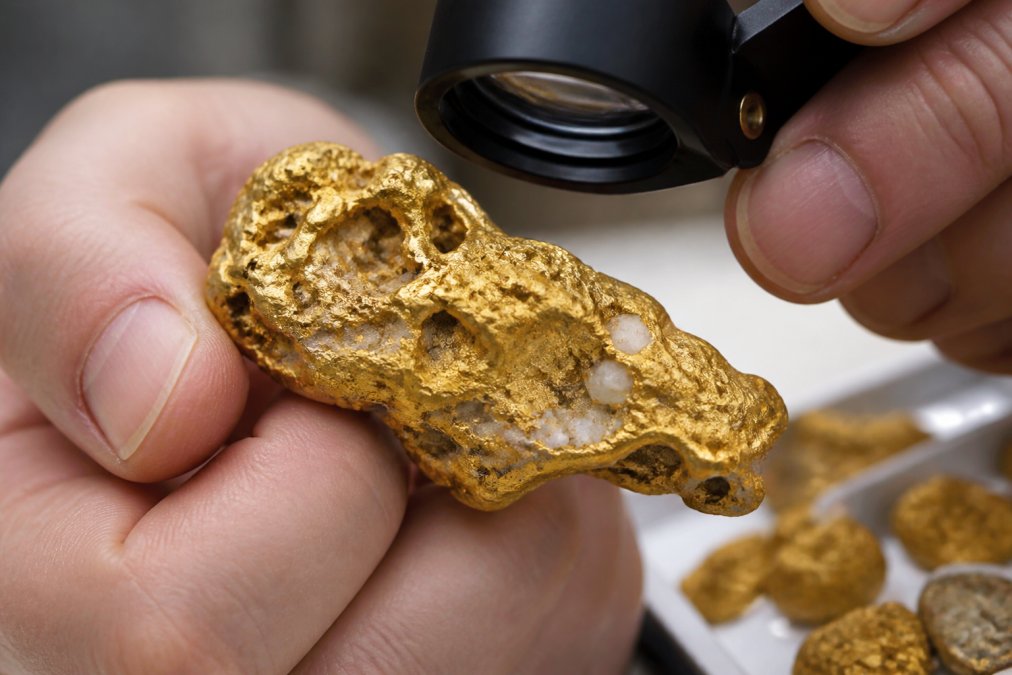
Real gold nuggets show a warm, deep yellow colour. The shade varies slightly depending on silver and copper content, but the hue remains distinctly golden. Fakes often appear too bright, too pale, or oddly orange-tinted because the base metal shows through thin plating.
Surface texture matters. Natural nuggets have an organic, irregular surface with natural cavities, pits, and flowing patterns created by water erosion over millennia. The surface feels rough or slightly bumpy to the touch. Artificially created specimens tend toward uniform, smooth surfaces or suspiciously regular shapes.
Look for natural colour variation across the surface. Authentic nuggets rarely display uniform colour throughout, edges may appear slightly darker or lighter depending on mineral content and oxidation. Consistent, perfect colour across the entire nugget suggests artificial enhancement or coating.
Check for signs of handling and aging. Genuine specimens often show slight surface wear, minor scratches, or areas where the gold has oxidised slightly.
The Ceramic Plate Streak Test
The streak test is one of the oldest and most reliable verification methods for gold. It's simple, requires minimal equipment, and provides immediate results.
What to expect with authentic gold:
- The streak appears immediately and is unmistakably golden-yellow
- The streak is bright and vibrant, not dull or greyish
- The nugget itself remains undamaged, gold is soft enough to leave a mark without breaking the tile
- The streak washes away easily with water
Gold Nugget Density Test: A Scientific Approach
Density testing is where amateur verification becomes genuinely scientific. Every element has a specific gravity, a ratio comparing its density to water. Gold's specific gravity is approximately 19.3. This means a cubic centimetre of gold weighs 19.3 times more than a cubic centimetre of water.
8.055g Natural Gold Nugget ‘The Boss’ →
Calculating Specific Gravity
The formula is simple:
Step-by-step process:
- Weigh the nugget on a digital scale accurate to 0.1 grams. Record this figure.
- Fill a graduated cylinder or measuring jug with water to a known level (for example, 100 ml).
- Carefully place the nugget in the water. The water level rises.
- Record the new water level. The difference is your nugget's volume.
- Divide the weight by the volume. A result between 18.5 and 19.8 indicates authentic gold.
Natural nuggets typically yield specific gravity readings between 18.8 and 19.5, slightly lower than pure gold because of silver and copper content. This variation is completely normal and actually confirms authenticity.
Identifying Raw Gold vs Pyrite and Other Imposters
Most fake gold nuggets are actually pyrite, also called fool's gold. Pyrite is common, inexpensive, and superficially resembles gold. However, the differences are pronounced once you know what to look for.
Distinguishing Pyrite and Chalcopyrite
Pyrite is brassy yellow, almost metallic in appearance. It forms cubic or octahedral crystals with a distinctive geometric shape. The colour is too bright and uniform, it lacks the warm, slightly muted tone of real gold. Pyrite is also harder and more brittle than gold. When struck, it shatters or chips rather than denting.
| Mineral | Colour | Streak | Specific Gravity | Hardness |
|---|---|---|---|---|
| Gold | Warm yellow | Golden-yellow | 19.3 | Soft (malleable) |
| Pyrite | Brassy yellow | Greenish-black | 5.0 | Hard (brittle) |
| Chalcopyrite | Yellow-green | Dark grey | 4.2 | Soft but brittle |
Magnetism and Non-Magnetic Properties
Gold is non-magnetic. This property offers another quick verification test.
Acid Testing Kits and Safety Considerations
Acid testing is the traditional jeweller's method for verifying gold purity. Commercial testing kits contain nitric acid, which reacts differently with gold and base metals.
How acid testing works:
Safety is critical when handling nitric acid:
- Work in a well-ventilated area or outdoors
- Wear chemical-resistant gloves and eye protection
- Never touch your face or eyes while handling acid
- Keep water nearby for emergency rinsing
- Dispose of used acid according to local regulations
- Never mix acids or add water to acid
- Store acid in a clearly labelled, sealed container away from heat
Natural Gold Nuggets and Jewellery: Professional Appraisal vs DIY Methods
DIY testing methods are effective and accessible, but they have limitations. Professional appraisers bring equipment, training, and experience that home testing cannot match.
A qualified precious metals appraiser uses sophisticated instruments:
- X-ray fluorescence (XRF) analysers determine exact elemental composition without damaging the specimen
- Precision balances accurate to 0.001 grams enable exact density calculations
- Microscopes reveal surface characteristics and internal structures invisible to the naked eye
- Ultrasonic testing equipment detects hollow cores or internal voids
When to Seek Professional Authentication
Seek professional appraisal when:
- You're purchasing a high-value specimen (over £1,000)
- The nugget's origin or history is unclear
- You intend to use the nugget as investment collateral
- You need insurance documentation
- The specimen shows unusual characteristics or apparent impurities you can't confidently evaluate
- You're acquiring a rare or historically significant piece
Gold2u provides detailed specifications for every natural gold nugget in our collection, including estimated purity ranges and origin documentation. Our 8.055g Natural Gold Nugget 'The Boss' exemplifies the authentication standards collectors expect, Australian origin, natural formation, and transparent purity estimates between 92-99%.
Frequently Asked Questions
How can I tell if my gold nugget is real?
Real gold nuggets display a golden-yellow streak on ceramic, are non-magnetic, and have a specific gravity between 18.8 and 19.5. Perform a ceramic plate streak test first: drag the nugget across unglazed ceramic and check for a yellow-gold mark. Fake nuggets often leave black or brown streaks. Combine this with a weight-to-volume density test using water displacement to confirm authenticity. Natural nuggets from reputable sources like Gold2u often contain natural quartz inclusions.
What is the difference between identifying raw gold vs pyrite?
Pyrite (fool's gold) is magnetic, brittle, and leaves a greenish-black streak on ceramic, whereas real gold is non-magnetic, malleable, and leaves a golden-yellow streak. Pyrite has a cubic crystal structure and appears brassy, while natural gold has an irregular, organic shape. Gold is also significantly heavier: a piece of pyrite the same size as a gold nugget will weigh far less. Testing with a magnet and performing the ceramic streak test quickly separates the two.
How do I calculate specific gravity for a gold nugget density test?
Weigh the nugget on a digital scale in air (in grams), then measure its volume by water displacement: place it in a graduated cylinder or measuring jug with a known water level and note the rise. Divide the weight by the volume increase to get specific gravity. Pure gold has a specific gravity of 19.3; natural nuggets typically range from 18.8-19.5 depending on quartz and mineral content. If your result falls significantly below this range, the nugget may contain substantial impurities or be counterfeit.
What should I do if I'm unsure about authenticity?
Start with non-destructive tests: visual inspection, streak test, and density calculation. If results are inconclusive, consult a professional assayer or jeweller accredited by a recognised precious metals body. Professional appraisal is especially important for high-value pieces or if you plan to sell. Gold2u provides authenticated natural nuggets with documented purity ranges, so purchasing from a trusted source reduces verification risk. Always retain certificates and documentation for any significant purchase.
Ready to buy?
Browse genuine Australian gold nuggets, each weighed, photographed and sold as the exact piece you receive.
Shop gold nuggets →


0 comments