

Natural Australian gold nuggets
Browse genuine Australian gold nuggets, each weighed, photographed and sold as the exact piece you receive.
Shop gold nuggets →Table of Contents
- Why Authenticity Matters for Gold Nugget Collectors
- Visual Identification: What Real Gold Looks Like
- The Streak Test Method for Quick Authentication
- Specific Gravity Test for Gold: Measuring Density
- The Difference Between Natural Gold and Pyrite
- Acid Testing: Safety Protocols and Procedures
- Non-Destructive Testing for Collectors
- Professional Gold Appraisal Services and Certification
- Frequently Asked Questions
Last Updated: September 21, 2026
Why Authenticity Matters for Gold Nugget Collectors
Buying a natural gold nugget without verifying its authenticity risks investing in something worth far less than you paid. A genuine nugget holds its value and tells a real geological story; a fake or treated piece does neither.

Counterfeit nuggets flood the market, often made from pyrite, chalcopyrite, or artificially enhanced material. The good news: you don't need expensive lab equipment to verify natural gold nuggets. Seven straightforward tests reveal whether you're holding the real thing.
Visual Identification: What Real Gold Looks Like
Natural gold has distinctive visual markers fakes rarely replicate. Real gold reflects light with a warm, consistent glow, it doesn't sparkle like pyrite or flash with a brassy tint like chalcopyrite.
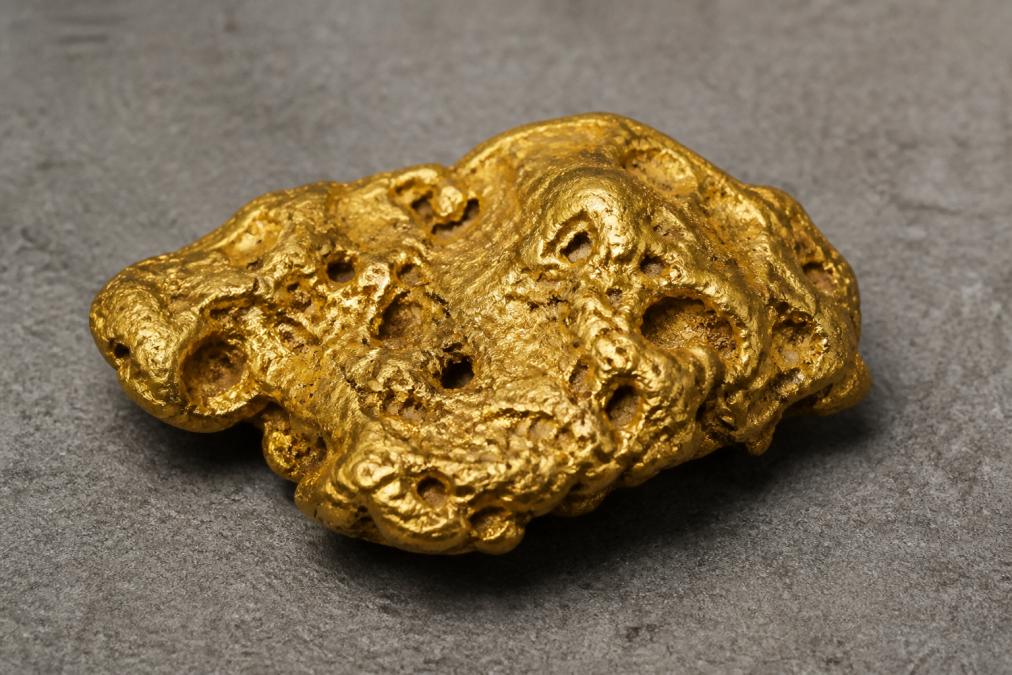
Metallic luster and surface texture
Authentic nuggets display metallic luster, a dull, warm shine from natural reflective properties. Real gold shows consistent colour from every angle; pyrite has a brassy, greenish tint when viewed differently. Natural nuggets are never smooth, millions of years underground create textured surfaces with small pits and cavities where water dissolved surrounding minerals. A polished or artificially smoothed nugget is a red flag.
Nugget morphology and natural cavities
Real nuggets form irregular, lumpy, asymmetrical shapes, never perfectly round. Natural cavities are crucial: look for random holes and indentations of varied depth across the surface. These pits formed during geological weathering and are impossible to fake convincingly. Counterfeit nuggets often have suspiciously uniform surfaces or artificial-looking dimples.
The Streak Test Method for Quick Authentication
The streak test is simple and reliable. Rub the nugget firmly across a ceramic tile or unglazed porcelain. Real gold leaves a golden-yellow streak that won't fade. Pyrite leaves a greenish-black or dark grey streak; chalcopyrite leaves black.
Specific Gravity Test for Gold: Measuring Density
The specific gravity test measures nugget density. Gold is heavy for its size, making this test one of the most reliable for separating genuine nuggets from lookalikes.
Water displacement technique
Weigh your nugget dry, then submerge it completely in water and weigh again. Calculate: Specific gravity = Dry weight ÷ (Dry weight − Wet weight). Real gold reads 19-20. Below 15 indicates significant impurities or fake. Pyrite reads ~5; chalcopyrite ~4.2.
Using hydrostatic balance scales
Hydrostatic balance scales measure weight in air and water simultaneously, calculating specific gravity automatically. They cost more than regular scales but provide absolute certainty about density for serious collectors.
The Difference Between Natural Gold and Pyrite
Pyrite, also called fool's gold, tricks more people than any other mineral. It looks shiny and feels heavy, but it's worth almost nothing compared to real gold.
Why pyrite fools prospectors
Pyrite forms cubic crystals visible under magnification; real gold nuggets show no crystal structure and look organic. Pyrite tarnishes when exposed to air and moisture; gold never tarnishes and stays bright indefinitely.
Hardness and malleability tests
Gold is soft, press a fingernail firmly into it and real gold dents slightly; pyrite is much harder and won't mark. Real gold is malleable and bends when tapped; pyrite shatters or cracks because it's brittle.
Acid Testing: Safety Protocols and Procedures
Acid testing is definitive but dangerous and should only be attempted when other non-destructive tests prove inconclusive. If visual inspection, streak testing, and specific gravity all point to real gold, acid testing adds little value and introduces unnecessary chemical hazard.
When acid testing is actually necessary
Acid testing is useful when you suspect gold-plating, see mixed properties, authenticate high-value specimens, or test material from locations with gold-coloured mineral impurities. If the nugget passes streak testing, shows specific gravity 19-20, and displays natural cavities, acid testing is unnecessary.
Using nitric acid safely
Never perform acid testing without proper safety equipment and understanding local chemical disposal regulations. You need: nitrile gloves, safety glasses, well-ventilated workspace, ceramic or glass dish, 10% nitric acid, paper towels, running water, and disposal container. Wear gloves and glasses before opening the bottle.
Interpreting acid test results
No reaction = genuine gold. The acid remains clear and does not change colour. The nugget surface shows no discolouration or pitting.
Safe disposal and regulatory requirements
Rinse the nugget thoroughly and dry it. Do not dispose of nitric acid down the drain, it's hazardous waste. Contact your local waste disposal service for guidance. Many centres accept small quantities of laboratory chemicals. If acid contacts skin, rinse with water for 15 minutes and seek medical attention.
The case for skipping acid testing
For most collectors, acid testing is unnecessary risk. A nugget that passes visual inspection, streak testing, and specific gravity testing is almost certainly genuine. The non-destructive methods in the next section provide equal certainty without chemical hazard or disposal complications.
8.055g Natural Gold Nugget ‘The Boss’ →
Non-Destructive Testing for Collectors
Non-destructive methods verify authenticity without risking the nugget's appearance or value. Used in combination, each method confirms the others, building complete authentication certainty without any destructive step.
Building a non-destructive testing sequence
The most reliable approach combines four non-destructive tests: visual and tactile assessment, magnetic property check, metal detector response, and specific gravity via water displacement. If all four align, you have authentication-grade certainty without acid or striking the specimen.
Magnetic property checks
Real gold is non-magnetic. Hold a strong neodymium magnet 5-10cm from your nugget, genuine gold won't move or stick. Pyrite and chalcopyrite contain iron and are weakly magnetic; a neodymium magnet will pull them slightly. This 10-second test is completely non-invasive and costs £5-£15.
Metal detector screening and signal interpretation
A quality metal detector identifies gold reliably. Real nuggets produce a clear, repeatable signal. Pyrite also triggers detectors but produces an erratic, stuttering, or weaker signal. Gold produces a steady tone that remains constant as you move the coil; pyrite's signal varies.
Specific gravity via water displacement (revisited as non-destructive confirmation)
The water displacement test, covered in detail in an earlier section, is the most definitive non-destructive method. It measures the nugget's density directly and compares it to the known specific gravity of pure gold (19.3).
- Shows no magnetic attraction
- Produces a clear, consistent metal detector signal
- Displays a specific gravity between 19 and 20
...is genuine gold. No further testing is needed.
Using XRF scanning for advanced non-destructive analysis
X-ray fluorescence (XRF) scanning is a professional-grade non-destructive method that measures the elemental composition of the nugget's surface without damaging it. An XRF device emits low-energy X-rays that cause the nugget's atoms to fluoresce, revealing which elements are present and in what proportion.
XRF scanning is particularly valuable if:
- You are authenticating a high-value nugget
- You suspect the nugget is gold-plated base metal
- You want a detailed elemental breakdown for insurance or investment documentation
- You are purchasing from an unfamiliar seller and want independent verification
The non-destructive testing advantage
Unlike acid testing, which consumes a small amount of material and requires hazardous chemical disposal, non-destructive methods preserve the specimen in perfect condition. A nugget tested with magnets, metal detectors, and water displacement shows no signs of testing. It remains in the exact condition you received it.
Professional Gold Appraisal Services and Certification
Sometimes the safest choice is professional authentication. Experienced appraisers have years of training and access to advanced testing equipment.
When to seek professional authentication
You should consider professional appraisal if:
- The nugget is exceptionally large or valuable
- You're purchasing from an unfamiliar seller
- The nugget shows signs of treatment or enhancement
- You want documentation for insurance purposes
- You're building an investment portfolio
A reputable appraiser examines the nugget under magnification, performs specific gravity testing, and sometimes uses X-ray fluorescence to measure purity. They provide a written report detailing their findings.
What certification documents mean
Certification documents from a professional appraiser include:
- Weight and dimensions
- Estimated purity percentage
- Visual assessment notes
- Test results (specific gravity, acid testing, or XRF analysis)
- Appraiser's signature and credentials
- Date of appraisal
These documents add value when you sell. Buyers trust certified pieces more than uncertified ones. The certificate proves the nugget was authenticated by a qualified professional.
Frequently Asked Questions
How can I tell if my gold nugget is real without professional testing?
Start with visual inspection: authentic gold nuggets display a distinctive metallic luster and natural surface texture with cavities formed over millions of years. Perform the streak test by rubbing the nugget on ceramic, real gold leaves a golden-yellow streak, not black or grey. Check malleability by carefully attempting to bend or dent a small edge; genuine gold deforms slightly, while pyrite shatters. These non-destructive methods provide strong initial evidence of authenticity before considering professional appraisal.
What is the difference between natural gold and pyrite?
Natural gold is soft, malleable, and leaves a golden-yellow streak on ceramic. Pyrite (fool's gold) is brittle, leaves a greenish-black streak, and often forms cubic crystal structures. Gold has a specific gravity around 19.3, meaning it feels substantially heavier than pyrite at the same volume. On the Mohs hardness scale, gold rates 2.5-3 (very soft), while pyrite rates 6-6.5. Pyrite also exhibits magnetic properties in some specimens, whereas natural gold shows no magnetic response.
Do I need a specific gravity test for gold to verify authenticity?
A specific gravity test is one of the most reliable non-destructive methods available. Water displacement testing reveals whether your nugget's density matches gold (approximately 19.3 g/cm³). You can perform this at home using a precise scale and a graduated cylinder: weigh the nugget in air, then measure its volume by water displacement. Divide mass by volume; results significantly lower than 19.3 suggest the specimen may contain base metals or impurities, warranting professional appraisal.
Is acid testing safe to do at home on gold nuggets?
Acid testing can be performed at home but requires strict safety protocols. Nitric acid is corrosive and produces harmful fumes, always work outdoors or in a well-ventilated space, wear chemical-resistant gloves and eye protection, and never mix acids. A small scratch on the nugget surface is tested with dilute nitric acid; genuine gold resists reaction, while base metals dissolve. If you lack experience with chemical handling, professional appraisal services eliminate risk while providing certified documentation of purity and authenticity.
Ready to buy?
Browse genuine Australian gold nuggets, each weighed, photographed and sold as the exact piece you receive.
Shop gold nuggets →


0 comments