

Last Updated: October 23, 2026
Quick Summary
Fake gold nuggets can be identified by seven key warning signs: unusual weight and density, magnetic reaction, surface wear inconsistencies, colour and finish anomalies, suspiciously smooth texture, failed scratch tests, and missing provenance documentation. Learning these physical characteristics helps you distinguish authentic specimens from counterfeits before investing significant money.
- Real gold has a specific gravity of approximately 19.3 and should feel disproportionately heavy for its size.
- Authentic gold is non-magnetic; any magnetic attraction indicates the specimen is not pure gold.
- Natural gold nuggets show uneven surface erosion and irregular wear patterns that cannot be easily replicated by hand.
- Gold is soft and scratches easily to reveal bright yellow metal beneath; harder metals like tungsten resist scratching.
- Professional assayers use X-ray fluorescence analysis and specific gravity measurement to verify authenticity with certainty.
Table of Contents
- Why Fake Gold Nuggets Matter: Understanding the Risk
- How to Tell if a Gold Nugget is Real: The Seven Warning Signs
- Fake Gold Nugget Tests You Can Perform at Home
- Pyrite vs Gold: Distinguishing Natural Lookalikes
- Professional Gold Testing: When to Seek Expert Verification
- Counterfeit Materials and Gold-Plated Deception
- Buying Authentic Gold Nuggets: Your Checklist
- Frequently Asked Questions
Why Fake Gold Nuggets Matter: Understanding the Risk
Counterfeit gold nuggets threaten collectors and investors as the market for natural gold grows and counterfeits become more sophisticated. Distinguishing real gold from fake gold nuggets requires knowing the physical characteristics that separate authentic specimens from imitations.

A single misdirected investment can drain thousands of pounds, and fake gold nuggets undermine trust in the entire market. Spotting counterfeits protects you and ensures your collection holds genuine value.
This guide covers the seven most reliable warning signs of authenticity, practical home tests, why some tests fail, and when professional verification becomes essential.
How to Tell if a Gold Nugget is Real: The Seven Warning Signs
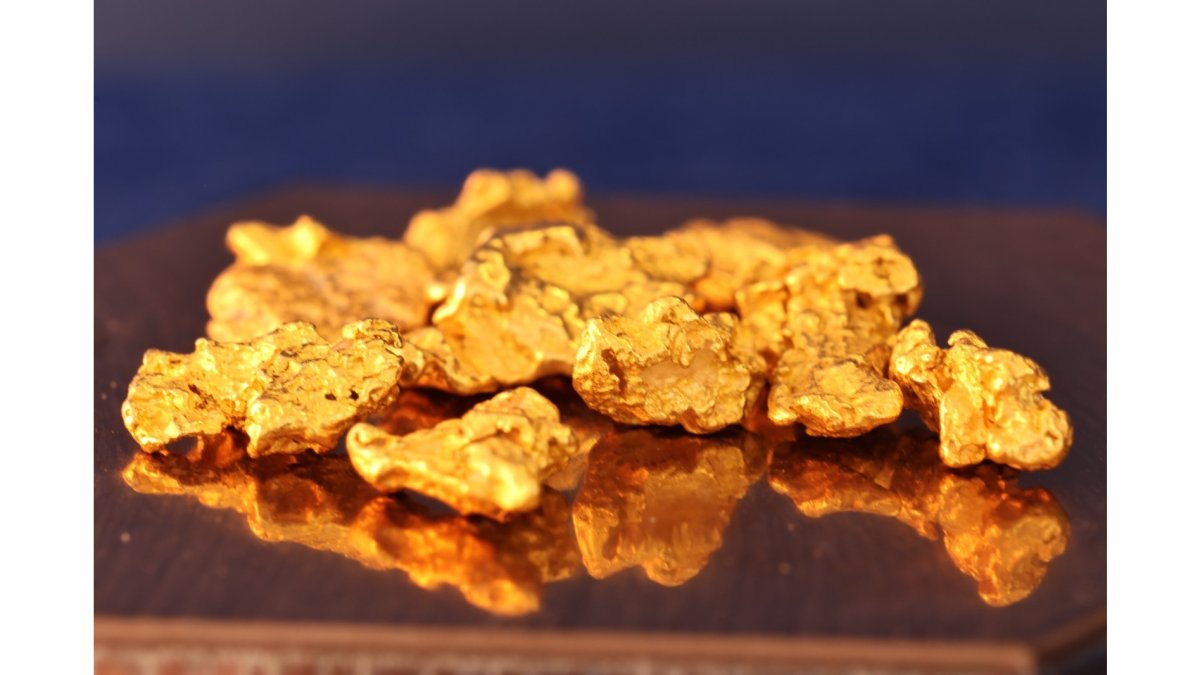
Identifying a fake gold nugget starts with understanding what authentic specimens look like. Natural gold nuggets carry distinctive markers, weight distribution, surface texture, magnetic properties, that tell a story of geological formation.

Sign 1: Unusual Weight and Density
Real gold is remarkably dense, with a specific gravity of approximately 19.3. A nugget that feels too light for its size is a red flag.
Counterfeits use lighter metals or alloys to cut costs.
A simple test: compare the suspect nugget to a known authentic piece of similar apparent size. If it feels suspiciously light, that's your first warning sign.
Sign 2: Magnetic Reaction
Gold is non-magnetic, so a strong magnet should have zero effect on an authentic nugget, one of the most straightforward home tests.
Many counterfeit materials are magnetic. Iron, nickel, and certain alloys respond to magnetic fields. Any attraction, even slight, indicates the specimen is not pure gold.
Sign 3: Surface Wear and Patina Inconsistencies
Natural gold nuggets develop wear patterns over millennia.
Counterfeits often display uniform wear or suspiciously perfect surfaces. A nugget that looks too pristine, too smooth, or too symmetrically worn is likely manufactured.
Look for natural pitting, smoothness from water erosion, and zones where gold was exposed through mineral loss, patterns that cannot be easily replicated by hand.
Sign 4: Colour and Finish Anomalies
Authentic natural gold carries a distinctive warm, rich yellow tone, consistent across the nugget though surface oxidation may create slight variations.
Fake gold nuggets often display colour inconsistencies.
Examine the specimen under bright, natural light, rotating it slowly. Authentic gold maintains its warm tone from every angle; dramatic colour shifts or unnatural appearance are suspect.
Sign 5: Suspiciously Smooth or Perfect Texture
Nature doesn't produce perfect surfaces. Real gold nuggets carry cavities, rough patches, mineral attachments, and irregular formations from their geological journey.
Counterfeiters sometimes sand or polish fake nuggets, removing the natural texture that distinguishes real specimens. Run your fingers across the surface: authentic nuggets feel varied, with rough areas, smoother areas, and natural cavities.
A nugget that feels like it's been deliberately machined or cast is almost certainly fake.
Sign 6: Scratching or Acid Test Results
Gold is soft, so a genuine nugget should scratch relatively easily with a steel implement. A light scratch on an inconspicuous area reveals bright yellow metal beneath on authentic gold.
Many counterfeits use harder metals. Tungsten, for example, resists scratching far better than gold. If your nugget resists a scratch test, that's a strong indicator it's not pure gold.
The acid test is more definitive but requires care.
Sign 7: Missing or Inconsistent Provenance
Authentic gold nuggets come with documentation: sourcing, recovery date, and certifications. Reputable dealers, like Gold2u, provide clear provenance for every specimen.
Counterfeits often lack documentation or come with vague, unverifiable histories. A seller unable to explain where a nugget came from or how it was authenticated should raise immediate suspicion, since provenance protects your investment.
When purchasing from a dealer, ask for certificates of authenticity, geological reports, or third-party verification. Missing documentation is itself a warning sign.
Fake Gold Nugget Tests You Can Perform at Home
Home testing provides a useful first pass, but each test has limitations. Understanding what they reveal, and what they don't, prevents false conclusions.
Safe Testing Without Damage
The magnet test, weight comparison, and visual inspection under bright light are all non-destructive and free. Together they eliminate most obvious counterfeits.
Start with the magnet test.
Check the seven warning signs: consistent colour, natural surface irregularity, and uneven, naturally weathered patina.
If all three tests pass, you likely have an authentic specimen. If any raises red flags, seek professional verification before investing significant money.
Limitations and False Positives
No single home test is foolproof. Some authentic nuggets may have unusual characteristics.
5.311g Natural Gold Nuggets – The Trader’s Lot – Premium Australian Specimen →
The magnet test can produce false positives if the nugget contains magnetic mineral inclusions.
Acid testing is destructive and requires professional-grade materials and knowledge; scratch tests damage the specimen permanently.
The real limitation: home tests cannot definitively prove authenticity. They can only flag suspicions. Professional verification provides certainty.
Pyrite vs Gold: Distinguishing Natural Lookalikes
Pyrite is the most common natural mineral mistaken for gold, "fool's gold." Knowing how to distinguish pyrite from real gold protects you from a common error.
Why Pyrite Fools Collectors
Pyrite is brassy yellow and metallic, occurring in nugget-like formations in certain geological contexts. To untrained eyes, it can resemble gold nuggets.
Pyrite's specific gravity is around 5 versus gold's 19.3, so a pyrite nugget of the same apparent size feels dramatically lighter, the quickest way to distinguish the two.
Most importantly, pyrite is worthless as an investment. Collectors buy gold nuggets for their precious metal value, which pyrite lacks entirely.
Other Mineral Imitations
Chalcopyrite is another brassy mineral that fools beginners.
Iron oxide minerals sometimes appear in nugget-like formations. They're non-magnetic or weakly magnetic, and more orange or reddish than gold's warm yellow.
Quartz with iron oxide inclusions can glitter like gold, but quartz is transparent or translucent while gold is opaque and metallic, obvious under magnification.
The common thread: natural mineral imitations fail the weight and magnet tests.
Professional Gold Testing: When to Seek Expert Verification
Professional testing removes doubt. When investing significant money, professional verification is worth the cost.
What Specialists Look For
Professional assayers use methods home testing cannot replicate. X-ray fluorescence (XRF) analysis identifies elemental composition without damaging the specimen: the machine directs X-rays at the nugget and measures the energy signature of reflected radiation, revealing exactly which metals are present (Rapid screening of heavy metals and trace elements in environmental samples using...).
Specific gravity measurement uses precision scales and water displacement: weighing the nugget in air, then submerged in water, reveals its density far more precisely than visual comparison.
Microscopic examination reveals surface structure at magnification impossible with the naked eye. Natural gold shows characteristic crystal formation patterns; manufactured or plated gold shows different ones.
Professionals also verify provenance documentation against known issuing authorities and assess whether the geological history matches the specimen's characteristics.
Certification and Documentation
Reputable professionals provide written certification stating the specimen's weight, dimensions, purity (if determinable), authenticity assessment, testing date, and the assayer's credentials.
Certification adds resale value, since buyers trust professionally verified specimens far more. For a collection or investment, certification justifies its cost through increased market confidence.
When purchasing from any dealer, demand certification as a condition of sale.
Counterfeit Materials and Gold-Plated Deception
Gold plating creates the appearance of gold over a cheaper base metal.
Gold plating is typically only a few micrometres thick and wears away with handling, revealing the base metal.
Tungsten is popular for high-end counterfeits because it's dense, but it's magnetic or semi-magnetic, so the magnet test catches most tungsten fakes.
The key indicator: authentic solid gold nuggets show consistent colour throughout.
Buying Authentic Gold Nuggets: Your Checklist
Protecting yourself starts before purchase. Evaluate the seller, examine the specimen, and demand documentation.
| Checklist Item | What to Look For | Red Flag |
|---|---|---|
| Seller Reputation | Established dealer, positive reviews, verifiable history | Unknown seller, no track record, vague contact details |
| Documentation | Certificate of authenticity, geological provenance, assay report | No documentation, vague history, undated certificates |
| Visual Inspection | Consistent colour, natural surface wear, irregular texture | Uniform colour, suspiciously smooth surface, unnatural appearance |
| Weight Test | Feels substantially heavy for its size | Feels light or hollow |
| Magnet Test | No magnetic reaction | Any observable magnetic attraction |
| Pricing | Aligns with current gold prices and market rates | Suspiciously cheap, too good to be true |
| Seller Communication | Clear answers to questions, willing to provide additional information | Evasive, defensive, unwilling to discuss sourcing |
Our specimens are sourced from trusted suppliers in Australia, one of the world's most respected gold-producing regions.
For collectors and investors seeking verified, authentic specimens, we offer options across price points. The 0.2043g Natural Australian Gold Nugget at £105.50 provides an entry point for new collectors. For serious investors, pieces like The Boss - 8.055g Natural Gold Nugget at £2,899.57 offer substantial specimens with full authentication.

Protecting your investment in gold nuggets requires vigilance and knowledge.
Home testing provides a useful first pass, but when investing hundreds or thousands of pounds, professional verification removes doubt entirely.
Gold2u specialises in authenticated natural gold nuggets. We verify every specimen and provide certification before sale, so you can start your collection knowing your purchase was evaluated by specialists committed to authenticity. Explore our verified collection today.
Frequently Asked Questions
How can you tell if a gold nugget is real?
Real gold nuggets display specific characteristics: natural surface texture with cavities and mineral inclusions, consistent weight relative to size, non-magnetic properties, and authentic patina. Counterfeit nuggets often show suspiciously smooth surfaces, magnetic reactions, or unusual weight. If you're uncertain, seek professional testing from a precious metals specialist who can verify authenticity through density testing and acid analysis.
What's the difference between pyrite and gold?
Pyrite (fool's gold) and real gold differ significantly. Gold is soft, malleable, and non-magnetic; pyrite is brittle and may show magnetic properties. Gold maintains consistent colour; pyrite often displays a brassy or greenish tint. Pyrite forms cubic crystals; natural gold nuggets show organic, irregular shapes. Real gold feels substantially heavier than pyrite of similar size due to higher density.
Can you test a gold nugget at home without damaging it?
Yes. The magnet test (real gold is non-magnetic) and visual inspection are damage-free. Weight and density checks using water displacement are safe. Avoid scratch tests or acid testing unless you're prepared to accept minor surface marks. For valuable specimens, professional testing is safer and more reliable than home methods, which can produce false positives with certain alloys or gold-plated counterfeits.
What should I look for when buying authentic gold nuggets?
Purchase from reputable dealers who provide documentation, certificates of authenticity, and clear provenance. Examine the nugget's surface for natural formation characteristics, irregular shape, textured finish, and visible cavities. Verify weight matches the claimed purity. Ask for professional testing results. Authentic sellers like Gold2u offer Australian natural gold nuggets with purity estimates (typically 92-98% natural gold).


0 comments