

Last Updated: October 23, 2026
Quick Summary
Natural gold vs fool's gold comes down to this: fool's gold is pyrite, an iron sulphide mineral that mimics real gold but lacks any precious metal value, while natural gold is a rare, soft precious metal formed deep within the Earth over millions of years. The two minerals have fundamentally different properties, gold is malleable and non-magnetic, while pyrite is brittle and harder, making them easy to distinguish through simple field tests like the streak test, weight assessment, and hardness evaluation.
- Natural gold displays a warm, buttery yellow colour with soft lustre, while fool's gold appears brassy or greenish-yellow with mirror-like metallic shine.
- Real gold leaves a yellow or golden streak on ceramic, whereas fool's gold leaves a greenish-black or brown-black streak.
- Gold has a specific gravity of approximately 19.3, making it significantly denser than pyrite at around 5.0 for equivalent volume.
- Real gold is soft and malleable, bending under pressure, while pyrite is brittle and shatters or crumbles when bent.
- The five-step identification workflow, visual inspection, weight test, streak test, scratch test, and magnet test, takes roughly 10 minutes and requires only a ceramic tile, metal pin, and magnet.
Table of Contents
- What Is Fool's Gold and How It Differs from Natural Gold
- Visual Identification: Colour, Luster, and Crystal Shape
- How to Tell If a Gold Nugget Is Real
- Natural Gold vs Pyrite: Physical Differences
- How to Test Gold at Home: Step-by-Step Methods
- Is Fool's Gold Valuable? Understanding Its Worth
- Other Gold Lookalikes Beyond Pyrite
- When to Seek Professional Identification
- Frequently Asked Questions
What Is Fool's Gold and How It Differs from Natural Gold
Understanding natural gold vs fool's gold is essential: fool's gold is not gold at all, it's pyrite, an iron sulphide mineral that mimics real gold well enough to deceive inexperienced prospectors, a name earned during 19th-century gold rushes.
Natural gold, by contrast, is a precious metal formed deep within the Earth over millions of years, occurring as pure elemental gold or mixed with other metals in ore deposits.
Fool's Gold: Pyrite's Identity and Occurrence
Pyrite forms in a completely different geological environment than natural gold, crystallising in cubic or multifaceted structures in sedimentary, metamorphic, and ore deposits.
Pyrite occurs far more abundantly than gold and appears in rock formations worldwide, which is why inexperienced prospectors so often mistake it for a valuable find in creek beds and panning sites. It is iron sulphide (FeS₂), containing iron and sulphur, neither of which adds value.
Real Gold: Formation and Properties
Natural gold forms in hydrothermal environments, typically in quartz veins deep underground. It's a soft metal that doesn't break or crumble under pressure, and it's chemically inert, resisting corrosion and tarnish, which is why gold jewellery from centuries past remains pristine today.
Gold nuggets like those offered by Gold2u come from placer deposits, where erosion has concentrated gold particles and larger fragments in creek beds and alluvial soil.
Visual Identification: Colour, Luster, and Crystal Shape
The most immediate way to distinguish natural gold vs fool's gold is by examining colour and surface appearance under good light. Both appear yellow, but the shade and reflective quality differ noticeably once you develop an eye for them.
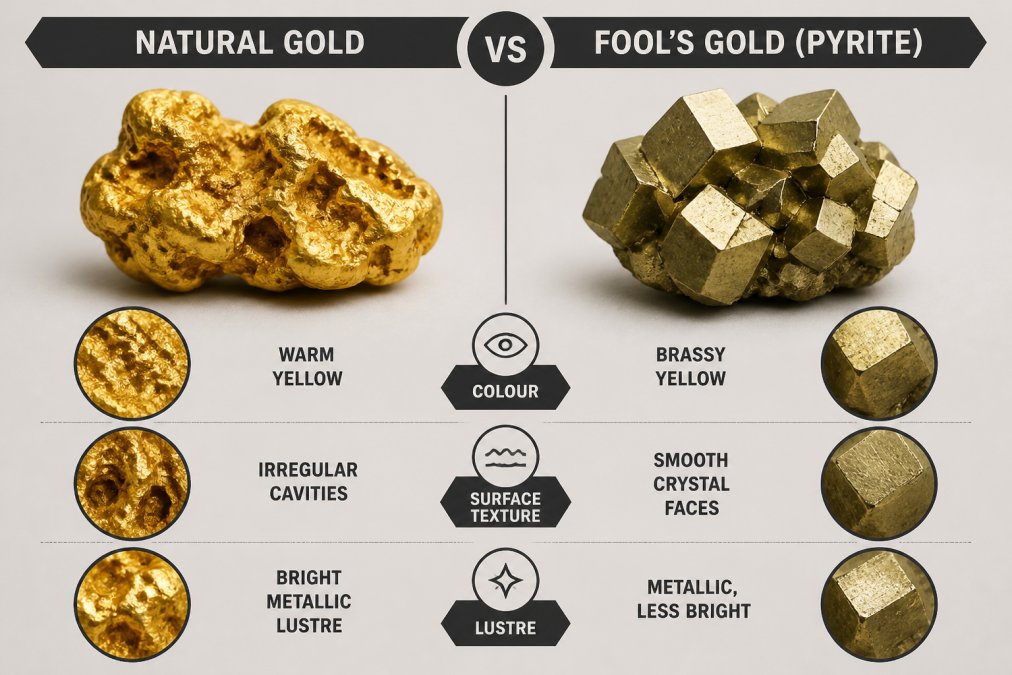
Colour and Surface Appearance
Natural gold displays a deep, warm yellow colour, buttery or honey-like, consistent across the entire surface of a nugget.
Real gold has a matte to semi-lustrous surface, while pyrite has a distinctly metallic, reflective quality.
Surface texture is another clue. Natural gold nuggets show small cavities, pits, and irregular indentations created by erosion and water flow, while pyrite crystals tend to have smooth, flat faces in geometric patterns.
Crystal Structure and Form
Pyrite forms distinct cubic or multifaceted crystals with sharp edges and flat surfaces, clearly defined crystal faces almost certainly mean fool's gold.
Crystal shape is one of the most reliable visual tests. Study authenticated specimens in person or through high-quality photographs from trusted sources like Gold2u's collection, and pyrite's geometric precision versus gold's organic irregularity becomes intuitive after a few examples.
How to Tell If a Gold Nugget Is Real
Beyond visual inspection, several physical tests can confirm whether a specimen is natural gold or fool's gold. Learn specific identification techniques for natural Australian gold nuggets to expand on these methods. They require minimal equipment and give reliable results when performed correctly.
The Streak Test
The streak test is one of the quickest field identification methods. Scratch the specimen firmly across a ceramic tile or unglazed porcelain plate.
Gold is soft enough to leave a visible mark reflecting its true colour, while harder pyrite leaves a streak revealing its iron sulphide composition rather than its surface colour.
The streak test works best on a white or light-coloured ceramic surface.
Weight and Density Assessment
Gold is significantly denser than pyrite. A natural gold nugget feels heavy for its size. Fool's gold, while denser than many rocks, is noticeably lighter than gold of equivalent volume.
With a scale and the specimen's volume (by water displacement or dimensions), you can estimate specific gravity. The specific gravity test method provides precise verification of natural gold nuggets through density assessment.
For more precise measurement, how to test gold at home offers detailed methods using basic household equipment.
Natural Gold vs Pyrite: Physical Differences
The physical properties of these two minerals create clear, testable distinctions that help you confidently identify specimens in any context.
Hardness and Scratch Testing
Gold is a soft metal with a Mohs hardness of 2.5 to 3, one of its defining characteristics, and why it's malleable enough to shape into jewellery and decorative objects.
Perform a scratch test with a metal pin or knife point, pressing firmly against the surface.
The scratch test works reliably but deliberately marks the specimen, so only use it if you accept a small blemish.
Malleability: The Bending Test
Gold is remarkably malleable: a thin flake or small nugget can be bent, flattened, or shaped without breaking. Real gold yields to pressure, deforming rather than fracturing.
Fool's gold is brittle. Apply pressure or attempt to bend a pyrite specimen, and it will crack, splinter, or break into fragments, one of the most distinctive differences between the two minerals.
To test malleability safely, place a small gold flake or thin piece in a vice or between two hard surfaces and apply gradual pressure. Real gold will flatten or bend; pyrite will shatter or crumble. This test is quick, obvious, and doesn't require specialised equipment.
4.407g Natural Gold Nuggets – Premium Australian Specimen →
How to Test Gold at Home: Step-by-Step Methods
A systematic approach to identifying specimens at home gives you confidence in your conclusions. Follow this workflow when you're uncertain about a sample.
Safe Field Identification Workflow
Step 1: Visual Inspection (2 minutes) Examine the specimen under bright light. Look for colour (warm yellow vs brassy yellow), surface texture (irregular cavities vs smooth crystal faces), and lustre (soft vs mirror-like). Note whether the shape is organic or geometric with defined crystal faces.
Step 2: Weight Test (3 minutes) Hold the specimen in one hand and compare it mentally to other rocks or minerals of similar size. Real gold feels dense and substantial; fool's gold feels lighter in comparison.
Step 3: Streak Test (2 minutes) Scratch the specimen across a ceramic tile. Yellow or golden streaks indicate real gold; greenish-black or brown-black streaks indicate pyrite.
Step 4: Scratch Test (2 minutes) Using a metal pin or knife point, attempt to scratch the specimen's surface. Real gold scratches easily. Pyrite resists scratching.
Step 5: Magnet Test (1 minute) Pass a strong magnet near the specimen. Natural gold is not magnetic.
| Test | Real Gold | Fool's Gold | Time Required |
|---|---|---|---|
| Colour | Warm, buttery yellow | Brassy, greenish-yellow | 1 minute |
| Lustre | Soft, warm glow | Metallic, mirror-like shine | 1 minute |
| Crystal Shape | Irregular, anhedral | Geometric, cubic faces | 1 minute |
| Streak | Yellow or golden | Greenish-black or brown | 2 minutes |
| Weight | Heavy for size | Lighter in comparison | 1 minute |
| Hardness | Scratches easily | Resists scratching | 2 minutes |
| Malleability | Bends without breaking | Breaks or crumbles | 2 minutes |
This five-step workflow takes roughly 10 minutes and requires only a ceramic tile, a metal pin, and a magnet. By the end, you'll have strong evidence pointing toward either natural gold or fool's gold.
Magnetism and Other Quick Checks
Natural gold is non-magnetic. If a strong neodymium magnet shows no attraction, that's consistent with real gold. Pyrite is also largely non-magnetic, so a negative test doesn't definitively prove gold, but a strong positive response suggests some other iron-rich mineral.
Another quick check involves observing how the specimen behaves in water. Real gold sinks immediately and stays on the bottom, far too dense to float.
Is Fool's Gold Valuable? Understanding Its Worth
Fool's gold has no precious metal value. Pyrite is an industrial mineral used in some manufacturing processes, particularly sulphuric acid production, but these applications command only a tiny fraction of the price of real gold.

Collectors occasionally value pyrite specimens for their crystal structure or aesthetic appeal, but this value is negligible compared to gold.
If you're prospecting or collecting, the distinction between fool's gold and real gold determines whether your find is worthless or genuinely valuable.
Other Gold Lookalikes Beyond Pyrite
While pyrite is the most common fool's gold, several other minerals can superficially resemble natural gold or appear in similar geological contexts.
Mica, Chalcopyrite, and Quartz
Mica is a soft, flaky mineral that can appear golden or silvery.
Chalcopyrite is a copper-iron sulphide mineral that can display a brassy yellow colour similar to pyrite.
Quartz occasionally contains gold flakes or small particles, which is why it's found alongside gold in many mining areas.
When prospecting in creeks or streams, you'll often encounter a mixture of minerals, quartz, mica, pyrite, and occasionally real gold flakes mixed with black sand.
When to Seek Professional Identification
For rare, valuable, or historically significant specimens, professional identification provides certainty and documentation that matters for insurance, investment, or collection purposes.
If you've found a specimen you believe might be valuable, or you're considering purchasing a natural gold nugget for investment or collection, professional authentication is worthwhile.
Gold2u's natural gold nuggets come with the assurance of authenticated sourcing from established Australian deposits.

For specimens you've found yourself or obtained from unknown sources, professional testing confirms what your field tests suggest.
Distinguishing natural gold from fool's gold comes down to understanding the fundamental differences between a precious metal and a common mineral. For collectors and investors seeking authentic natural gold nuggets, Gold2u provides verified Australian specimens with full documentation of origin and purity, eliminating guesswork and ensuring you own genuine, investment-grade natural gold.

Frequently Asked Questions
How can you tell if a gold nugget is real?
Real gold nuggets display deep yellow or orange-yellow colour, irregular anhedral shapes formed naturally over millions of years, and a metallic luster. Use the streak test: real gold leaves a golden-yellow streak on an unglazed ceramic plate, while pyrite leaves greenish-black. Real gold is also soft and malleable, it bends or flattens under pressure rather than crumbling. Weight is significant too: natural gold feels substantially heavier than pyrite of similar size due to its higher density. If you're starting your collection, Gold2u offers a budget entry point with their 0.2043g Natural Australian Gold Nugget at £105.50, allowing you to examine authentic natural gold firsthand.
What is the difference between natural gold and fool's gold?
Natural gold is a soft, dense metal with a deep yellow colour, irregular shape, and metallic luster that doesn't tarnish. Fool's gold (pyrite) is a brittle mineral with a brassy-yellow or pale colour, often forming perfect cubic crystals, and produces a greenish-black streak. Gold bends and flattens under pressure; pyrite crumbles or shatters. Real gold is non-magnetic. Real gold has a specific gravity around 19.3, making it far heavier than pyrite's 5.0 for the same volume. These differences make field identification straightforward once you know what to test for.
Can you identify gold by its colour and shape?
Colour and shape are useful starting points but not definitive alone. Real gold appears deep yellow or orange-yellow and forms irregular, anhedral shapes without geometric patterns. Pyrite is paler, brassy-yellow, and often displays perfect cubic or multifaceted crystals. However, other minerals like mica and chalcopyrite can mimic gold's colour. Shape alone is unreliable because natural gold nuggets vary greatly. Always combine visual inspection with physical tests, the streak test, hardness check, and malleability test, to confirm identity. These combined observations eliminate most confusion and give you confidence in your identification.
Is fool's gold valuable?
Fool's gold (pyrite) has minimal monetary value as a precious metal, it contains no gold and is not a viable source of it. However, pyrite does have some industrial and collector value. It is used in sulphuric acid production, jewellery as a decorative stone, and mineral specimens for educational or aesthetic purposes. Collectors may pay modest sums for well-formed pyrite crystals, but prices are far lower than real gold. A specimen-quality pyrite crystal might sell for a few pounds, whereas authentic natural gold nuggets from Gold2u, such as their 4.407g Premium Australian Specimen at £1,167.86, command thousands because of real gold's intrinsic value and investment potential.
How can I test gold at home without damaging it?
The streak test is non-destructive: rub the gold sample firmly on an unglazed ceramic plate or streak plate. Real gold leaves a golden-yellow streak; pyrite leaves greenish-black. Next, assess weight and density by holding the sample, real gold feels much heavier than pyrite of similar size. The magnet test is also safe: real gold is non-magnetic, whereas some pyrite samples show weak magnetism. Finally, examine crystal form and colour under good light. Avoid destructive tests like filing or cutting unless you're certain you want to alter the sample. These simple, non-invasive methods work reliably and preserve the specimen's condition and value.


0 comments