

Table of Contents
- Why Gold Matters for Portfolio Diversification
- Gold ETF vs Physical Gold: Which Suits Your Strategy
- Gold Coins vs Gold Bars: Comparing Liquidity and Practicality
- Gold Allocation in a Portfolio: Finding Your Target Percentage
- Gold Investment Risks and Costs: What You Need to Know
- Natural Gold Nuggets and Rare Coins: The Collector's Advantage
- Building Your 2026 Gold Strategy: A Framework for Action
- Frequently Asked Questions
Last Updated: October 12, 2026
Why Gold Matters for Portfolio Diversification
Gold has served as a store of value for millennia. Unlike stocks and bonds, which move together during market stress, gold often behaves independently, rising when equities fall and currencies weaken, an inverse correlation that makes the best gold assets for portfolio diversification essential for most investors.
The best gold assets for portfolio diversification in 2026 fall into four categories: physical holdings (coins, bars, nuggets), exchange-traded funds, mining stocks, and structured products.
Gold's pound performance demonstrates consistent long-term value. From 2006 to 2025, the sterling price of gold rose roughly 12.6% annually, finishing 17 of those 20 years higher, with strong gains in 2008 (up 43.9%) and 2025 (up 52.9%).
Gold ETF vs Physical Gold: Which Suits Your Strategy
Exchange-traded funds offer the simplest route into gold for most investors. A gold ETF tracks the spot price with minimal tracking error and lets you buy or sell within seconds during market hours, with no storage, authentication, or insurance concerns.
Physical gold, coins, bars, and nuggets, offers tangible ownership and no counterparty risk: no fund manager can mismanage it, no custodian can fail. That peace of mind carries a cost: storage, insurance, authentication, and a bid-ask spread 2-4% wider than an ETF.
The decision hinges on your circumstances. If you're building a core allocation and value simplicity, an ETF is superior. Gold2u specialises in authenticated physical gold, natural Australian gold nuggets and historical sovereigns, for investors who prioritise tangible ownership and provenance.

Gold Coins vs Gold Bars: Comparing Liquidity and Practicality
Gold coins and bars serve different roles.
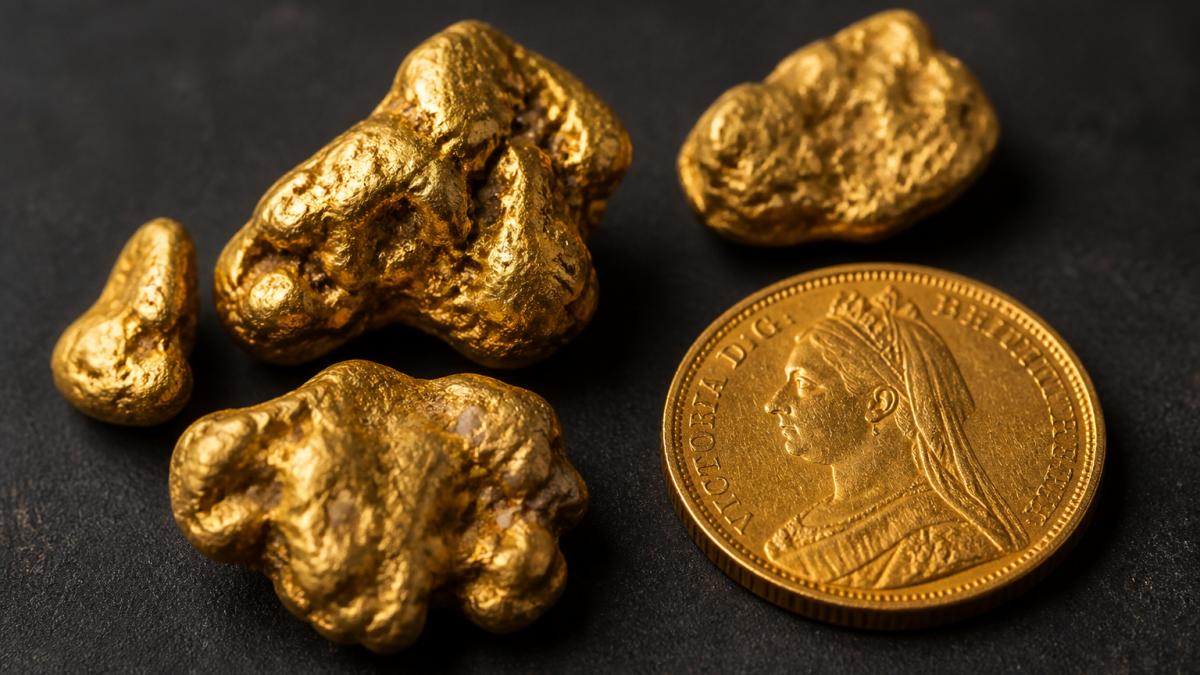
Coins, particularly recognised historical pieces like sovereigns, command better liquidity and often carry numismatic premiums beyond their gold content. A 1871 Queen Victoria Full Gold Sovereign from Gold2u contains 7.3 grams of pure gold but trades at £1,100.00, reflecting both its gold weight and historical significance.

Natural gold nuggets combine the tangibility of physical gold with the individuality of collectibles. A 6.6-gram natural Australian gold nugget (£1,450.00) is completely unique, no two are identical in shape or structure, appealing to collectors who see gold as both a hedge and a conversation piece.
| Asset Type | Cost per Gram | Liquidity | Best For |
|---|---|---|---|
| Gold Bars | Lowest | Moderate | Pure gold accumulation |
| Sovereigns & Coins | Medium | High | Collectors, numismatists |
| Natural Nuggets | Medium-High | Lower | Collectors, unique ownership |
Gold Allocation in a Portfolio: Finding Your Target Percentage
Most guides hand you a number, 5%, 10%, sometimes 20%, and move on. That is a guess dressed up as advice.
Time horizon. Gold's diversification value is realised over full market cycles, not quarters. If you need the money within five years, a forced sale during a drawdown is a real risk, so 3-5% is prudent.
Risk tolerance and income needs. Gold produces no coupon and no dividend, so every pound in gold is a pound not generating yield.
Existing holdings. Gold's diversification benefit depends on what it diversifies against.
Rebalancing rules. A target without a band is a target you will never act on.
| Investor profile | Typical target | Band | Rationale |
|---|---|---|---|
| Near retirement, income-dependent | 3-5% | ±1% | Limited capacity for a non-yielding, volatile sleeve |
| Mid-career accumulator, equity-heavy | 5-8% | ±2% | Meaningful hedge without dragging long-run returns |
| Long horizon, currency-risk exposed | 8-12% | ±3% | Time to ride out drawdowns; hedge against sterling weakness |
| Deep systemic-risk concern | 12-20% | ±4% | Insurance-first framing; accepts years of underperformance |
These are starting points, not prescriptions. The number should be traceable to a reason: if you cannot explain why you hold 8% rather than 5%, you have a position, not an allocation.
Treat the allocation as a living decision. As your horizon shortens and income needs rise, the sensible gold weight usually falls; as currency and real-rate risks rise, it usually rises. The band lets you change the number without abandoning discipline.
Gold Investment Risks and Costs: What You Need to Know
Costs and risks in gold change shape depending on the wrapper you choose.
Total cost of ownership, compared.
| Cost / risk | Physical bullion (allocated) | Gold ETF | Mining equities | Structured / leveraged products |
|---|---|---|---|---|
| Dealer spread | 2-5% typical on coins and small bars | 0.1-0.3% | Broker commission | Often embedded in the product |
| Ongoing charge | Storage and insurance, £100-500+ per year | 0.10-0.40% annual management fee | None, but company costs borne by the business | Product fees, sometimes plus financing |
| Counterparty exposure | None if you hold allocated metal | Fund manager and custodian | The company itself | The issuer and its hedging book |
| Liquidity | Days, dealer-dependent | Seconds during market hours | Seconds during market hours | Product-dependent; can be thin |
| Income | None | None | Possible dividends | Usually none |
| Tax treatment | Depends on form and holding; capital gains rules apply | Depends on wrapper (ISA, SIPP, GIA) | Depends on wrapper | Depends on structure |
Product structure matters more than the label. "Physical gold" is not one thing.
Counterparty and custody risk. With an ETF you depend on the fund manager's solvency and the custodian's integrity.
Authentication and fraud. Counterfeit sovereigns and bars exist, and the risk is highest with unverified sources. Reputable dealers provide authentication and provenance documentation for every piece. If a seller cannot document origin and purity, walk away.
4.638g Natural Gold Nuggets – The Investor’s Lot – Premium Australian Specimen →
Liquidity risk. A standard bar or common bullion coin can be sold to any dealer within days; a rare numismatic coin may take weeks to find the right buyer.
Tax treatment. Gold held in an ISA or SIPP sits inside a tax wrapper, changing the after-tax comparison between an ETF and physical metal held outside one.
The honest summary. Physical allocated gold has the highest frictional costs and the lowest counterparty risk. ETFs have the lowest frictional costs and introduce fund and custodian risk. Mining equities add business risk on top of price risk. Structured products add complexity and issuer risk. There is no free option, only a choice about which risk you would rather carry.
Natural Gold Nuggets and Rare Coins: The Collector's Advantage
Natural gold nuggets and historical coins blur the line between investment and collecting. Unlike standardised bullion, each piece is genuinely unique: a natural Australian gold nugget carries geological character formed over millions of years, with unrepeatable shape, texture, and mineral inclusions.

Gold2u's collection of natural Australian gold nuggets, from the 3.111-gram specimen (£824.42) to "The Boss" at 8.055 grams (£2,899.57), caters to this mindset.
Historical sovereigns like the 1871 Queen Victoria Full Gold Sovereign (£1,100.00) combine gold content with numismatic appeal; the 1871 date with Die Number 75 is considered rare.
The collector's advantage is psychological and practical: you own something genuinely scarce and irreplaceable.
Building Your 2026 Gold Strategy: A Framework for Action
Start by defining your gold allocation as a percentage of total investable assets: 5-7% if conservative, 10-15% if concerned about currency weakness or financial instability.
Next, decide between physical and financial exposure. For allocations under £5,000, an ETF is simpler; for larger allocations or those who value tangible ownership, physical gold makes sense.
Gold2u offers a curated selection of authenticated pieces suited to different strategies.
Build your position gradually. Avoid trying to time the market perfectly, waiting for the "right" price often means never buying. Pound-cost averaging, adding monthly or quarterly, smooths volatility and removes emotion.
Finally, document everything: purchase dates, prices, weights, and purity for each piece, stored securely, as it matters for insurance claims and eventual resale.
Building a gold strategy for 2026 requires matching the right asset type to your circumstances.
Frequently Asked Questions
What are the best gold assets for portfolio diversification in 2026?
The best gold assets depend on your investment goals and circumstances. Physical gold, including natural nuggets, coins, and bars, provides tangible ownership and inflation protection. Gold ETFs offer liquidity and lower costs. Gold stocks provide equity exposure to gold's price movements. Historical data shows gold in pounds rose at approximately 12.6% annually over 20 years (2006-2025), finishing higher in 17 of those 20 years. A diversified approach combines multiple asset types based on your risk tolerance and time horizon.
Is physical gold or a gold ETF better for diversification?
Physical gold and gold ETFs serve different roles. Physical gold, such as natural nuggets or coins, provides direct ownership, protection against counterparty risk, and tangible wealth preservation. Gold ETFs offer lower transaction costs, instant liquidity, and easier portfolio rebalancing. For true portfolio diversification, many investors use both: physical gold for core wealth protection and ETFs for tactical exposure. The choice depends on your liquidity needs, storage preferences, and management fees tolerance.
How much gold should I hold in a diversified portfolio?
Conventional guidance suggests 5-10% of a balanced portfolio in gold, though this varies by individual circumstances. Conservative investors may prefer 5%, while those seeking greater inflation protection might allocate 10-15%. Your allocation should reflect your risk tolerance, investment horizon, and economic outlook. Consider your existing asset allocation, if you hold significant bonds and equities, a smaller gold percentage may suffice. Review and rebalance annually to maintain your target allocation as gold and other assets appreciate at different rates.
Are gold coins or gold bars easier to sell?
Gold bars generally offer better liquidity for larger amounts due to standardised weights and easier bulk transactions. Gold coins, especially rare or historical pieces like sovereigns, may attract premium prices from collectors but can take longer to sell at fair value. Natural gold nuggets occupy a middle ground, they're authentic and desirable to collectors, yet less standardised than bars. For fastest conversion to cash, bars and modern bullion coins are superior. For long-term wealth preservation and collector appeal, rare coins and natural nuggets may offer better value appreciation.
What are the main risks of investing in gold?
Gold carries several risks: price volatility (though historically moderated by diversification), storage and insurance costs for physical gold, counterparty risk with custodians or ETF providers, and opportunity cost when equities outperform. Physical gold also faces liquidity risk if you need to sell quickly. Gold mining stocks add operational and geopolitical risks. To manage these, diversify across asset types, maintain adequate insurance, use trusted custodians, and ensure gold represents an appropriate percentage of your overall portfolio rather than a concentrated bet.
How can I check the authenticity and value of a gold coin?
Verify authenticity by checking weight, dimensions, and fineness against official specifications from the Royal Mint or original issuer. For example, an 1871 Queen Victoria sovereign should weigh 7.98 grams with 916.7 fineness. Request certificates of authenticity from reputable dealers. Examine the coin under magnification for quality of strike and die numbers, rarer die numbers increase value. Compare recent sales of similar coins to assess fair pricing. Reputable dealers like Gold2u provide video viewings and documentation, reducing authentication risk. Avoid coins with suspiciously low prices or unverifiable provenance.
Should I invest in gold mining stocks or physical gold?
Gold mining stocks and physical gold serve different purposes. Physical gold, nuggets, coins, bars, provides direct ownership, inflation protection, and portfolio stability during equity downturns. Mining stocks offer equity leverage to gold prices and dividend potential, but carry operational, geopolitical, and company-specific risks. For true diversification, consider holding both: physical gold as a hedge and core holding, mining stocks for growth exposure. Mining stocks correlate less perfectly with physical gold, enhancing diversification benefits. Your allocation should reflect your risk tolerance and time horizon.
How often should I review my gold allocation?
Review your gold allocation annually or when major market events occur. Gold prices fluctuate significantly, in 2025, gold rose approximately 52.9% in pounds, so your allocation percentage may drift from your target. If gold appreciates substantially, you may become overweighted and should consider rebalancing by selling some gold or adding to other assets. Conversely, if equities surge, your gold weighting may fall below your target. Rebalancing maintains your desired risk profile and forces disciplined buying low and selling high. Adjust your strategy if your circumstances, time horizon, or risk tolerance change.


0 comments