

Table of Contents
- Gold Coins vs Gold Bars: Why Coins Win for Most Investors
- 1. Lower Purchase Premiums and Manufacturing Costs
- 2. Superior Resale Value and Collector Demand
- 3. Greater Liquidity and Quick Access to Cash
- 4. Flexible Denominations for Partial Liquidation
- 5. Global Recognition and Easier Authentication
- 6. Collectible and Historical Value Beyond Spot Price
- 7. Practical Storage and Portability Advantages
- Why Bars Win in One Scenario
- Frequently Asked Questions
Last Updated: October 14, 2026
Gold Coins vs Gold Bars: Why Coins Win for Most Investors
The choice between gold coins and gold bars shapes your storage costs, resale options, and ability to liquidate quickly.
Coins offer structural benefits that compound over time: lower entry costs, faster sales, better global recognition, and the option to sell fractional amounts. Bars excel at bulk storage efficiency, but that advantage narrows once you factor in premium costs, authentication challenges, and selling friction.
This guide covers the 10 reasons to choose gold coins over gold bars, with worked examples showing real cost differences and practical scenarios where coins outperform.
1. Lower Purchase Premiums and Manufacturing Costs
Gold coins typically carry lower premiums per gram than bars, so you pay less above spot price.
When you buy a 1871 Queen Victoria Full Gold Sovereign at £1,100, you're paying for a 7.98-gram coin with 7.3224 grams of pure gold.

Sovereigns benefit from established demand and standardised production. Bars, especially smaller denominations, can have higher costs.
A worked example: total cost of ownership over five years
The real comparison is total cost of ownership, purchase premium, storage, insurance, and the dealer spread on resale. Here is an illustrative example using round figures for a £5,000 outlay held for five years.
| Cost item | Five full sovereigns | One 100g gold bar |
|---|---|---|
| Gold value at spot | £4,650 | £4,650 |
| Purchase premium (approx.) | 7.5% = £349 | 11% = £512 |
| Total outlay | £4,999 | £5,162 |
| Annual storage (home safe, apportioned) | £25 | £25 |
| Annual insurance (apportioned) | £30 | £30 |
| Five-year holding cost | £275 | £275 |
| Indicative resale spread | 4-6% | 6-9% |
| Estimated resale proceeds | £4,900-£5,050 | £4,850-£5,000 |
The headline is the purchase premium. The subtler point is the resale spread. Sovereigns trade in a deep, continuous market, so dealers quote tighter buy-sell spreads, while a single 100g bar is a lumpier unit dealers price for the risk of holding it until a matching buyer appears.
Why the premium gap exists
Three factors keep coin premiums lower per gram:
- Production scale. The Royal Mint strikes sovereigns in very large runs, so fixed tooling and design costs spread across a huge volume.
- Standardisation. A sovereign is always 22-carat, 7.98 grams, 22.05mm. Dealers know exactly what they are buying, reducing handling and testing costs.
- Secondary market depth. Sovereigns circulate constantly, so dealers buy and resell within days. Bars, particularly non-standard weights, can sit in inventory for weeks, and that carrying cost is priced into the premium.
The exception: very large bars
One scenario where bars win on premium: a 1kg bar from a recognised refinery can carry a lower premium above spot. If you are deploying a large sum and never intend to sell in part, that lower percentage is real, but it comes with all-or-nothing liquidation, authentication friction, and a narrower pool of retail buyers.
2. Superior Resale Value and Collector Demand
Coins command resale premiums that bars rarely achieve. A coin adds collector demand, historical significance, and rarity.
The 2025 Royal Mint Three-Coin Gold Proof Sovereign Set at £2,250 exemplifies this. These limited-edition proof strikes, only 650 sets issued, appreciate beyond spot price because collectors compete for them.
Historical sovereigns show the same pattern. The 1917 King George V Full Gold Sovereign - Perth Mint carries a £1,200 price tag because collectors seek Perth Mint coins specifically.
This collector premium isn't speculation. When you sell, you recover the premium you paid, and potentially add to it.
3. Greater Liquidity and Quick Access to Cash
Coins sell faster than bars, and that speed translates to better pricing.
Liquidity matters most when you need cash. Needing £5,000 by Wednesday, selling five sovereigns takes minutes; selling a 100-gram bar requires finding a buyer for that specific weight, or accepting a lower price for quick liquidation.
The 2017 Queen Elizabeth II Full Gold Sovereign is one of the most liquid coins available. Any dealer will quote a price instantly. Bars, especially custom weights, sit in inventory waiting for matching buyers.

This advantage compounds if you need partial access to capital: selling two sovereigns leaves a diversified holding, while selling half a bar is impossible without melting and recasting.
4. Flexible Denominations for Partial Liquidation
Coins come in fractional sizes, quarter sovereigns, half sovereigns, full sovereigns, letting you liquidate exactly what you need. Bars force an all-or-nothing decision on each unit.
The 2023 King Charles III Quarter Gold Sovereign at £450 and the 1999 Queen Elizabeth II Gold Half Sovereign at £600 show this flexibility in practice.
This matters for long-term portfolio management. As your needs change, a child's education, a home repair, a market opportunity, coins let you respond without disrupting your entire holding, while bars force you to liquidate more than you planned.
| Denomination | Typical Price | Gold Content | Use Case |
|---|---|---|---|
| Quarter Sovereign | £450 | 2g | Small gifts, testing the market |
| Half Sovereign | £600 | 3.66g | Modest liquidation, partial sales |
| Full Sovereign | £1,050-£1,200 | 7.32g | Core portfolio building |
| Sovereign Set | £2,250 | 12.81g | Collector focus, long-term holding |
5. Global Recognition and Easier Authentication
A gold sovereign is recognised in many markets. A bar requires authentication paperwork, assay certificates, and dealer verification. Coins carry centuries of recognition built in.
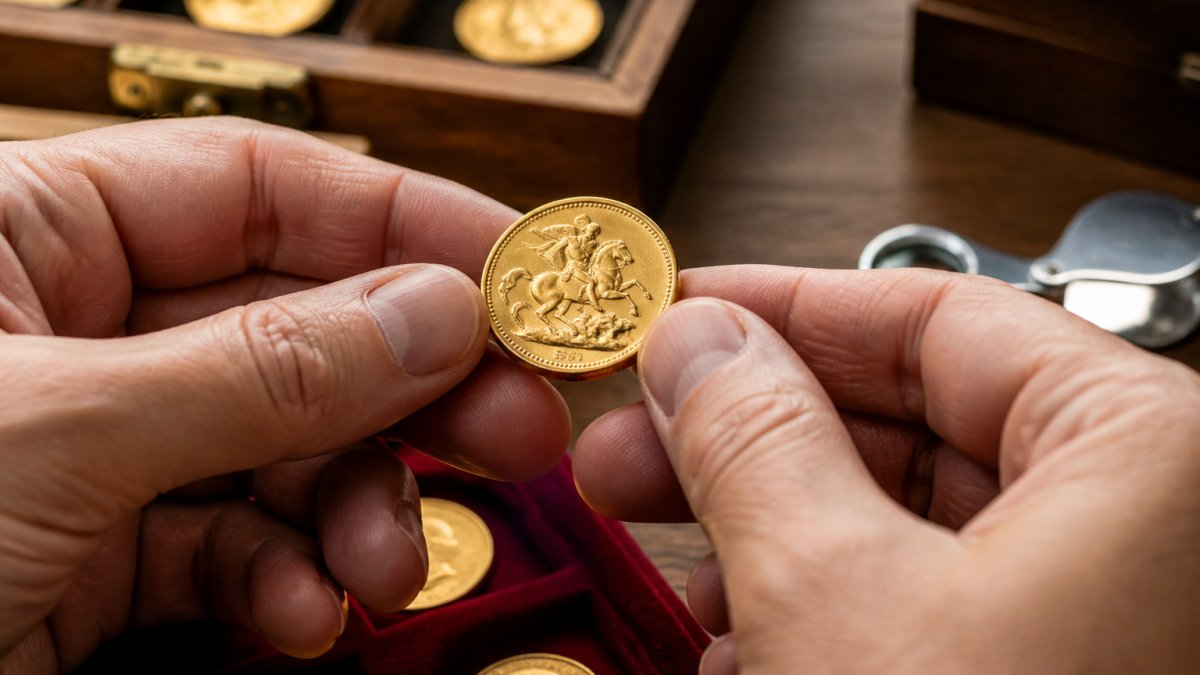
Walk into a precious metals dealer in London with a sovereign, and they'll quote a price instantly. Design, weight, and dimensions are standardised across centuries, no certificate or testing needed, because provenance is embedded in the coin's face.
1871 Queen Victoria Full Gold Sovereign →
Bars create authentication friction. A 100-gram bar from an unknown refinery requires testing to confirm purity and weight, costing money and time, and dealers discount bars without clear provenance.
Practical authentication checks you can do yourself
You do not need to be a numismatist to spot the basics. A few checks cover most of the risk:
- Weight and diameter. A full sovereign should weigh 7.98 grams and measure 22.05mm across. A half sovereign is 3.99 grams and 19.30mm (Gold Sovereign Sizes and Weights). A quarter sovereign is 1.997 grams and 13.50mm (Gold Sovereign Sizes and Weights). If the numbers are off, walk away.
- Magnetism. Gold is not magnetic. A strong magnet should not attract a genuine coin. (This is a screening test, not proof, some non-magnetic fakes exist.)
- Ring test. Tap the coin gently on a hard surface. A genuine gold coin produces a clear, sustained ring. A base-metal fake sounds dull. This is subjective and best used alongside other checks.
- Visual strike quality. Royal Mint coins have crisp, well-defined relief. Blurred lettering, soft edges, or a soapy-looking finish are warning signs.
- Edge and reeding. Sovereigns have a milled (reeded) edge. Irregular or missing reeding is a red flag.
For anything beyond a casual purchase, a reputable dealer may use a precious metal verifier, an electronic tester that measures resistivity and confirms the alloy, as standard on any coin they buy.
How provenance and packaging affect buyer confidence
Provenance is the documented history of a coin or bar. It matters because it reduces the buyer's risk, and lower risk means a better price for you.
For coins, provenance is largely built into the product. A sovereign's date, mintmark, and design are stamped on the face. A 1917 Perth Mint strike is identifiable on sight.
For bars, provenance lives in the paperwork. A bar with its original assay certificate, sealed packaging, and a recognised refinery may fetch a tighter spread than the same bar loose and undocumented.
Why this matters at resale
When you sell, the buyer's confidence is your price. A coin any dealer can verify in seconds attracts competitive quotes; a bar that needs testing, or lacks its original certificate, attracts fewer buyers and lower offers. Coins win on the speed and certainty with which a buyer can trust what they hold.
This global recognition also means you can sell in many places. A sovereign works in London with no conversion friction, while a bar from a lesser-known refinery might not be accepted without testing.
6. Collectible and Historical Value Beyond Spot Price
Coins appreciate beyond their gold content because they tell stories. The 1869 Queen Victoria Gold Sovereign is a tangible connection to the Victorian era, and that narrative drives collector demand.

Bars have no story. They're commodity bullion. A 100-gram bar from 2026 is indistinguishable from one cast in 2020.
The 1917 King George V Full Gold Sovereign - Perth Mint commands a premium because Perth Mint coins are less common than London Mint strikes. That rarity, plus the historical significance of the date, creates a premium pure gold content doesn't explain.
This collectible value isn't guaranteed, it depends on condition, rarity, and demand. Bars simply don't participate in this market.
7. Practical Storage and Portability Advantages
Coins take up less space per unit of value than bars. A sovereign weighs 7.98 grams and measures 22.05mm in diameter. A 100-gram bar measures roughly 50mm x 30mm x 10mm. For the same amount of gold, coins stack more efficiently and are easier to move.
Portability matters if you ever need to transport your holding. Ten sovereigns fit in a small pouch, while a kilogram of bars requires a lockbox. Coins also let you diversify across multiple locations more easily and are simpler to manage when relocating.
Storage costs also favour coins. Insurance premiums are often calculated per item or per storage location.
Why Bars Win in One Scenario
Bars excel at one thing: bulk investing. If you're deploying a large sum and never plan to liquidate until retirement, a bar's lower per-gram cost and compact storage make sense. You save on premiums and take up minimal vault space.
But this scenario is rare. Most investors need flexibility. Most situations require partial liquidation at some point. Most portfolios benefit from diversification across denominations and dates.
For everyone else, collectors, diversifiers, those who value liquidity and global recognition, 10 reasons to choose gold coins over gold bars boil down to one principle: coins are designed for actual use. Bars are designed for bulk storage.
Gold2u specialises in historical sovereigns and collectable coins that combine investment gold with numismatic value. Whether you're starting a portfolio with the 2017 Queen Elizabeth II Full Gold Sovereign or building a collector's set with rare dates like the 1917 Perth Mint strike, we hold authentic pieces backed by Royal Mint provenance.
Frequently Asked Questions
Is it better to hold gold coins or bars?
Gold coins typically suit individual investors better due to flexible denominations, easier resale, and global recognition. Bars work better for bulk storage and lower premiums if you plan long-term holding without selling portions. For most portfolios, coins offer superior liquidity and collectible potential. The choice depends on your investment horizon and whether you may need to liquidate partially.
Do gold coins have a higher premium than gold bars?
Gold coins generally carry higher premiums per gram than bars, but this premium often reflects added value: collectibility, historical significance, easier authentication, and stronger resale demand. A 1871 Queen Victoria Gold Sovereign at £1,100 contains approximately 7.32 grams of pure gold. For investors prioritising flexibility and liquidity, this premium is justified.
Are gold coins easier to sell than gold bars?
Yes. Gold coins attract a broader buyer base: collectors, investors, and gift-buyers all seek coins. Bars appeal primarily to bulk investors. Coins in smaller denominations allow partial liquidation without selling your entire holding. Sovereigns, for example, are British legal tender with established buyback networks. This wider demand and fractional selling capability make coins substantially easier to convert to cash quickly.
What are the tax advantages of investing in gold coins?
Sovereigns minted after 1837 are exempt from Capital Gains Tax in the UK, making them tax-efficient for long-term investors. They are also VAT-free when purchased as bullion investments. This tax treatment significantly improves returns compared to gold bars, which attract VAT on purchase. Consult a tax adviser for your specific circumstances, but the CGT exemption alone makes coins attractive for wealth preservation.


0 comments