

Table of Contents
- Start With the Coin in Your Hand: Physical Inspection Basics
- How to Spot Counterfeit Gold Coins: Hallmarks, Casting and Magneticity
- Rare Gold Coin Provenance Documentation Requirements: What to Collect
- Digital Provenance and Blockchain Verification for Antique Gold Coins
- Legal Implications of Unprovenanced Coins and Micro-Analysis Tools
- Common Mistakes When Identifying Genuine Antique Gold Coins
- Where to Buy Authenticated Antique Gold Coins
- Frequently Asked Questions
Last Updated: September 22, 2026
Start With the Coin in Your Hand: Physical Inspection Basics
Identifying genuine antique gold coins starts with the coin itself, not the paperwork. Provenance matters, but a fake with a convincing story is still a fake. This guide from Gold2u covers the physical checks first, then the documentation that proves ownership history.
Provenance is the documented ownership history of a coin, from the day it was struck to the day it reaches your hand. Without it, you own gold. With it, you own a story that buyers will pay more for.
Start with three tools: a jeweller's loupe, digital scales accurate to 0.01g, and digital calipers.
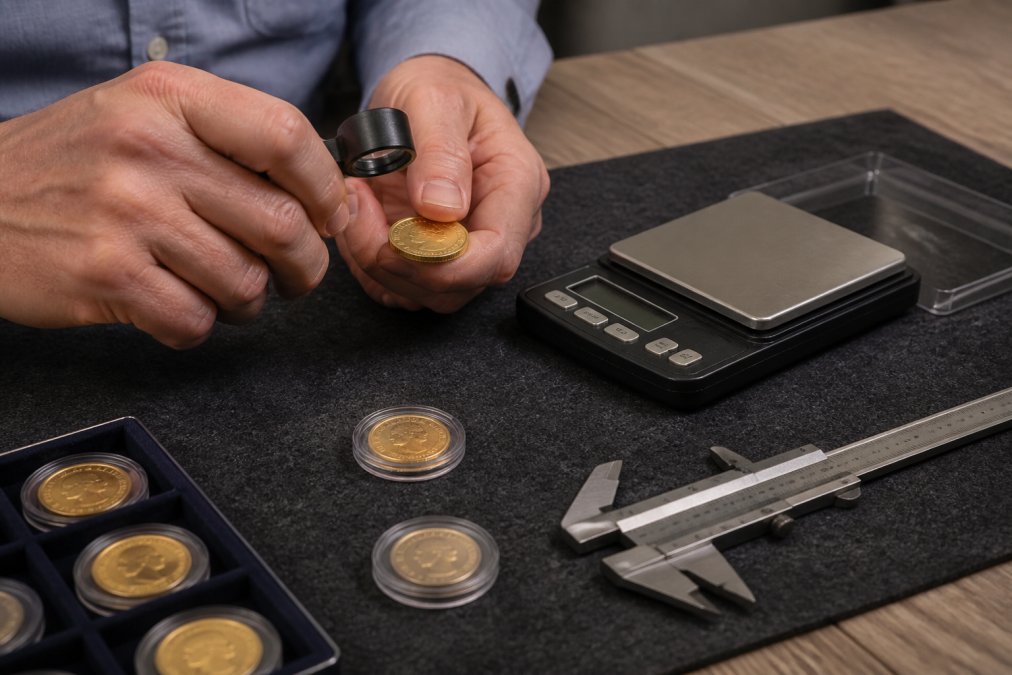
Weight, Diameter and Specific Gravity Checks
A genuine coin matches its official specs exactly. Take the 1893 Queen Victoria Sovereign in the Gold2u collection: 7.988g weight, 22.05mm diameter, 916.7 fineness. A counterfeit will be close, but rarely exact.

Check these against published mint records:
- Weight in grams, to two decimal places
- Diameter in millimetres
- Thickness, where known
- Specific gravity, which exposes tungsten cores
Gold has a specific gravity near 19.3. Tungsten sits at 19.25, close enough to fool a scale but not a proper gravity test.
Surface Texture, Patina and Edge Milling
Real coins show die-struck surfaces with sharp relief and fine flow lines. Fakes often look too smooth or too soft.
Look for patina, the natural ageing film that builds over decades. It should sit in the recesses, not on the high points.
Then check the edge milling. Count the reeds. Compare spacing. Uneven or shallow milling is a red flag.
How to Spot Counterfeit Gold Coins: Hallmarks, Casting and Magneticity
Most counterfeits fail on method, not appearance. If you know how a coin was made, you know what to look for.
Die-Struck vs Cast: Why Minting Method Matters
Genuine coins are die-struck under high pressure. Metal flows into the die, creating crisp edges and a slightly raised rim.
Cast copies are poured into moulds. They show tiny bubbles, soft detail, and a grainy surface texture under magnification.
Hold the coin at an angle under good light. Struck coins flash. Cast coins look dull and flat.
Portrait Style, Micro-Lettering and Assay Tests
Study the portrait style against known examples. Every monarch's portrait has a specific design, and forgers often get the details wrong.
Check micro-lettering on the truncation of the neck or the legend. Genuine lettering is sharp and evenly spaced.
For magneticity, use a strong magnet.
Rare Gold Coin Provenance Documentation Requirements: What to Collect
Documentation is where most collectors fall short. A coin without a provenance trail sells at a discount, every time. The gap competitors leave is not the list of documents, it is how to assemble, store and hand on a provenance record that survives scrutiny.
1855 - Queen Victoria - Full Gold →
Collect these records where you can:
- Original auction invoices and lot numbers, with the saleroom name and sale date
- Dealer receipts showing the date, description, weight and fineness at point of sale
- Grading certificates from recognised services, with the certificate number and any population data
- Old photographs showing the coin in a prior collection, ideally with a dated mount or album page
- Any historical documentation linking it to a known owner, a will, an insurance schedule, a family inventory, a museum loan agreement
- Export or import paperwork where the coin has crossed a border
- Correspondence with the seller or auction house about the coin's history
Building a Provenance Trail: Auction Records and Certificates
Auction records are the backbone of any serious provenance. A coin that appears in a dated sale catalogue has a verifiable paper trail, and the lot number lets a future buyer trace the same coin through the saleroom's archive.
Provenance Documentation Template for Collectors
Use this template for every coin you buy or sell. It is deliberately plain so it can be filled in by hand, typed, or pasted into a spreadsheet.
COIN PROVENANCE RECORD Coin: [name, year, mint mark] Specs: [weight, diameter, fineness] Acquired: [date] from [seller name] Price paid: [amount] Documents held:
- Auction invoice / lot number
- Dealer receipt
- Grading certificate
- Prior owner records
- Photographs
- Export / import paperwork
- Insurance schedule or valuation Notes: [condition, patina, any repairs]
Digital Provenance and Blockchain Verification for Antique Gold Coins
Blockchain verification is the newest tool in numismatics, and it is still finding its footing. The idea is simple: log a coin's ownership history on a tamper-proof ledger.
A digital record can hold:
- High-resolution photos of both faces
- Weight and diameter readings
- Certificate numbers
- Every transfer of ownership, timestamped
Legal Implications of Unprovenanced Coins and Micro-Analysis Tools
Coins without clear ownership history carry legal risk. Under the Dealing in Cultural Objects (Offences) Act 2003, it is an offence to deal in tainted cultural objects, and a coin with no paper trail is harder to defend. The Act applies to objects removed from a building, monument or excavation without consent, and to objects illegally removed from a country after 30 December 2003.
Buyers should ask:
- Where did this coin come from?
- Can the seller show a lawful chain of ownership?
- Is there any record of export or import?
- Was the coin declared on entry to the UK, and is there a customs record?
- Does the seller's own anti-money-laundering process match the price point?
Micro-Analysis Tools for Collectors
Micro-analysis tools are changing what collectors can check at home. The point is not to replace a professional assessment, but to catch the obvious problems before you pay for one.
- Jeweller's loupe (10x): the baseline tool. Look for die markers, micro-lettering and the surface texture of the field.
- USB digital microscope (20x-200x): reveals casting bubbles, tooling marks and the flow lines left by a die strike. A common pattern is that cast copies show rounded, porous edges where a struck coin shows a sharp rim.
- Handheld X-ray fluorescence (XRF): reads metal composition without damaging the coin. It will tell you whether the surface is gold, but it reads only a shallow depth, so a plated tungsten core can still pass.
- Ultrasonic thickness gauge: useful for detecting a hollow or cored coin, though it needs a flat area and can be awkward on a relief portrait.
- Precision scales and calipers: cheap, reliable, and the first line of defence. A coin that is 0.2g light or 0.3mm narrow is a problem before any microscope is needed.
Common Mistakes When Identifying Genuine Antique Gold Coins
The same errors show up again and again. Here are the ones to avoid.
- Trusting the seller's story over the coin. A good story does not make a real coin.
- Skipping the weight test. A coin that is 0.2g light is not a coin, it is a problem.
- Ignoring the edge. Reeding is one of the hardest features to fake well.
- Cleaning the coin. You strip patina and cut value.
- Buying without a receipt. No paperwork means no provenance.
- Assuming a certificate proves everything. Certification confirms authenticity, not ownership history.
- Overlooking the mint mark. A small "M", "S" or "P" changes where a coin was struck and what it is worth.
Where to Buy Authenticated Antique Gold Coins
Buying from a dealer who documents every coin saves you the guesswork.
Frequently Asked Questions
What is the best way to verify the history of an antique gold coin?
Start with the coin itself: check its weight, diameter and specific gravity against known specifications. Then gather documentation such as auction records, dealer invoices and certificates of authenticity. Cross-reference the coin's mintmark and portrait style with historical records. For rare gold coin provenance documentation requirements, aim for a continuous ownership history where possible. Digital tools like blockchain registries are emerging but are not yet a substitute for physical evidence and paper trails.
How does provenance affect the value of historical gold coins?
Provenance can significantly increase value, especially for rare or collector-grade pieces. A coin with a clear ownership history, original certificates and auction records often sells for more than an identical coin without documentation. In practice, provenance provides confidence to buyers and can reduce the risk of legal issues. For example, an 1855 Queen Victoria Full Gold Sovereign priced at £950 with full documentation may command a higher price than an undocumented example.
Do antique gold coins come with certificates of authenticity?
Not always. Many antique coins, especially those from the 19th century, were not issued with certificates. However, reputable dealers often provide their own documentation, including invoices, grading notes and provenance details. When buying, ask for any available paperwork. For rare gold coin provenance documentation requirements, a certificate from a recognised numismatic body or a detailed dealer guarantee adds assurance. Without it, you rely more on physical inspection and expert opinion.
Can I use online databases to check the provenance of a gold coin?
Yes, several online databases and auction archives can help trace a coin's history. Websites like the Royal Mint's historical records, auction house archives and numismatic society databases allow you to search by date, mintmark and design. However, these are not exhaustive. Combine online research with physical inspection and any paper documentation you have. For rare gold coin provenance documentation requirements, online checks are a useful starting point but not a complete solution.


0 comments