

Table of Contents
- Why Historical Gold Coins Matter to Collectors and Investors
- Quick Comparison: Our Top Five Historical Gold Coins
- 1. 1855 Queen Victoria Full Gold Sovereign: Early Reign Rarity
- 2. 1917 King George V Perth Mint Sovereign: Colonial Significance
- 3. 1873 Queen Victoria Sydney Mint Sovereign: Young Head Design
- How to Verify Gold Coin Authenticity and Assess Condition
- Rare Gold Coin Provenance Documentation Requirements
- Building a Historical Gold Coin Collection: Investment Strategy
- Frequently Asked Questions
Last Updated: September 23, 2026
Why Historical Gold Coins Matter to Collectors and Investors
Historical gold coins combine intrinsic gold content with premiums from age, provenance, and condition. At Gold2u, successful collectors treat top 5 gold coins for historical value as individual pieces with distinct market dynamics, not interchangeable commodities.
A 1917 sovereign and a 2017 sovereign both contain the same fine gold, yet trade in entirely different markets. One commands premium for colonial significance and scarcity; the other trades at modest premium to spot price. Understanding this split between bullion and numismatic value is essential.
Many investors focus exclusively on gold content, missing that historical coins derive value from rarity, condition grading, mintmark provenance, and authentication. This guide explores the top 5 gold coins for historical value, then covers verification, provenance, and collection strategy.
Quick Comparison: Our Top Five Historical Gold Coins
| Coin | Year | Mint | Price | Gold Content | Historical Significance | Best For |
|---|---|---|---|---|---|---|
| 1855 Queen Victoria Full Sovereign | 1855 | Royal Mint | £950 | 7.32g fine gold | Early reign rarity | Serious collectors seeking early Victorian pieces |
| 1917 King George V Perth Mint Sovereign | 1917 | Perth Mint | £1,200 | 7.32g fine gold | Colonial significance | Investors valuing colonial provenance |
| 1873 Queen Victoria Sydney Mint Sovereign | 1873 | Sydney Mint | £900 | 7.32g fine gold | Young Head design rarity | Collectors focused on design evolution |
| 1893 Queen Victoria Gold Sovereign | 1893 | Royal Mint | £790 | 7.32g fine gold | Jubilee portrait period | Budget-conscious entry to Victorian era |
| 1871 Queen Victoria Full Sovereign | 1871 | London Mint | £850 | 7.32g fine gold | Die number rarity | Specialists in quality control variants |
1. 1855 Queen Victoria Full Gold Sovereign: Early Reign Rarity
The 1855 Queen Victoria Full Gold Sovereign represents the earliest phase of Victoria's reign with substantially lower mintage than later decades, carrying historical weight beyond its 7.32 grams of fine gold.

Most surviving examples show significant wear; finding one in strong condition commands a premium reflecting genuine rarity rather than bullion markup. The 1855 vintage sits at the intersection of investment-grade bullion and collectible numismatic value.
The Royal Mint's historical production records document that early 1850s sovereigns were struck in limited quantities compared to the industrial-scale production of later Victorian eras. This documented scarcity translates directly to market liquidity and capital appreciation potential beyond spot price movements.
Gold2u's 1855 Queen Victoria Full Gold Sovereign is offered at £950, reflecting intrinsic gold value and historical premium.
2. 1917 King George V Perth Mint Sovereign: Colonial Significance
The 1917 King George V Perth Mint Sovereign carries historical significance beyond its gold content. The 'P' mintmark identifies this coin as struck in Australia when colonial mints operated with autonomy in precious metals production.

The Perth Mint piece trades at £1,200, substantially above its 7.32 grams of fine gold, because collectors value colonial provenance.
Colonial-struck sovereigns appeal to investors building geographically diverse collections and those interested in Commonwealth numismatic history.
Authentication focuses on mintmark position, die characteristics specific to Perth Mint production, and wear patterns consistent with colonial circulation. Counterfeit detection emphasises mintmark clarity and die configurations unique to Perth in 1917.
3. 1873 Queen Victoria Sydney Mint Sovereign: Young Head Design
The 1873 Queen Victoria Sydney Mint Sovereign represents the Young Head design period, characterised by William Wyon's portraiture. The 'S' mintmark denotes Sydney Mint production, adding Australian colonial significance.

This piece interests collectors focused on design evolution. The Young Head design differs markedly from later Jubilee and Old Head portraits. The 1873 date places it at Victoria's reign midpoint, capturing a specific moment in British monetary history.
Condition grading becomes critical here. The Young Head design shows finer detail than later portraits, meaning well-preserved examples command substantial premiums. A coin in strong condition demonstrates not only rarity but also the collector's commitment to preservation, factors that numismatic grading standards explicitly recognise in condition assessment.
Gold2u offers the 1873 Queen Victoria Sydney Mint Sovereign at £900.
Sydney Mint sovereigns represent a moment when Australian precious metals production was establishing its reputation for quality, making them essential to Commonwealth numismatic collections.
How to Verify Gold Coin Authenticity and Assess Condition
Authenticating historical gold coins requires systematic evaluation: weight, dimensions, metal composition, die characteristics, and wear patterns. Convergent evidence from multiple checks builds confidence.
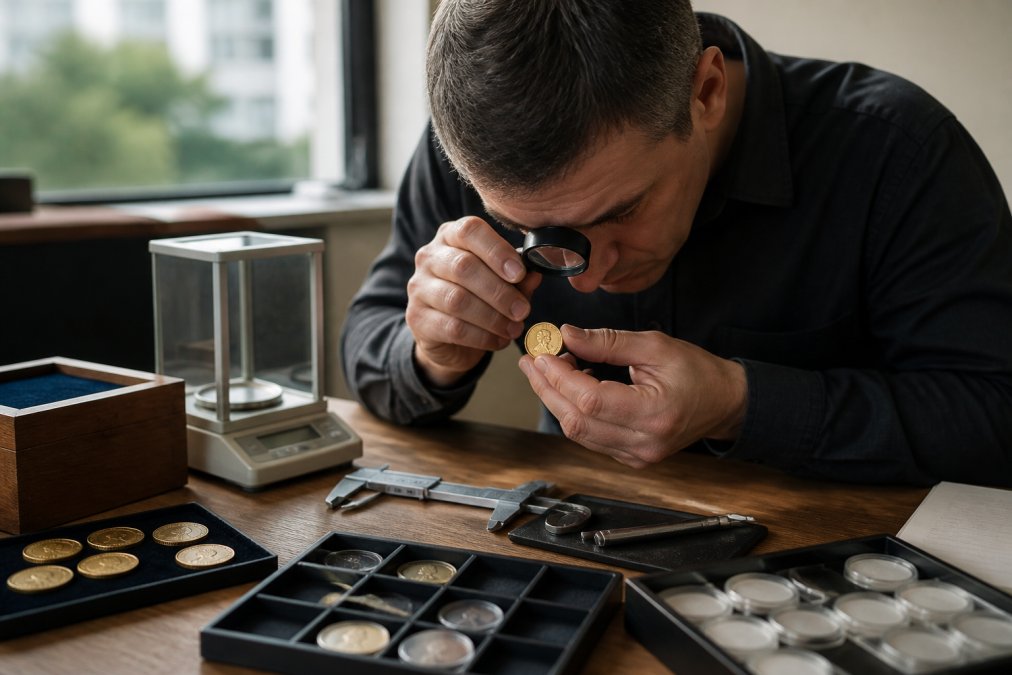
Weight and dimensions form the foundation. A genuine sovereign should weigh 7.98 grams and measure 22.05mm in diameter.
1855 - Queen Victoria - Full Gold →
Metal composition requires assay or specific gravity testing. Counterfeiters sometimes use base metals with gold plating, which fails specific gravity tests.
Die characteristics demand knowledge of specific mint production. Each mint, London, Melbourne, Perth, Sydney, used distinct dies that produced unique wear patterns and design variations. Learning the die characteristics of your target coin's mint and year eliminates broad categories of counterfeits. References like the British Numismatic Society's die variety catalogues document these variations.
Wear patterns tell a chronological story. A coin dated 1873 should show wear consistent with 150+ years of circulation. Artificial aging produces unnatural patterns, concentrated in high spots rather than distributed, that contradict the coin's stated age.
Mintmark clarity matters enormously. Fuzzy, poorly-defined mintmarks signal counterfeiting. Genuine mintmarks show sharp definition from being struck directly into the die. Magnification at 10x reveals the difference.
Condition grading follows established scales: Mint State (MS), About Uncirculated (AU), Extremely Fine (EF), Very Fine (VF), Fine (F), and lower grades. Each grade reflects preservation level and directly impacts market value.
Rare Gold Coin Provenance Documentation Requirements
Provenance, the documented ownership history of a coin, transforms a piece of gold into a collectible asset with verified authenticity and historical context. Serious collectors and investors treat provenance documentation as essential to value preservation.
Auction house records provide the strongest provenance foundation. When a coin appears in a major auction catalogue, the auction house's research team documents its history, condition, and authentication. Sotheby's, Christie's, and specialist numismatic auctioneers maintain searchable archives. A coin with auction house provenance carries institutional credibility that individual dealer sales cannot match.
Dealer certification and grading from established numismatic dealers creates documented trails. Reputable dealers maintain records linking coins to customers, creating verifiable ownership chains. Gold2u maintains detailed documentation for each historical coin, providing buyers with authentication records and condition assessments that support future resale.
Third-party grading service slabs offer independent authentication and condition assessment. Services like PCGS and NGC encapsulate coins in tamper-evident holders with detailed grading reports. The slabbing process itself, rigorous examination by professional numismatists, becomes part of the provenance record. A slabbed coin carries institutional authentication that appeals to investors prioritising certainty.
Estate and collection documentation matters when coins come from established collections. A coin with clear documentation of its place in a known collection, supported by photographs, catalogue entries, or correspondence, carries historical weight. These coins often command premiums because their provenance reduces authentication risk.
Gaps in provenance create risk. A coin with unknown ownership history for extended periods raises questions about authenticity and condition representation. Collectors accept gaps of a few decades, but coins with unclear provenance spanning multiple centuries warrant scepticism. The question becomes: why is the ownership history undocumented?
Documentation should include photographs showing obverse and reverse, mintmark clarity, die characteristics, and any distinguishing features.
Building a Historical Gold Coin Collection: Investment Strategy
Storage and insurance require planning. Physical gold coins demand secure storage, either in a home safe, bank safe deposit box, or professional vault. Insurance should cover both intrinsic gold value and numismatic premium. Documented provenance and professional photography support insurance claims and facilitate future sales.
Frequently Asked Questions
Why does provenance matter for historical gold coins?
Provenance establishes ownership history and authenticity, directly affecting market value and investor confidence. Coins with documented provenance command premium prices because buyers can verify the coin's journey through time. Clear documentation protects against counterfeit claims and supports capital gains tax reporting. When you purchase from established dealers, provenance documentation provides legal protection and ensures you're acquiring a genuine historical asset with verifiable historical significance.
How can I verify the authenticity of an old gold coin?
Check weight, dimensions, and gold content. Examine the mint mark, die number, and surface wear patterns under magnification, counterfeits often show inconsistent details. Assess the coin's condition grade and compare it against certified examples. Purchase only from reputable dealers who provide certification and authentication guarantees. Professional numismatic grading services offer third-party verification. Request documentation of the coin's provenance and previous ownership to confirm its authenticity chain.
What legal documentation do I need when buying a rare gold coin?
In the UK, you should receive a receipt showing the coin's specifications, weight, fineness, and purchase price. Request a certificate of authenticity detailing the coin's condition grade, die number (if applicable), and mint mark. Maintain records of all purchases for tax purposes. Reputable dealers provide written guarantees of authenticity and often offer return policies if the coin doesn't match its description.
Which gold coins are most commonly counterfeited?
High-value historical sovereigns and coins with strong market demand face the highest counterfeiting risk, particularly rare mintmarks and early Victorian issues. Counterfeits often show weight discrepancies, poorly executed design details, and incorrect surface patina. Coins from colonial mints (Perth, Sydney, Melbourne) are targeted. Always purchase from established dealers who guarantee authenticity. Use professional grading services for high-value acquisitions. Examine die numbers and mintmarks carefully, these details are difficult for counterfeiters to replicate accurately.


0 comments