

Last Updated: October 28, 2026
Quick Summary
An 18k gold trilogy ring sets three diamonds in a row for broader finger coverage and past-present-future symbolism, while a solitaire features one diamond alone for maximum centre-stone focus and lower upkeep. Choose a trilogy for visible width and a solitaire for one hero diamond, and compare centre-stone weight rather than total carat weight when weighing cost.
- 18k gold contains 750 parts pure gold per 1,000, with the remaining 250 parts alloy metals.
- Jewellers often recommend 18k for trilogy rings where colour consistency across three settings matters.
- A 3.00 carat oval diamond 18k trilogy ring is priced at £12,750 as a reference point.
- Compare centre-stone weight, not total carat weight, because total carat weight flatters the trilogy.
- Check prongs every few months by running a fingernail gently along each claw.
Table of Contents
- Trilogy vs Solitaire Ring: The Core Difference
- How 18k Gold Changes the Comparison
- 18k Gold Ring Durability: What to Expect Day to Day
- Which Ring Setting Makes Diamonds Look Bigger?
- Price and Value: Like-for-Like in 18k Gold
- Maintenance, Snagging and Daily Wear
- Choosing Your 18k Gold Trilogy or Solitaire Ring
- Frequently Asked Questions
Trilogy vs Solitaire Ring: The Core Difference
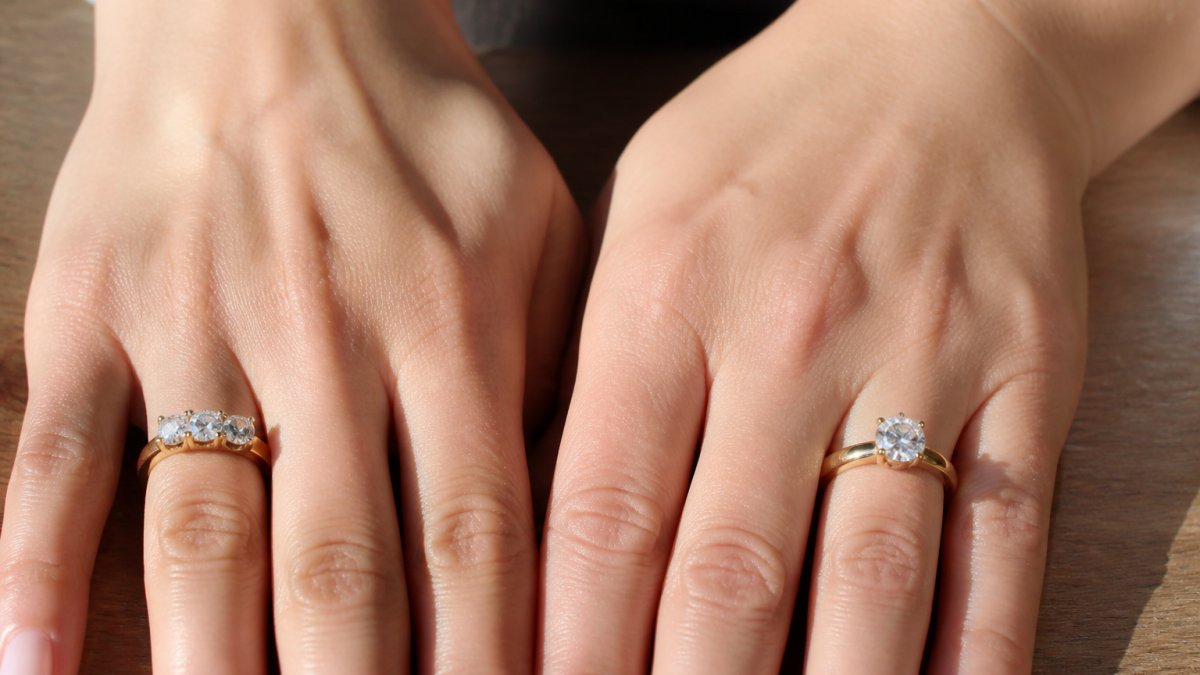
A trilogy ring holds three stones, with the centre diamond flanked by two smaller diamonds, while a solitaire ring features one diamond alone on the band. That single structural difference drives everything else: how the ring looks, how it wears, and what it costs. When comparing 18k gold trilogy rings vs solitaire settings, the core difference is not just stone count. It is how the design directs the eye.
A solitaire setting is a ring with a single centre stone held by prongs or a bezel on a plain band. A trilogy ring, also called a three-stone ring, sets three diamonds in a row to represent past, present and future. The centre-stone prominence of a solitaire is absolute. In a trilogy, the side stones share the visual load.
The choice rarely comes down to which is "better." It comes down to which suits the hand, the budget and the daily routine. Our guide to old cut three stone rings explores how antique trilogy designs differ from modern ones, which helps if you are drawn to the three-stone format.
How 18k Gold Changes the Comparison
Metal choice affects a trilogy versus solitaire decision more than most buyers expect, and 18k gold deserves a closer look than the usual "it's 75% pure" line. Live gold price lets you follow the global gold market with a live spot price, an interactive chart and an at-a-glance conversion into the weight units buyers use. 18k gold contains 750 parts pure gold per 1,000, with the remaining 250 parts made up of alloy metals.
The alloy mix decides the final tone and some of the working behaviour:
18k versus 14k in practice
A common pattern among jewellers is to recommend 18k for trilogy rings where colour consistency across three settings matters, and to accept that the metal will show fine surface marks sooner than 14k would. Those marks are shallow and can be polished out; they are not a sign of weakness. What 18k does not do is resist bending better than 14k, so prong thickness and setting height still matter more than karat for security.
Why the setting changes the metal calculation
London Bullion Market Association guidance on gold purity and alloys
18k Gold Ring Durability: What to Expect Day to Day
A common mistake is choosing a high-set trilogy for everyday wear without checking how the side stones sit against the fingers. If the gallery is open and tall, the ring will catch on everything.
3.00 Carat Oval Diamond 18K Trilogy Ring →
Which Ring Setting Makes Diamonds Look Bigger?
Here is the trade-off in plain terms:
| Factor | Solitaire | Trilogy |
|---|---|---|
| Perceived size | One stone, fully exposed | Wider spread across the finger |
| Centre-stone prominence | Maximum | Shared with side stones |
| Finger coverage | Narrow | Broader |
| Best for | Buyers wanting one hero diamond | Buyers wanting visible width |
Our 3.00 carat oval diamond trilogy ring guide explains how a three-stone layout changes perceived spread on an oval cut.
Price and Value: Like-for-Like in 18k Gold
Price comparison only works when you hold the variables steady, and most comparisons fail because they change too many things at once. To compare a solitaire and a trilogy fairly in 18k gold, fix four variables: gold karat and colour, diamond colour and clarity grades, centre-stone cut and proportions, and either total carat weight or centre-stone weight. Change one of those and the price difference stops meaning anything.
What actually drives the price
- Diamond quality distribution. A solitaire puts its budget into one stone, so a higher grade is affordable. A trilogy can put a strong centre stone with slightly lower-graded side stones, which is a common way to control cost without a visible difference on the hand.
Transparent example configurations
| Configuration | Solitaire | Trilogy |
|---|---|---|
| Centre stone | 1.50ct, G/VS2 | 1.00ct, G/VS2 |
| Side stones | None | 2 × 0.25ct, G/VS2 |
| Total carat weight | 1.50ct | 1.50ct |
| 18k gold | Yellow, 4.0g band | Yellow, 4.8g band |
| Relative price | Lower labour, one setting | Higher labour, three settings, matched pair |
Our 3.00 carat oval diamond 18k trilogy ring is priced at £12,750, a useful reference point for what a substantial three-stone piece in solid 18k gold costs. For buyers weighing long-term worth, our article on diamond rings for investment and wear covers how to think about resale and daily value together.

Maintenance, Snagging and Daily Wear
- Check prongs every few months by running a fingernail gently along each claw
- Remove the ring for gym sessions, gardening and heavy cleaning
- Clean with warm water and mild soap, then dry fully before wearing
- Have a jeweller tighten and re-tip prongs when they show wear
- Store trilogy rings separately so side stones do not rub against other jewellery
Choosing Your 18k Gold Trilogy or Solitaire Ring
- Want maximum centre-stone focus and lowest upkeep? Choose a solitaire.
- Want broader finger coverage and past-present-future symbolism? Choose a trilogy.
- Wear the ring daily in a hands-on job? Favour a lower profile in either style.
- Working to a fixed budget? Compare centre-stone weight, not total carat weight.
Frequently Asked Questions
What is the difference between a trilogy ring and a solitaire ring?
A solitaire ring holds one centre stone on a plain band, keeping all attention on that diamond. A trilogy ring, also called a three-stone ring, sets three stones in a row, usually with a larger centre stone flanked by two smaller ones. The solitaire gives a clean, single focal point, while the trilogy adds width, balance and extra sparkle across the finger. Both styles work in 18k gold, so the choice comes down to how much visual impact you want.
Does a trilogy ring sparkle more than a solitaire?
A trilogy ring usually shows more total sparkle because three stones catch and reflect light across a wider area. A solitaire concentrates brilliance into one larger stone, which can look brighter at the centre. In 18k gold, the metal's warm tone can soften white diamond contrast slightly, so cut quality matters more than stone count. If you want maximum overall flash, trilogy wins; if you want one bold, focused stone, solitaire is the better fit.
Is 18k gold too soft for a wedding band?
18k gold is 75% pure gold, which makes it softer than 14k or 9k alloys, but it is still perfectly wearable for a wedding band. The trade-off is that it scratches and dents more easily with daily wear, and prongs may need tightening sooner. For a solitaire with a high-set stone, check the setting regularly. For a trilogy ring, the wider band spreads wear across more metal, which helps. Store it separately and remove it for heavy manual work.
Which ring setting is easier to maintain: trilogy or solitaire?
A solitaire is generally easier to maintain because there is only one stone and one set of prongs to check and clean. A trilogy ring has three stones, so there are more prongs, more gaps for dirt to collect and more points to inspect for looseness. Both need professional checks every 12 to 18 months. With 18k gold being softer, trilogy owners should pay closer attention to side-stone security, especially if the ring is worn daily.
The right 18k gold ring comes down to matching the setting to how you actually live. At Gold2u, we stock solid 18k gold pieces with natural diamonds, including a classic three-stone design with a secure claw setting and matched side stones, plus fully insured delivery. Explore the collection and choose a ring built to be worn, not stored away.


0 comments