

Last Updated: October 26, 2026
Quick Summary
To choose a high quality diamond pendant, rank the 4Cs in this order: cut, colour, clarity and carat weight. Stay at Very Good cut or above, drop clarity to VS2 or SI1 if the stone is eye-clean, and buy just under a round carat weight to save money.
- Cut is graded from Excellent to Poor, so stay at Very Good or above.
- Colour grades G to J look white in most pendants.
- The jump from VS1 to VS2 commonly saves 5-10% of the stone price.
- Bezel settings offer the highest security for everyday wear.
- A shorter chain length sits at the base of the neck and a longer chain at the collarbone.
Table of Contents
- Start With the Diamond Pendant 4Cs Before Anything Else
- VS1 vs VS2 Diamond: Which Clarity Grade Belongs in a Pendant
- Diamond Pendant Settings: Prong, Bezel, and Halo Compared
- Choosing a Diamond Shape and Pendant Style That Suits You
- Diamond Pendant Cost: What Drives the Price and Where to Save
- Certification, Provenance, and Natural Versus Lab-Grown Diamonds
- Your Inspection Checklist Before You Commit to a Pendant
- Book a Viewing of a Hallmarked Diamond Pendant
- Frequently Asked Questions
Start With the Diamond Pendant 4Cs Before Anything Else
Learning how to choose a high quality diamond pendant starts with four grades: cut, colour, clarity and carat weight. These are the diamond pendant 4Cs, and they decide how a stone looks in daylight. Cut drives sparkle, colour and clarity set the grade, and carat sets the size. We tell buyers to rank them in that order for a pendant.
Here is why the order matters. A pendant hangs close to the face and catches light from every angle. A well-cut stone with slight inclusions will out-sparkle a higher-clarity stone with a shallow cut. Every time.
The Gemological Institute of America's diamond grading guide sets the language jewellers use for each grade, so learn those terms before you shop.
Cut is graded from Excellent down to Poor. Stay at Very Good or above. Colour runs from D, colourless, to Z, tinted. G to J looks white in most pendants. Clarity scales from Flawless to Included.
A common mistake is chasing carat first. In a pendant, spread across the face beats weight hidden in the depth of the stone.
VS1 vs VS2 Diamond: Which Clarity Grade Belongs in a Pendant
The VS1 vs VS2 diamond question comes down to one test: can you see anything without a loupe? Both grades are very slightly included, meaning tiny marks a trained eye finds at 10x magnification. In a pendant, both usually look clean to the naked eye, so VS2 is often the smarter buy.
Clarity grades run FL, IF, VVS1, VVS2, VS1, VS2, SI1, SI2 and I1 to I3 (gia.edu). The jump from VS1 to VS2 saves money, and that saving is better spent on cut or colour.
Two things change the answer:
- Step-cut shapes such as emerald cuts show inclusions more openly. Here, VS1 earns its premium.
- Small stones under about 0.30ct hide flaws well. VS2 or even SI1 can work if the stone is eye-clean.
Ask to see the stone face-up in daylight, not under a jeweller's spotlight. That is the view you will live with.
Diamond Pendant Settings: Prong, Bezel, and Halo Compared
Diamond pendant settings hold the stone, and each style trades security against sparkle. Prong settings show the most diamond, bezel settings protect the girdle, and halo settings add a ring of smaller stones for extra brilliance.
| Setting |
|---|
| Look |
| --- |
| Prong |
| Bezel |
| Halo |
Prong settings need a check every year or so, because a bent claw can loosen the stone. Bezel settings cost more in metal and labour, but they rarely need attention.
If the pendant will be worn daily, a bezel or a low-set prong is the practical choice.
Choosing a Diamond Shape and Pendant Style That Suits You
Shape and style are where a diamond pendant becomes personal, but they are also where buyers make expensive mistakes.
Start with shape, because the shape dictates the setting options and the price per carat. You can browse the diamond collection to compare shapes and settings.
Round brilliant gives the most sparkle of any shape because its 57 or 58 facets are engineered to return light.
Emerald and princess cuts read sharper and more modern, but step-cut emerald shapes show inclusions openly, so clarity matters more here (see the VS1 vs VS2 section above).
Marquise, cushion and radiant shapes sit between these extremes.
Style follows shape. A solitaire pendant keeps the focus on one stone and is the most versatile choice.
Chain length matters as much as the stone.
Cherry Blossom Articulated Pendant with Diamonds and Pink Sapphire – 18k Rose →
For a worked example of an articulated design, look at this Cherry Blossom articulated pendant with diamonds and pink sapphire in 18k rose gold, which shows how layered petals and diamond accents catch light as the wearer moves.

Diamond Pendant Cost: What Drives the Price and Where to Save
Diamond pendant cost is driven by four things: the stone's grades, the metal, the setting's labour, and the brand. You cannot cut the first one without changing how the pendant looks. You can save on the others, and the savings are larger than most buyers expect.
Here is how the money actually splits, using a 0.50ct round brilliant in a simple pendant as the reference point. These are illustrative proportions, not quotes, because metal prices and labour rates move:
- The stone is typically 55-70% of the total.
- The metal is typically 15-25%, depending on whether you choose 9ct, 14ct, 18ct gold or platinum.
- The setting labour is typically 10-20%, rising sharply for halos and articulated designs.
- The brand and retail margin sit on top of all three.
Where the money goes, grade by grade:
- Cut is worth paying for. It is the one grade you see from across a room, and it cannot be fixed later. Stay at Very Good or above.
- Colour can drop to H or I with little visible change in a pendant, because the stone sits against skin rather than white paper. Each colour grade down typically saves a few per cent of the stone price.
- Clarity can drop to VS2 or SI1 if the stone is eye-clean. The jump from VS1 to VS2 alone commonly saves 5-10% of the stone price, and that saving is better spent on cut.
- Carat is the biggest lever. Moving from 0.40ct to 0.50ct can add 20-30% to the stone price for a barely visible size difference, because price per carat rises in steps at round weights such as 0.50ct, 0.75ct and 1.00ct. A 0.48ct stone often costs noticeably less than a 0.50ct stone of the same grades.
Metal choice matters more than buyers think. 18ct gold costs more than 14ct, and platinum costs more again, both in metal and in the labour needed to work it.
Watch out for two traps. First, a "bargain" stone with a poor cut will look dull next to a better-cut stone of the same size, and no setting hides that. Second, a price that is far below the market for the stated grades usually means the grades are not independently verified, check the grading report before you compare prices at all.
When you compare two pendants, compare them on the same four grades, the same metal and the same setting type. Anything else is not a like-for-like comparison, and the cheaper piece is often cheaper for a reason you cannot see in a photograph.
Certification, Provenance, and Natural Versus Lab-Grown Diamonds
Certification is the difference between a claim and a fact. A diamond pendant should come with an independent grading report from a recognised laboratory, listing the 4Cs, the measurements and any treatments.
Natural versus lab-grown is the other decision. Lab-grown diamonds have the same optical and physical properties as natural stones, and they cost less. Natural stones carry scarcity and resale history. Neither is "better"; they suit different buyers.
Provenance matters for both. You can browse loose GIA-certified diamonds to see provenance details in practice. If you are weighing the two routes for an engagement piece, this guide to vintage diamonds versus lab grown diamonds goes deeper.
For metal, look for a UK hallmark. It is a legal stamp showing the metal's purity, applied by an assay office (Guidance for selling precious metal items to the public).
Your Inspection Checklist Before You Commit to a Pendant
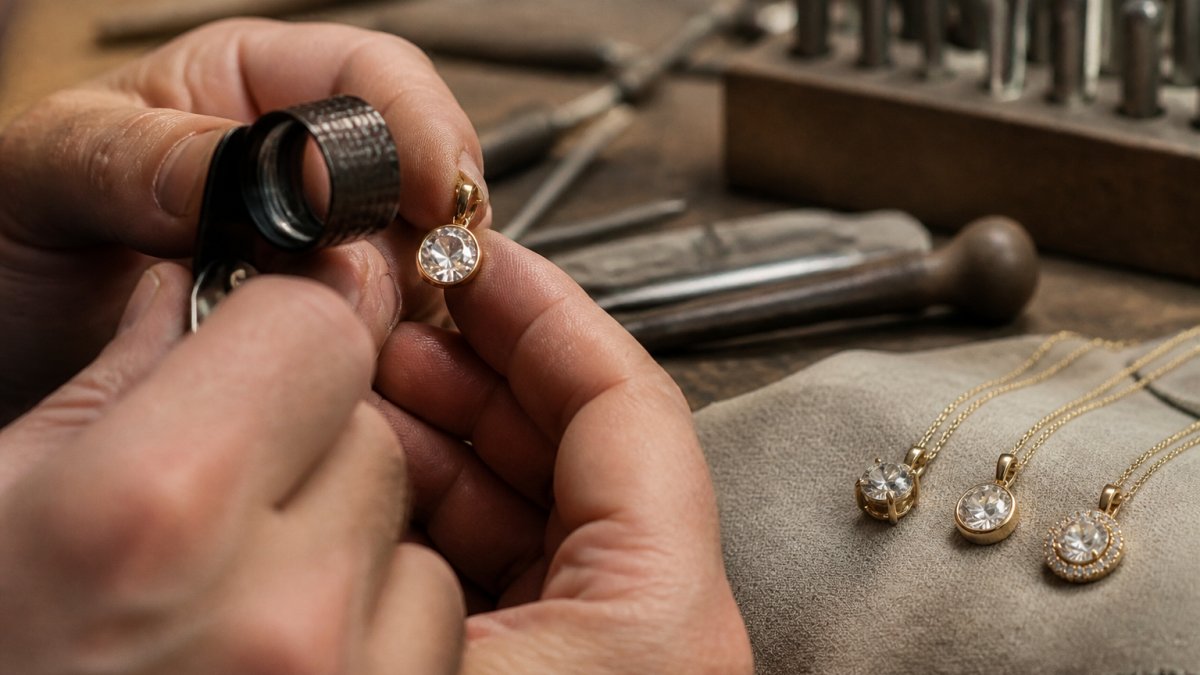
An inspection takes ten minutes and saves a lot of regret. Do it in daylight, with the pendant out of the box, and ask for a loupe.
- Check the grading report number matches the stone and the paperwork
- Confirm the UK hallmark on the pendant and the chain clasp
- View the stone face-up in daylight, not under a spotlight
- Look for visible inclusions or clouds at arm's length
- Check the claws or bezel for gaps and loose stones
- Test the clasp and the chain's flexibility
- Confirm the metal karat and weight in writing
- Ask about the returns policy and any resizing terms
- Keep the certificate and receipt together
Watch out: a certificate that names a different laboratory than the one you expected, or a report number that does not match the stone, is a reason to walk away. Ask for it in writing before you pay.
Book a Viewing of a Hallmarked Diamond Pendant
Seeing a pendant in person settles questions a photo cannot. You can check the sparkle in daylight, feel the weight of the gold, and confirm the hallmark with your own eyes.
At Gold2u, every piece is checked for hallmarks and stone condition before it reaches you. Our range includes antique old mine cut diamond jewellery, natural Australian gold nuggets and historical gold coins, so you can compare eras and styles in one place.
Frequently Asked Questions
How can I tell if a diamond pendant is high quality?
Check the stone against the 4Cs: cut, colour, clarity, and carat. A well-cut diamond returns light sharply even under ordinary room lighting, so look for brightness and contrast rather than size alone. Ask for the grading report, confirm the metal is hallmarked, and inspect the setting for even prongs and no movement in the stone. A diamond pendant with a certified stone and a tidy setting will hold its appearance far better than an uncertified bargain.
Should I choose a VS1 or VS2 diamond for a pendant?
For a pendant, VS2 is usually the sensible choice. Both grades are eye-clean, meaning inclusions are not visible to the naked eye, but VS2 stones cost less because they carry slightly more internal detail under magnification. Put the saving into cut quality, which is what you actually see when the pendant moves in light. Reserve VS1 for larger stones or shapes with wide tables where clarity is easier to spot.
How much should a diamond pendant cost?
Diamond pendant cost depends mainly on carat weight, cut grade, metal, and whether the stone is certified. Small pendants in 9ct or 18ct gold sit at the lower end, while articulated statement pieces with matched diamond accents and a coloured centre stone run into several thousand pounds. As a reference point, the Cherry Blossom articulated pendant in 18k rose gold with diamonds and a pink sapphire is £3,750. Set a budget before you browse and decide whether stone or metal matters more to you.
Is a diamond certificate important when buying a pendant?
Yes, particularly above a certain value. A grading report from a recognised laboratory records the stone's carat weight, colour, clarity, and cut, and it protects you if you later sell or insure the piece. For antique or old mine cut jewellery, provenance documentation matters as much as the grade because it supports the piece's history. Always ask whether the certificate covers the centre stone only or the accent stones as well, and keep the paperwork with your purchase.
Choosing a high quality diamond pendant gets much easier once you know what to look at: cut before carat, a certificate you can verify, and a setting that matches how you live. Gold2u can help you compare hallmarked pieces, check provenance and see the stone in person before you decide. Get started with Gold2u and choose a pendant you will still be glad you bought in twenty years.


0 comments