

Last Updated: October 26, 2026
Quick Summary
To identify antique diamond jewelry, check the cut first: an old mine cut has a high crown, small table and visible culet. Then read the hallmarks and maker's marks, confirm the setting and wear tell the same story, and inspect prongs, solder lines and replaced stones before you commit.
- Old mine cuts are cushion-shaped with a high crown, small table and deep pavilion.
- A crisp, modern-looking hallmark on a supposedly old ring is a warning sign.
- Work through the evidence in order: cut, setting, metal and marks, wear, paperwork.
- A certificate confirms carat and broad grade but cannot establish when a stone was cut.
- Budget for an independent appraisal and specialist jewellery insurance beyond the ticket price.
Table of Contents
- Start With the Cut: How to Identify an Old Mine Cut Diamond
- Read the Hallmarks, Maker's Marks and Metal Stamps
- How to Authenticate Antique Jewelry Beyond the Sparkle
- Assess Antique Diamond Ring Condition Before You Commit
- How to Tell If Vintage Jewellery Is Valuable
- Build a Practical Inspection Checklist for Viewings and Online Buys
- Factor In Total Ownership Costs and Insurance Valuation
- Choose Your Antique Diamond Piece From Gold2u
- Frequently Asked Questions
Start With the Cut: How to Identify an Old Mine Cut Diamond
Knowing what to look for in antique diamond jewelry starts with the stone itself. An old mine cut diamond is a hand-cut stone from the Georgian or early Victorian period, shaped with a high crown, a small table and a deep pavilion. For a closer look at how it differs from other cuts, see our old mine vs old European vs modern brilliant comparison.
Cushion Shape, High Crown, Small Table
Old mine cuts are roughly cushion-shaped, often a little irregular. The crown sits tall above the girdle, and the table is small compared with a modern stone. That combination is why old cuts throw slower, warmer flashes of light. A common mistake is judging one under bright shop lighting. Ask to see it near a window instead.
Visible Culet and Kozibe Reflections
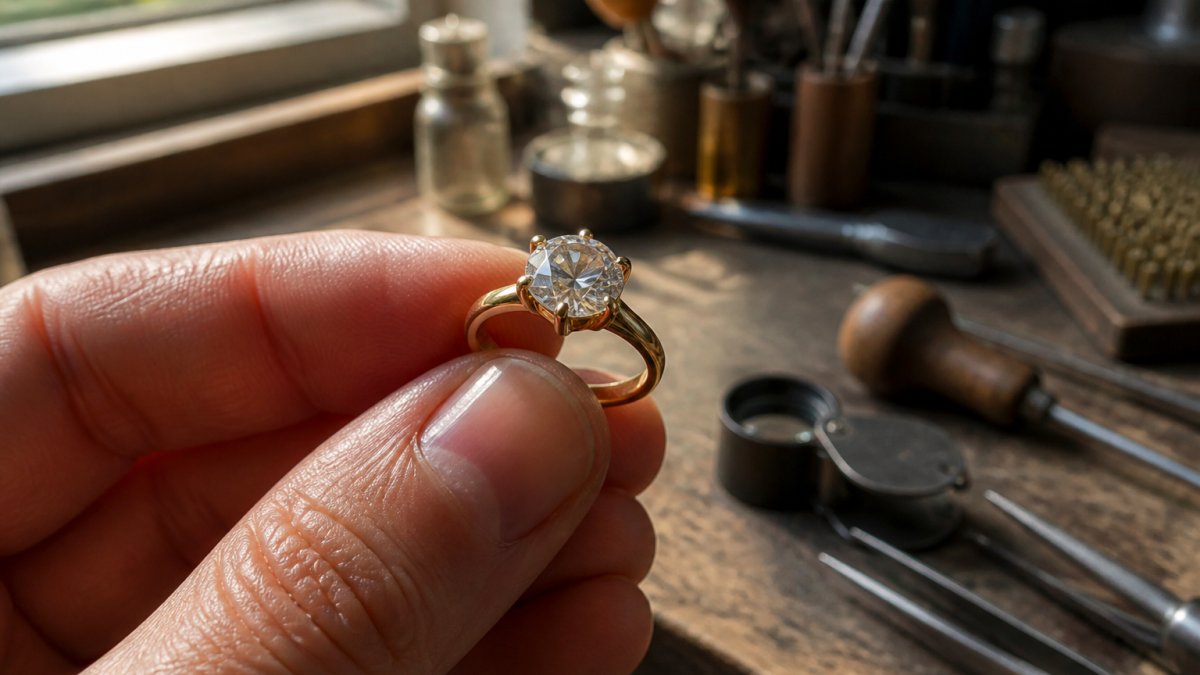
Turn the stone face-up and look through the table. Browse our old mine cut diamond jewelry to see these features on real pieces.
Read the Hallmarks, Maker's Marks and Metal Stamps
Hallmarks are the fastest way to place a piece in time. A hallmark is an official stamp struck into precious metal, showing the maker, the metal purity and the assay office. The Assay Office hallmarking guide explains how British marks work and what each symbol means. If you want to use those marks to place the stone itself, our practical guide to dating antique diamond cuts walks through the evidence.
How to Authenticate Antique Jewelry Beyond the Sparkle
Authenticity comes down to consistency. The cut, the setting, the metal and the wear should all tell the same story. A hand-cut stone in a hand-fabricated setting, with wear in the right places, is a good sign. A hand-cut stone dropped into a modern cast mount is not necessarily fake, but it has been altered, and that affects value. Work through the evidence in a fixed order so one strong signal does not blind you to a weak one: cut first, then setting construction, then metal and marks, then wear patterns, then paperwork.
Grading Certificates and Their Limits
Modern diamond grading was built for modern cuts. A laboratory report will confirm carat weight and give colour and clarity grades, but it will not tell you whether the stone is genuinely antique. That distinction matters more than most buyers realise, because the grading scales themselves were designed around the modern round brilliant.
Three practical consequences follow. First, many old cuts are graded in the mounting, because removing a hand-cut stone from an original setting risks damage and destroys the very context that supports its age. Second, a report can confirm what a stone is by weight and broad grade without ever establishing when it was cut. Third, a certificate issued decades after manufacture tells you about the stone today, not its history.
Treat a certificate as one piece of evidence, not the whole case.
Provenance and Ethical Sourcing
Provenance is the documented history of a piece. For antique pieces, the Kimberley Process guidance on conflict diamonds is a useful reference point, since stones cut before modern certification schemes sit outside them.
A seller who answers honestly, and who says plainly when a history is unproven, is worth more than one with a vague and impressive story. Written statements beat verbal ones, and a short signed description of what is known and what is assumed is a reasonable thing to request.
Assess Antique Diamond Ring Condition Before You Commit
Condition is where most buyers lose money. Antique diamond ring condition covers three things: the wear that is normal for age, the repairs that have been done, and the alterations that have changed the piece. Light scratches on the shank, softened edges and a warm patina are all expected. Cracks, loose stones and thin, worn prongs are not.
Repairs, Replaced Stones and Altered Settings
Check every prong under a loupe. Look for solder lines, mismatched metal colour and stones that sit at different heights. A replaced stone is common and not fatal, but it should be reflected in the price. Resizing can thin a shank or disrupt a hallmark, so ask whether the ring has been altered.
Victorian-Era Old Cut Diamond Three Stone Ring – 1.75 Carats Total →
The harder skill is telling a period repair from a later alteration, because the two affect value very differently. A repair carried out close to the time of manufacture, in the same workshop tradition and the same metal, is part of the piece's history and often barely dents value. A later alteration, a shank replaced in the twentieth century, a modern cast setting substituted for a hand-fabricated one, a cluster rebuilt around replacement stones, changes what the piece is. Use these signals to separate them:
- Metal match. Period work usually uses metal of the same alloy and colour. A patch of noticeably pinker or whiter metal at a joint suggests a later repair with a different alloy.
- Tool marks. Hand-fabricated period settings show saw marks, file marks and hand-raised claws. A smooth, uniform, cast-looking mount beside an old stone is a strong sign of later substitution.
- Solder colour and flow. Old solder often oxidises differently from the surrounding metal and sits in a heavier, less tidy line. Neat, bright, modern solder at a joint points to recent work.
- Prong style. Period claws have a characteristic shape and taper. Re-tipped or replaced claws in a modern profile are common and acceptable, but they should be disclosed.
- Shank thickness and profile. Resizing thins the shank and can leave a faint inner seam. A shank that is markedly thinner at the back, or carries a join near the hallmark, has likely been sized.
- Stone matching. Compare colour, cut and facet pattern across a multi-stone piece. One stone that is brighter, rounder or more regular than its neighbours is probably a later replacement.
- Hallmark disruption. A date letter that is partly obliterated, or a shank that has been replaced entirely, can erase the clearest dating evidence on the piece.
None of this makes an altered piece worthless. It makes it a different purchase, and the price should reflect the alteration. The point of the inspection is not to reject every ring with a repair; it is to know what you are buying before you commit. For the wider process, read our guide to buying an antique diamond engagement ring in the UK.
How to Tell If Vintage Jewellery Is Valuable
Value in vintage jewellery rests on five things: the cut and quality of the stone, the metal and its weight, the maker, the condition and the rarity of the design. A signed piece from a known workshop is worth more than an unsigned one of equal quality. Original settings add value; heavily restored pieces lose it. Use this quick ranking when you compare two pieces:
| Factor | What Raises Value | What Lowers It |
|---|---|---|
| Cut | Old mine or old European, well matched | Mismatched or modern replacement stones |
| Metal | High-carat gold or platinum, good weight | Thin, hollowed or heavily resized shanks |
| Maker | Signed or documented workshop | Unsigned with no history |
| Condition | Original setting, light wear | Cracks, loose stones, crude repairs |
| Rarity | Unusual design, complete set | Common design, missing parts |
Build a Practical Inspection Checklist for Viewings and Online Buys
A checklist stops you falling for a pretty stone. Use the same list whether you are in a showroom or buying from photographs. For online buys, ask for close-ups of the hallmark, the culet and the inside of the shank in daylight.
- Confirm the cut: high crown, small table, visible culet
- Check the hallmark and maker's mark with a loupe
- Test the metal: 18ct, 22ct or platinum as stated
- Inspect every prong for wear and looseness
- Look for solder lines and replaced stones
- Ask whether the ring has been resized
- Request daylight photos and a video of the stone
- Confirm the return and authentication terms in writing
Watch out: buying from photos alone without a written return policy is the most common way buyers end up with a piece they cannot return.
Factor In Total Ownership Costs and Insurance Valuation
The ticket price is not the whole cost. Budget for an independent appraisal, which most insurers ask for before covering a piece. Add specialist jewellery insurance, since standard home cover often caps single items. Resizing, a new setting or a re-tip of worn prongs all carry a cost. Keep your paperwork together: the receipt, the appraisal and any certificate. The Financial Ombudsman Service guidance on insurance complaints is worth knowing if a claim is ever disputed.
Choose Your Antique Diamond Piece From Gold2u
The best antique diamond jewelry rewards a careful eye, not a fast decision. Check the cut, read the marks, confirm the condition and price in the extras. Do that, and you buy a piece with a real history behind it.
Gold2u curates antique old mine cut diamond jewellery alongside natural gold nuggets and historical gold coins. Our five stone old cut diamond heirloom ring is a fine place to start, with five graduating old cut stones in warm gold.

Frequently Asked Questions
Are antique diamonds worth anything?
Antique diamonds hold value for their rarity and character rather than weight alone. A hand-cut old mine or old European diamond cannot be replicated today, so collectors pay for the cut, the original setting and the history. Value depends on carat weight, colour, clarity, condition and provenance. At Gold2u, pieces range from the £1,390 five-stone heirloom ring to the £25,000 three-carat Edwardian ring, showing how widely antique diamond jewelry is priced.
How can you tell whether an antique diamond is real?
Start with a jeweller's loupe: a real diamond has sharp facet edges and a visible culet in old cuts, while paste or glass shows rounded edges and bubbles. Ask for a grading report from a recognised laboratory and check the certificate number against the stone. A professional GIA diamond tester, as used on Gold2u pieces, confirms authenticity. Never rely on sparkle alone, because old cuts are designed for fire rather than the bright brilliance of modern stones.
What should you check before buying an antique diamond ring?
Inspect the hallmark and metal stamp, confirm the cut matches the stated era, and look for wear consistent with age such as soft scratches and rounded edges. Check the prongs for thinning, the shank for repairs and the stones for replacements that do not match in colour or cut. Ask for provenance documentation and an independent appraisal. Finally, confirm the return policy and insurance valuation so you know the total cost of ownership.
Should antique diamond jewelry be professionally appraised?
Yes. An independent appraisal confirms the replacement value for insurance and flags any treatments, repairs or replaced stones you may have missed. Ask for a written valuation that names the cut, carat weight, colour, clarity and metal content. Keep the certificate with the piece. For higher-value items such as the three-carat Edwardian ring, an appraisal is essential before you rely on the seller's description alone.
Ready to own a piece with a century behind it? Get started with Gold2u and find an old cut diamond that suits your hand, your budget and your collection.


0 comments