

Last Updated: October 26, 2026
Quick Summary
Choosing the right diamond cut for heirloom jewelry means matching the stone to its setting, not the other way round. Antique cuts like old mine and old European suit period settings, while a round brilliant is the safest choice for a new heirloom piece. Measure the seat and depth before buying any loose stone.
- Diamond cut is how a stone is faceted; shape is its outline.
- Modern cut grades run from Excellent down to Poor.
- A stone within about half a millimetre of the seat usually fits with minor adjustment.
- Pointed shapes such as pear and marquise need a protective prong or bezel at the tip.
- Have any heirloom piece inspected by a jeweller every year or two.
Table of Contents
- Why the Right Diamond Cut Matters in Heirloom Jewellery
- Diamond Cut and Shape Difference: What You Are Actually Choosing
- Timeless Diamond Cuts That Suit Heirloom Settings
- Old Mine Cut Diamonds and Other Antique Cuts
- Choosing a Diamond for an Existing Setting
- Durability, Repairs and Provenance for the Long Term
- Book a Viewing of Gold2u's Old Cut Diamond Pieces
- Frequently Asked Questions
Why the Right Diamond Cut Matters in Heirloom Jewellery
Choosing the right diamond cut for heirloom jewelry starts with one question: will this stone still look beautiful in fifty years?
A diamond cut is not the same as a diamond shape. Cut is how a stone is faceted. Shape is its outline.
Heirloom pieces get worn, inherited, repaired and reset. A cut chosen for a photograph today may look flat in a low antique setting tomorrow.
Diamond Cut and Shape Difference: What You Are Actually Choosing
Diamond cut describes the arrangement of facets, angles and proportions that control how light moves through a stone. Diamond shape describes its outline, such as round, oval or emerald.
The same shape can have two very different cut qualities. A round stone with poor proportions looks dull next to a well-cut round of the same carat weight. Shape catches the eye; cut decides whether the eye stays.
How Cut Quality Is Graded
Most grading labs assess cut on three measures:
- Proportions - the angles of the crown and pavilion, plus table and depth percentages
- Symmetry - how precisely the facets align
- Polish - the smoothness of the facet surfaces
These combine into a cut grade, usually from Excellent down to Poor (gia.edu). An excellent cut returns more light to the viewer. A fair cut leaks it out the sides.
Antique cuts were never graded this way. For a clear comparison of old mine, old European and modern brilliant cuts, see our diamond cut comparison guide. They were cut by hand and by eye, before modern proportion standards existed.
Timeless Diamond Cuts That Suit Heirloom Settings
Timeless diamond cuts share one trait: they look as good in an old setting as they did a century ago. These are the cuts we would put in a piece meant to be passed down.
- Round brilliant - maximum brilliance, works in almost any setting, the safest choice for a new heirloom piece
- Old mine cut - high crown, small table, soft chunky fire, made for candlelight and low-profile antique settings
- Old European cut - the round predecessor to the modern brilliant, with a small table and deeper pavilion
Comparison Table: Cuts at a Glance
| Cut | Light Character | Best Setting | Durability Note |
|---|---|---|---|
| Round brilliant | Maximum brilliance | Any | Excellent, no fragile points |
| Old mine | Soft fire, chunky flashes | Antique claw, low crown setting | Good, check high crown for wear |
| Old European | Warm fire | Antique cluster, halo | Good, similar to old mine |
| Cushion | Soft, broad sparkle | Bezel, halo | Very good, rounded corners |
| Oval | Broad brilliance | Four or six prong, bezel | Good, watch thin girdle |
| Emerald | Step-cut flashes | Bezel, channel | Fair, corners chip if unprotected |
| Pear | Mixed brilliance and fire | Three-prong with V-tip, bezel | Fair, the point needs cover |
If you want to see these cuts side by side in real pieces, our collection shows how each one reads in an actual setting.
Old Mine Cut Diamonds and Other Antique Cuts
Old mine cut diamonds are hand-cut stones from roughly the Georgian and Victorian periods, with a high crown, a small table and a deep pavilion.
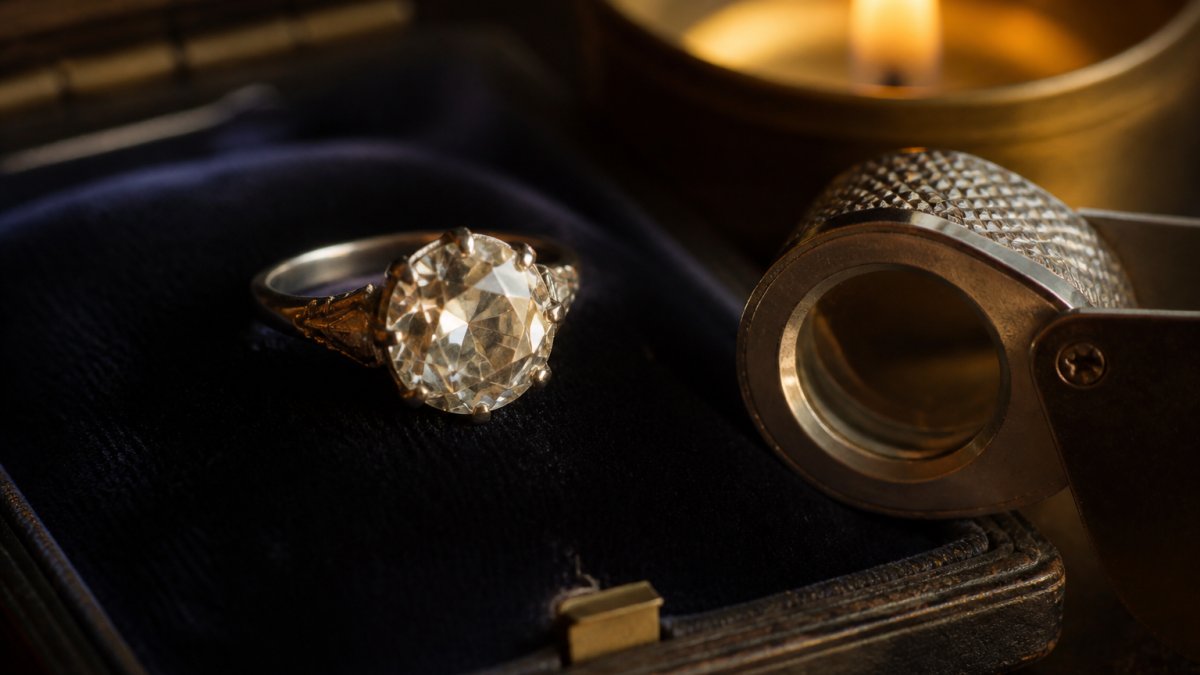
What separates the main antique cuts is the faceting logic behind them.
- Old mine cut, roughly Georgian to early Victorian. Cushion or irregular outline, high crown, small table, deep pavilion, large culet facet at the bottom. The culet is a flat facet, not a point, and it is one of the quickest ways to recognise the cut. Light returns in broad, soft flashes rather than tight pinfire.
- Old European cut, the round bridge between old mine and modern brilliant, emerging in the late nineteenth century and common into the early twentieth. Still has a small table and a high crown, but the outline is circular and the facet arrangement is closer to the modern round. It reads as warm and slightly softer than a modern brilliant.
- Transitional cut, a loosely defined group from the early twentieth century that sits between old European and modern brilliant, often with a larger table than an old European but a higher crown than a modern stone. These are common in Edwardian and early Art Deco pieces.
The trade-off is honest: antique cuts show more colour and more visible inclusions than modern stones of the same grade. That is character, not a fault.
How to Judge an Antique Cut
Modern cut grades do not map cleanly onto antique stones, so assess them on their own terms:
- Outline symmetry, hand-cut stones are often slightly out of round or out of square. A little irregularity is normal; a badly lopsided outline affects how the stone sits in a setting.
- Crown height, a high crown is characteristic and gives the soft fire, but it also stands proud of the setting and is more exposed to knocks. Check the crown edges for abrasion.
- Culet condition, the flat culet facet can chip. Inspect it under a loupe, especially on old mine cuts.
Antique stones are judged more on character and condition than on a numeric grade. Ask a jeweller to assess the stone in daylight and under a loupe, noting any chips, abrasions or previous repairs.
Our guide to the history and characteristics of antique diamond cuts goes deeper on why collectors choose them, and our comparison of old mine, old European and modern brilliant cuts breaks down the differences before you commit.
6.5 Carat Edwardian Platinum Graduated Old Cut Diamond Bracelet →
Choosing a Diamond for an Existing Setting
Choosing a diamond for an existing setting means matching the stone to the metal, not the other way round. The setting decides the shape, depth and often the cut; a stone that is beautiful loose can look wrong once set if its proportions do not suit the seat.
Start with the seat, the opening the stone sits in. A replacement stone that is too deep will not sit flush; too shallow, and the prongs will not grip.
Measuring the Seat Before You Buy
Before you buy a loose stone, measure the setting itself:
- Measure the seat opening in millimetres, length and width
- Measure the usable depth from the seat to the base of the setting
- Check the existing prong count and their condition
A stone within about half a millimetre of the seat measurement usually fits with a minor adjustment. Beyond that, expect a reset. Depth is most often overlooked: a deep old mine cut may not fit a shallow modern setting, and a shallow modern brilliant may rattle in a deep antique seat.
Matching the Cut to the Setting Style
The setting style narrows the sensible choices:
- Claw and prong settings, suit most shapes, but pointed shapes such as pear and marquise need a protective prong or V-tip at the point. Claw settings are easier to work on but the prongs wear and need checking.
- Bezel settings, a metal rim around the stone. Excellent for cushion, oval and emerald cuts because the rim protects the edges. A bezel holds a stone securely but costs more to reset.
- Halo and cluster settings, the centre stone must sit at the right height relative to the surrounding stones, or the halo will look uneven. Matching the cut of the centre to the accents matters; a modern brilliant centre in a cluster of single cuts can look out of place.
For antique settings, an antique cut is almost always the better match. A modern brilliant in a Victorian claw setting looks out of place, and the proportions often will not sit right. The high crown of an old mine cut was designed to sit proud of a low antique setting and catch candlelight; a flatter modern stone in the same seat can look sunk.
A Practical Decision Order
When you are deciding, work in this order:
- Inspect the setting, condition, prong wear, metal type, any previous repairs. A setting that is structurally tired may need restoration before it takes a new stone.
- Measure the seat and depth, this sets the hard limits on what will fit.
- Decide whether you are preserving or resetting, preserving means matching the period and proportions; resetting opens up modern cuts but changes the piece.
- Match the cut to the setting style, use the guidance above.
- Check the wearer's habits, daily wear favours rounded shapes and protected settings; occasional wear allows more delicate choices.
- Confirm with a jeweller, have them check the stone in the setting before any work begins.
Our comparison of old mine, old European and modern brilliant cuts breaks down the differences before you commit.
Durability, Repairs and Provenance for the Long Term
Durability is where shape matters more than sparkle. Pointed shapes, such as pear and marquise, chip at the tip unless a prong or bezel protects them.
Repairability follows the setting: a bezel holds a stone securely but costs more to reset, while claw settings are easier to work on but the prongs wear and need checking.
Provenance is the other half of value. To establish the age of a cut, our guide to dating antique diamond cuts walks through the practical checks.
Book a Viewing of Gold2u's Old Cut Diamond Pieces
The best way to judge a cut is in person, in natural light, on the hand. Photographs flatten the fire that makes antique stones worth owning.
Our collection includes pieces such as The Five-Stone Old Cut Diamond Heirloom Ring at £1,390, a Victorian-Era Old Cut Diamond Three Stone Ring - 1.75 Carats Total at £3,500, and a 6.5 Carat Edwardian Platinum Graduated Old Cut Diamond Bracelet at £12,500. Each is a one-off, so availability changes.

Frequently Asked Questions
Which diamond cut is the most timeless for heirloom jewellery?
Round brilliant and oval cuts hold their appeal across decades, but in heirloom pieces the old mine cut and old European cut are the most enduring. Their high crowns, small tables and broad facets were cut by hand for candlelight, and that warm fire is why collectors still seek them. If you are resetting an inherited stone, match the cut to the period of the setting rather than chasing current trends. A cut that suits the mount will look intentional in fifty years, not dated.
Should I choose a diamond cut to suit the original setting?
Yes, and the setting usually decides more than personal taste. Measure the seat, the internal diameter of the mount and the depth clearance under the girdle before shopping. A deep old mine cut diamond may not sit in a shallow modern bezel, and an elongated oval will not fit a square collet. Bring the piece to a jeweller who works with antique mounts. Choosing a diamond for an existing setting is a fitting exercise first and an aesthetic one second.
Can an old mine cut diamond be reset in a modern setting?
It can, but the mount needs to protect a stone with a thinner girdle and a taller crown than a modern brilliant. A bezel or a well-made crown setting with properly shaped prongs spreads the load and reduces the risk of chipping. Ask the setter to check the girdle thickness first. Resetting also changes the piece's character, so keep the original mount if provenance matters to you; a documented antique setting adds to an heirloom's story and its resale appeal.
How do diamond shape and cut affect an heirloom's appearance?
Shape is the outline you see from above: round, oval, emerald, pear, cushion. Cut is how the facets are arranged to return light, which decides brilliance, fire and scintillation. A well-cut oval can out-sparkle a poorly cut round brilliant, so grade matters more than outline. In an heirloom, the shape should echo the era of the mount, while cut quality decides how the stone performs. Compare both before you commit, ideally in daylight and under low light.
Matching a cut to an heirloom setting takes patience, and getting it wrong is expensive. Gold2u can help you compare antique cuts in person, check the condition and provenance of each piece, and match a stone to an existing setting before you commit. Get started with Gold2u and choose a diamond cut built to last another generation.


0 comments