

Last Updated: October 26, 2026
Quick Summary
The best GIA certified diamonds for custom rings are natural loose stones with a verifiable GIA report number, D colour, VVS1 clarity and Excellent to Very Good cut grades. At Gold2u, our 0.50 carat D VVS1 round brilliants are priced at £1,650.00 each, with depths from 59.4% to 63.7% and tables from 56% to 61%.
- Verify every GIA report number through the GIA Report Check service and match it to the girdle inscription.
- Our view: buy VS2 clarity and put the saving into cut or colour instead of VS1.
- A depth percentage above roughly 62.5% makes a stone sit deep and face up small in a bezel.
- A table percentage below 55% concentrates brilliance in the centre and can look dark in a thin halo.
- Every diamond in our current selection is graded None for fluorescence.
Table of Contents
- Why GIA Certified Loose Diamonds Matter for Custom Rings
- How to Read a GIA Diamond Grading Report
- VS1 vs VS2 Diamond: Which Clarity Grade Fits a Custom Ring
- Choosing the Best Diamond Shape for an Engagement Ring
- Matching a Loose Diamond to a Custom Setting
- Natural vs Lab-Grown: Certification and Cost Trade-Offs
- Your Loose Diamond Buying Guide: Total Cost and Compatibility
- Ordering Your GIA Certified Diamond from Gold2u
- Frequently Asked Questions
Why GIA Certified Loose Diamonds Matter for Custom Rings
GIA certified diamonds are stones whose grading has been independently verified by the Gemological Institute of America. At Gold2u, we offer natural loose diamonds with GIA reports.
Below, we walk through checks to consider before committing a loose diamond to a bespoke setting.
How to Read a GIA Diamond Grading Report
The GIA diamond grading report provides grading details. You can review the report number, measurements and the Four Cs.
Verifying the Report Number and Measurements
Every GIA report carries a unique number, and it should match the inscription on the stone's girdle. Look the number up directly through the GIA Report Check service. A report that cannot be verified is not a report.
Then compare the measurements. Our 0.50 carat D VVS1 round brilliant, report 2237078867, measures 5.09-5.11 x 3.16 mm.
The Four Cs in Plain Terms
- Cut is a grading detail. The listed round brilliants have cut grades ranging from Very Good to Excellent.
- Colour is a grading detail. The listed diamonds are D colour.
- Clarity is a grading detail. The listed diamonds are VVS1 clarity.
- Carat is a grading detail. The listed diamonds weigh 0.50 carat.
Every diamond in our current selection is graded None for fluorescence.
VS1 vs VS2 Diamond: Which Clarity Grade Fits a Custom Ring
Our view: buy VS2 and put the saving into cut or colour. A VS2 with Excellent cut and D colour will outperform a VS1 with Very Good cut every time. Where clarity genuinely matters is in step cuts such as emerald and asscher, whose large open tables show inclusions that a brilliant cut would scatter.
Choosing the Best Diamond Shape for an Engagement Ring
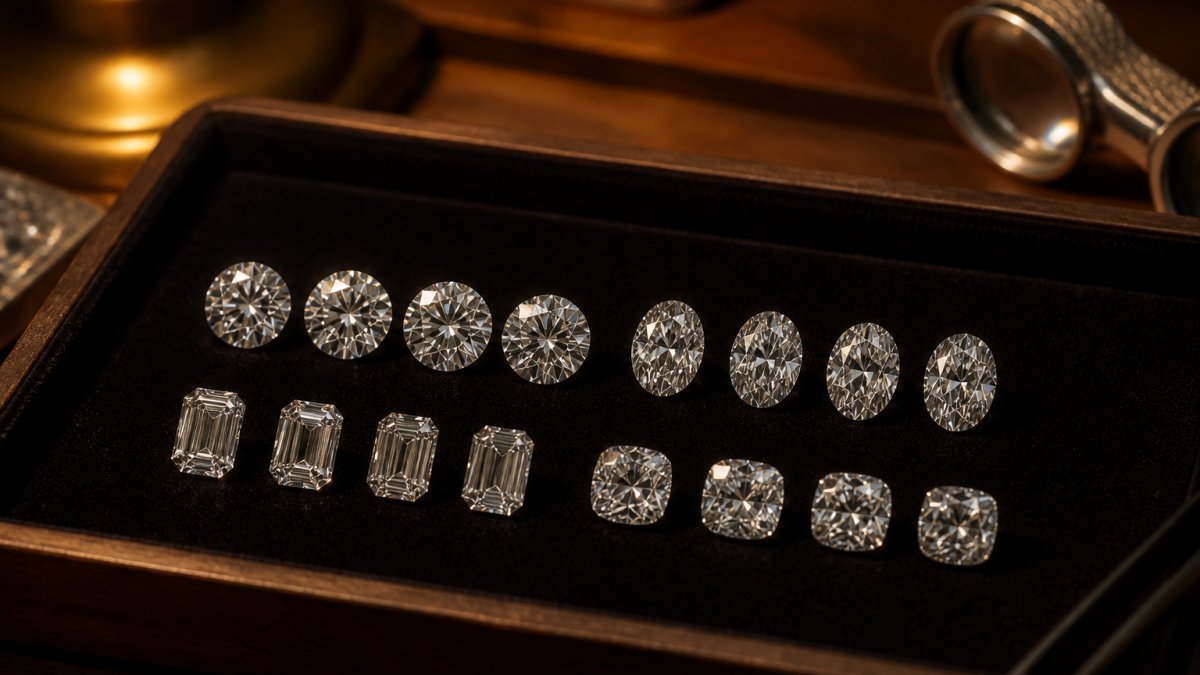
If you are drawn to antique character, our guide to 7 diamond cuts for heirloom jewellery covers how each shape behaves in an old-cut-inspired setting.
Matching a Loose Diamond to a Custom Setting
A depth percentage above roughly 62.5% produces a stone that sits deep and faces up small, which can sink inside a bezel. A table percentage below 55% concentrates brilliance in the centre and can look dark in a thin halo. Spread matters most in solitaires, where the stone is the whole design.
Natural vs Lab-Grown: Certification and Cost Trade-Offs
Natural and lab-grown diamonds are chemically identical; the difference is origin, and origin changes both the certificate and the resale picture. GIA grades lab-grown stones to the same standard but issues a distinct report that states the growth method, so the two can never be confused by a careful buyer.
0.50 Carat D VVS1 Round Brilliant Cut Loose Diamond - GIA Certified 2237078867 →
How the GIA Reports Differ
A GIA report for a natural diamond and a GIA report for a lab-grown diamond share the same Four Cs framework, but the lab-grown report carries additional disclosure. Look for the growth method (CVD or HPHT) and the phrase 'Laboratory-Grown' on the report header. The report number is still verifiable through the GIA Report Check service, and the girdle inscription on a lab-grown stone typically includes a prefix or symbol indicating lab origin. If a seller cannot show you a report that explicitly states the growth method, treat the stone as undocumented.
The Cost Gap in a Custom-Ring Budget
Natural stones hold value differently because supply is finite, but resale is not guaranteed for either category. A custom ring is a personal purchase first; treat resale as a secondary consideration and ask the seller what documentation they provide for insurance replacement.
Which Report to Ask For
For a deeper comparison of how antique and lab-grown stones differ in character and provenance, read antique diamond jewellery vs lab-grown diamonds.
Your Loose Diamond Buying Guide: Total Cost and Compatibility
| Cost element | What drives it | What to confirm in writing |
|---|---|---|
| Loose diamond | Carat, colour, clarity, cut grade, fluorescence | GIA report number, measurements, whether the stone is natural or lab-grown |
| Setting | Metal choice (platinum, 18ct gold, palladium), complexity, hand-finishing | Metal purity, setting style, whether the price includes setting the stone |
| Making and sizing | Bespoke labour, resizing, engraving | Resizing policy, turnaround time, whether resizing is included or charged |
| Certification and valuation | GIA report, insurance valuation | Whether the valuation is independent and what it covers |
| Aftercare | Re-tipping, rhodium plating, checking | Warranty period, what is covered, where servicing is done |
Matching Stone Dimensions to the Setting
A depth percentage above roughly 62.5% produces a stone that sits deep and faces up small, which can sink inside a bezel. A table percentage below 55% concentrates brilliance in the centre and can look dark in a thin halo. Spread matters most in solitaires, where the stone is the whole design. For step cuts such as emerald and asscher, clarity matters more because the large open table shows inclusions that a brilliant cut would scatter.
Budgeting the Work
For a worked example, see this 0.50 carat D VVS1 round brilliant GIA certified loose diamond.

Ordering Your GIA Certified Diamond from Gold2u
Every listed loose diamond has a GIA report number, grading details and measurements. Browse custom jewellery and GIA certified loose diamonds from the retailer.
Our natural 0.50 carat D colour VVS1 round brilliant diamonds are priced at £1,650.00 each. Each has its own GIA report number. The listed stones have depths from 59.4% to 63.7%, tables from 56% to 61%, and cut grades from Excellent to Very Good.
Gold2u offers natural diamonds independently graded by GIA and a curated selection of antique old mine cut diamond jewellery. The listed diamonds include GIA report numbers.
Frequently Asked Questions
Should I choose a VS1 or VS2 diamond for a custom ring?
Both grades are eye-clean in most sizes, so the choice usually comes down to budget and setting. A VS2 stone often looks identical to VS1 once set, especially in a bezel or halo that hides the girdle. Put the saved money into cut quality instead. At 0.50 carat, the difference is rarely visible without a loupe, so pick the report with the better cut and polish grades.
What should I look for in a GIA diamond grading report?
The listed diamonds have GIA report numbers that can be verified online. Their listings provide measurements, carat weight, colour, clarity, cut, polish, symmetry, fluorescence, depth and table percentages.
Is a GIA-graded diamond better for a custom ring?
The listed diamonds have GIA reports with report numbers that can be verified online.
How do I choose the right diamond shape for a custom ring?
Start with the setting style and hand shape, then the stone. Round brilliant cuts suit almost any mount and hide inclusions well. Oval and pear shapes lengthen the finger, while emerald and Asscher cuts show clarity flaws more openly, so they need higher grades. If you want a classic look that never dates, round remains the safest choice for an engagement ring.


0 comments