

Table of Contents
- What Is a Hallmark and Why It Matters
- The Four Components of a Hallmark: Maker's Mark, Standard Mark, Assay Office and Date Letter
- 1. Read the Maker's Mark: Antique Jewellery Maker's Marks Identification
- 2. Decode UK Assay Office Hallmark Date Letters
- 3. Identify the Assay Office: Leopard's Head, Anchor and Other Symbols
- 4. Check Metal Purity Stamps: Carat, Fineness and Sterling Silver
- 5. Spot Imitation Stamps and Counterfeit Marks
- 6. Use a Jeweller's Loupe and Prepare Pieces for Inspection
- 7. Verify Provenance: Identifying Genuine Antique Jewellery Provenance
- Frequently Asked Questions
Last Updated: September 21, 2026
What Is a Hallmark and Why It Matters
A hallmark is an official stamp struck into a precious metal item by an independent assay office to confirm its metal purity and legal compliance with UK hallmarking law, and it is the foundation of reading antique jewellery hallmarks. It is not a brand logo or decorative engraving, but a legal guarantee, and the single most reliable starting point when you set out to identify antique jewellery hallmarks.
At Gold2u, we handle antique old mine cut diamond pieces and historical gold items daily, and the first question we ask is always the same: what does the hallmark say? A genuine stamp tells you the metal content, who submitted the item for testing, and roughly when it was assayed. A missing or inconsistent stamp tells you something too.

The UK operates one of the oldest and most strictly enforced hallmarking systems in the world. According to Assay Office London's guide to hallmarking, the system has protected buyers since the 14th century, and it remains a legal requirement for most items sold as gold, silver or platinum today.
That legal weight is what makes hallmarks so useful: a hallmark is not an opinion but a government-backed statement of fact about metal composition, and learning to read one is the fastest route to separating a genuine antique from a convincing fake.
The Four Components of a Hallmark: Maker's Mark, Standard Mark, Assay Office and Date Letter
A complete UK hallmark contains four distinct marks, each answering a different question about the piece. Miss any and you are reading an incomplete story.
The four components are:
- Maker's mark (also called the sponsor's mark): identifies who submitted the item for assay
- Standard mark: states the metal purity, such as 375, 750 or 925
- Assay office mark: shows which office tested and stamped the item
- Date letter: a letter code that indicates the year of assay
On older pieces, these marks often sit tightly together inside a small rectangular or shield-shaped outline called a cartouche. The cartouche shape itself can help narrow down the period, because different assay offices used different outline styles over time.
What most guides miss is that the four marks were not always applied together. On some Georgian and Victorian pieces, marks are spread across different parts of the item, and on heavily worn jewellery, one or two may have been rubbed away entirely. A missing date letter does not automatically mean a fake, but it does mean you need to look harder at everything else.
1. Read the Maker's Mark: Antique Jewellery Maker's Marks Identification
Antique jewellery maker's marks identification starts with the shape and font of the stamp, not just the initials inside it. Maker's marks are typically two or three letters, sometimes with a symbol, punched into the metal in a distinctive cartouche.
Every registered maker had a unique mark recorded with the assay office. That registry is why a maker's mark is so valuable: match it to a registered name and date range and you can often date a piece to within a decade.
How the maker's mark registry actually works
To submit work for assay, a silversmith or jeweller had to register a distinctive mark at the assay office, which recorded the mark, the maker's name, their business address and the registration date in a ledger. Those ledgers survive for most UK assay offices and have been transcribed into published reference works and, increasingly, searchable online databases.
The practical consequence: a maker's mark is only useful if you can match it to a registry entry. Two makers in different cities could register similar initials, so the cartouche shape, the font and the accompanying assay office mark are what tell them apart.
Recognisable maker's marks you will encounter
A few names come up repeatedly on antique pieces, and knowing them helps you sanity-check a stamp quickly:
- Charles Horner, registered in Birmingham, active from the late Victorian period into the early 20th century, known for silver and enamel jewellery and the famous hatpin.
- Sampson Mordan, London-based, registered from the early 19th century, best known for silver propelling pencils and novelty pieces.
- Liberty & Co., the retailer's mark appears on Arts and Crafts and Art Nouveau pieces made by various workshops; the mark tells you who sold it, not necessarily who made it.
- Henry Griffith & Sons, Birmingham, active across the late 19th and early 20th centuries, common on silver jewellery.
These are starting points, not a complete list. The point is that a maker's mark should be verifiable against a published register, if it is not, look harder at the rest of the piece.
A step-by-step visual workflow for reading a maker's mark
Work through this physical process in order:
- Clean the mark gently. Warm water, a drop of mild washing-up liquid and a soft brush. Never polish a hallmark, you will wear it away.
- Set up angled light. A small torch held low across the surface reveals the depth of the punch. Flat overhead light hides it.
- Magnify at 10x. Hold the loupe to your eye, then bring the piece to the loupe, not the other way round.
- Photograph the mark straight on. Use a phone on a tripod or brace your elbows. You want a sharp, flat image of the cartouche.
- Note the cartouche outline. Rectangle, shield, oval, chamfered corners, record what you see before you try to interpret it.
- Note the font. Serif lettering with pronounced crossbars suggests an earlier date. Sharper, more uniform lettering suggests a later, machine-cut punch.
- Cross-reference. Match the initials, cartouche and font against a published maker's mark register or an online database before drawing any conclusion.
What the mark does and does not tell you
A common mistake is assuming a famous maker's name on the stamp means the piece is genuine. The name only tells you who submitted it for assay. Fakers replicate popular marks constantly, so the maker's mark should never be your only evidence.
Equally, a mark you cannot identify is not automatically a fake. Many small workshops registered poorly documented marks, and some provincial marks are genuinely obscure. Cross-check an unidentified mark against the other three components, the standard mark, the assay office mark and the date letter, and see whether the whole set tells a consistent story.
Digital tools that speed this up
Online hallmark registries and mobile apps let you search maker's marks by initials, cartouche shape and assay office, while image-comparison tools overlay your photograph against a database entry to spot font inconsistencies. These tools are a starting point, not a verdict, they narrow the field so you can focus manual research on the most likely candidates. For obscure provincial makers, a printed reference work or a specialist dealer's archive is often still the fastest route.
2. Decode UK Assay Office Hallmark Date Letters
UK Assay Office hallmark date letters are single letters indicating the year an item was assayed, and each assay office ran its own letter cycle. Dating gets tricky here, because the same letter reappears on a repeating cycle.
A date letter alone is not enough to date a piece. You need to know which assay office struck it, because each used a different alphabet sequence and cycle length. A "B" from one office might mean 1897, while the same letter from another points to a completely different year.
A practical approach:
- Identify the assay office mark first (see section 3)
- Match the letter and its font style to that office's known cycle
- Cross-check the letter's cartouche shape against the same period
- Sanity-check the result against the piece's overall style and construction
Date codes are also a useful authenticity signal. If a date letter points to a year that predates the introduction of a particular metal standard, or if the font style is anachronistic for that year, something is wrong. The Birmingham Assay Office's date letter archives publish historical letter sequences that make this cross-checking straightforward.
3. Identify the Assay Office: Leopard's Head, Anchor and Other Symbols
The assay office mark tells you which UK assay office tested the item, and it is usually the easiest of the four marks to recognise once you know the symbols. Each office has used a distinctive emblem for centuries.
The most commonly encountered assay office marks include:
- Leopard's head: London
- Anchor: Birmingham
- Rose: Sheffield
- Three castles: Edinburgh
- Irish harp: Dublin
Why the assay office mark matters more than people realise
The assay office mark is not just a geographic label, it is the key that unlocks the date letter. Each office ran its own alphabet cycle, cycle length and font conventions, so you cannot interpret a date letter until you know which office struck it. Read the assay office mark first.
Cherry Blossom Articulated Pendant with →
How the marks changed over time
Assay office marks were not static. The London leopard's head appears uncrowned for some periods and crowned for others, with well-documented change points; the Birmingham anchor has appeared in slightly different forms; and the Sheffield rose has appeared with and without a stem. These small variations are exactly what let you narrow a date range by decades rather than centuries.
A practical approach is to treat the assay office mark as a dating tool in its own right:
- Identify the office from the emblem.
- Note the exact form of the emblem, crowned or uncrowned, stemmed or stemless, orientation of the symbol.
- Cross-check that form against the known change points for that office.
- Only then move on to the date letter, using that office's specific cycle.
The London leopard's head in practice
The London leopard's head is the mark most buyers recognise, partly because London was the dominant assay office for centuries. You will see it clearly on pieces like our Cherry Blossom Articulated Pendant with Diamonds and pink sapphire 18k Rose Gold, where it sits alongside the 18ct standard mark and the maker's mark.

On a genuine piece, the leopard's head should sit inside a cartouche whose outline is consistent with the period. A crowned head on a piece claiming to be early 19th century, or an uncrowned head on a piece claiming to be Elizabethan, is a contradiction worth investigating.
Regional differences in hallmarking systems
The four nations did not operate identically. Scotland had its own assay offices in Edinburgh and Glasgow, and Irish pieces were assayed in Dublin, and the marks, date letter cycles and even standard marks differ subtly between these systems. A piece with an Edinburgh three castles mark follows Edinburgh's date letter sequence, not London's, mixing the two up is one of the most common dating errors.
This is why the four marks must be read together rather than in isolation. The assay office mark tells you which rulebook to use; the other three marks give you the information to apply it.
Digital tools for cross-referencing assay office marks
Online hallmark databases and mobile apps let you search assay office marks by emblem, period and cartouche shape, and image-comparison tools overlay your photograph against a database entry to confirm the exact form of the mark. These are a useful shortcut but no substitute for understanding the change points, a database tells you what a mark looks like, not whether it is consistent with the rest of the piece.
4. Check Metal Purity Stamps: Carat, Fineness and Sterling Silver
Purity stamps state the fineness of the metal, expressed either as a carat figure for gold or a millesimal number for all precious metals. This mark tells you what the piece is actually made of.
The standard marks you will encounter most often:
| Mark | Meaning | Common On |
|---|---|---|
| 375 | 9ct gold | Modern and vintage gold jewellery |
| 750 | 18ct gold | Fine antique and vintage pieces |
| 916 | 22ct gold | Older gold, often coins and bands |
| 925 | Sterling silver | Silver jewellery and flatware |
| 950 | Platinum | Edwardian and later fine pieces |
Fineness is expressed in parts per thousand, so 750 means 75% pure gold. Older pieces sometimes carry a carat figure instead, particularly pre-20th-century gold.
A genuine Edwardian piece, for example, will almost always show 950 for platinum or 750 for 18ct gold inside a period-appropriate cartouche. Purity stamps get interesting when the metal composition does not match the stated mark, an acid test or professional metal testing can confirm whether the stamp tells the truth.
5. Spot Imitation Stamps and Counterfeit Marks
Counterfeit marks are the hardest part of hallmark reading, because the best fakes are genuinely well executed. The good news: most imitation stamps fail on the details rather than the overall impression.
Signs that a stamp may be imitation:
- Too perfect. Genuine hand-stamped marks have slight depth variation and minor edge distortion. Laser-etched marks look flat and uniform.
- Wrong font for the period. A modern sans-serif font on a piece claiming to be Georgian is a red flag.
- Inconsistent cartouche. The outline shape does not match the claimed assay office or era.
- Mismatched marks. A date letter that does not align with the maker's known working period.
- Shallow or faint impressions. Genuine marks are struck deeply enough to survive a century of wear.
There is also a legal dimension worth knowing. The Hallmarking Act 1973 makes it an offence to apply a false hallmark or to sell an item with a counterfeit mark. That matters for buyers because it means genuine UK-hallmarked pieces carry real legal protection behind them.
If you are uncertain about a piece, a professional jewellery appraisal is money well spent. Independent appraisers can confirm metal composition and flag reproduction marks that are easy to miss at home.
6. Use a Jeweller's Loupe and Prepare Pieces for Inspection
A jeweller's loupe is the single most important tool for hallmark inspection, and 10x magnification is the standard choice. You cannot reliably read a worn hallmark with the naked eye, and phone cameras alone rarely capture enough detail.
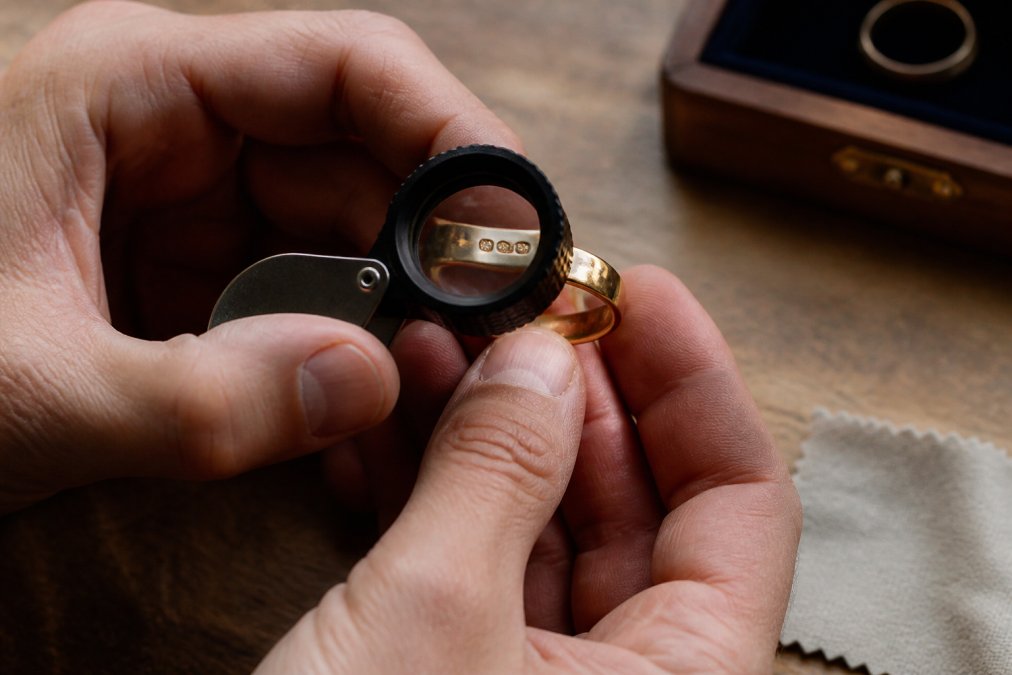
Preparation matters as much as magnification. A workflow that works:
- Clean the piece gently first. Warm water with a drop of mild washing-up liquid and a soft brush removes the grime that fills stamped lettering. Never use abrasive polishes on a hallmark, because you can wear the mark away permanently.
- Dry thoroughly and work under bright, angled light. Raking light across the surface reveals depth in the stamp that flat lighting hides.
- Hold the loupe close to your eye, then bring the piece to the loupe. Do not move the loupe toward the piece.
- Photograph each mark separately at maximum magnification for later comparison.
For hallmarks on the inside of a band or the reverse of a pendant, a small torch at a low angle makes an enormous difference. The goal is to see the depth and edges of the punch, because that is where fakes give themselves away.
7. Verify Provenance: Identifying Genuine Antique Jewellery Provenance
Identifying genuine antique jewellery provenance means building a documented history for the piece, not just reading its stamps. Hallmarks date and authenticate the metal. Provenance tells you where the piece has been and who has owned it.
Strong provenance evidence includes:
- Original receipts, insurance valuations or auction records
- Period-appropriate boxes and packaging
- Matching documentation from a previous jewellery appraisal
- Photographic records showing the piece over time
- Maker or retailer records that align with the hallmark
Digital tools have made this easier: online hallmark registries and mobile apps let you cross-reference maker's marks and date letters without a reference book, and image-comparison tools spot font inconsistencies quickly.
Frequently Asked Questions
What is the difference between a maker's mark and a hallmark?
A maker's mark is the unique stamp of the jeweller or workshop that created the piece, usually initials inside a cartouche. A hallmark is the official stamp applied by an assay office after testing the metal, confirming its purity. A complete hallmark combines the maker's mark, standard mark, assay office mark and date letter. When identifying antique jewellery hallmarks, look for all four components together.
How do I use the UK Assay Office hallmark date letters to date a piece?
Each assay office uses a different font and shield shape for its date letters, cycling through the alphabet. You match the letter, font and surrounding cartouche to a published date table for that specific office. For example, a lowercase 'a' in a particular shield shape at the London office corresponds to one specific year. Cross-referencing the date letter with the maker's mark and style of the piece confirms the period.
Is there a free app to identify vintage jewellery hallmarks?
Several mobile apps and online databases let you photograph a hallmark and compare it against reference libraries. Free options exist but their databases are often incomplete for rare or regional marks. They work best as a first step, helping you narrow down the assay office or date range. For pieces of significant value, always confirm with a professional jeweller or the assay office's own records.
How can I tell if a hallmark is genuine or a counterfeit stamp?
Genuine hallmarks are crisp, evenly struck and show consistent depth. Counterfeit stamps often look shallow, blurred or unevenly spaced, and the font may be wrong for the claimed period. Check the cartouche shape against known assay office punches. Also examine the metal around the mark for signs of re-stamping or smoothing. If the hallmark looks too perfect or the font is modern on an 'antique' piece, treat it with suspicion.
What does the 'c*c' mark on jewellery mean?
The 'c*c' mark is not a standard UK hallmark. It may be a partial maker's mark, a foreign import mark or a decorative stamp. Some pieces carry incomplete or worn marks that are hard to read. If you see an unfamiliar mark like this, compare it against a hallmark registry or ask a jeweller to examine it under magnification. Context, metal testing and style analysis can help confirm what it actually is.


0 comments