

Table of Contents
- Why Clasps Are the Most Reliable Dating Tool
- How to Identify Antique Jewellery: The Clasp-First Method
- Antique Jewellery Clasp Types and What They Reveal
- Vintage Brooch Pin Mechanisms Timeline: From C-Clasp to Safety Catch
- Antique Jewellery Hallmark Identification Alongside Clasp Dating
- Spotting Reproductions: When a Clasp Doesn't Match the Period
- Conclusion
- Frequently Asked Questions
Last Updated: September 25, 2026
Why Clasps Are the Most Reliable Dating Tool
Clasps are often the clearest clue to an antique jewellery piece's real age. Styles changed with fashion and technology, so the fastener usually narrows a date better than the stones or setting.
How to Identify Antique Jewellery: The Clasp-First Method
The clasp-first method means you examine the fastener before anything else: identify the clasp type, then match it to the period when that mechanism was in common use. Clasp designs moved in clear waves, and makers rarely used an old style once a new one took over. Here is the process in two steps.
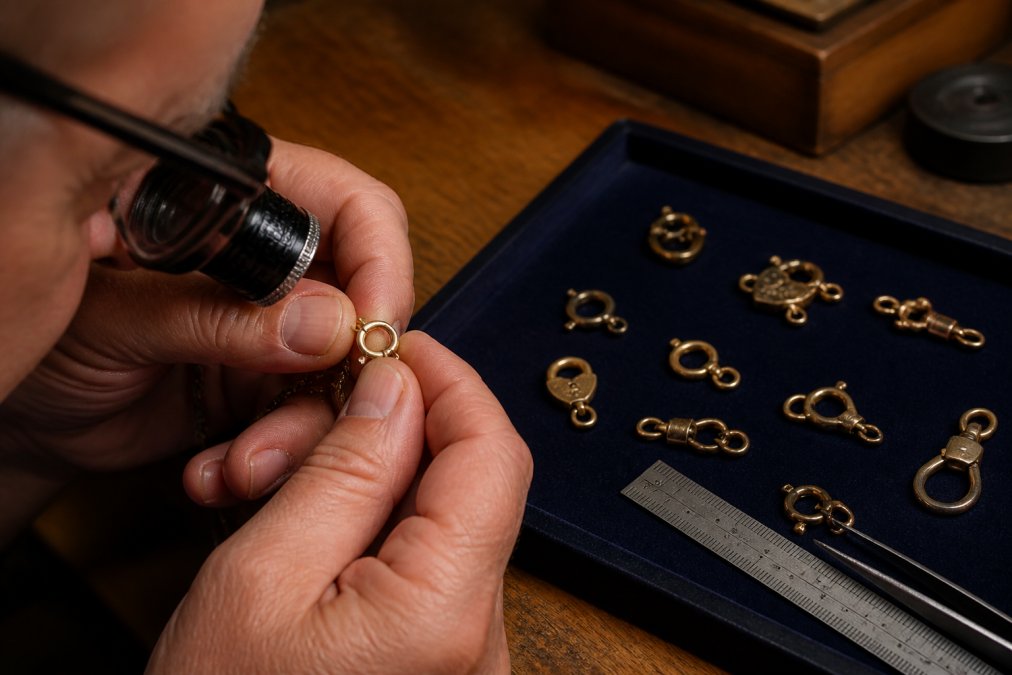
Step 1: Examine the Clasp Under Magnification
A 10x jeweller's loupe is the single most useful tool you can own. Under magnification, look for:
- Construction marks: file marks, solder joints, and hand-cut edges
- Wear patterns: where the metal has rubbed smooth from use
- Material: solid gold, gold-filled, or base metal beneath the plating
- Mechanism type: how the clasp actually opens and closes
Step 2: Cross-Reference the Clasp Type With Known Periods
Once you know the mechanism, match it to the era. A bolt ring points to one window, a tube clasp to another. The table below gives the quick version.
| Clasp type | Typical period | What it tells you |
|---|---|---|
| Hook and eye | Georgian and earlier | Hand-made, often converted from a brooch |
| C-clasp | Georgian to early Victorian | Common on brooches, often with a pinstem |
| Box clasp | Victorian onward | Often paired with a safety catch |
| Tube clasp | Victorian to Edwardian | Slide mechanism, common on bracelets |
| Bolt ring | Late Victorian onward | Still made today, so check the wear |
| Trombone clasp | Victorian to Edwardian | Distinctive telescopic action |
Antique Jewellery Clasp Types and What They Reveal
Each clasp type belongs to a period, and the type alone can place a piece within a few decades. But the type is only half the answer, the other half is how the mechanism is built and what metal it is made from, where reproductions slip up.
Spring Ring and Bolt Ring Clasps
The spring ring is a circular clasp with a spring-loaded gate. It appeared in the late Victorian era and became standard on necklaces and bracelets through the 20th century. The bolt ring works the same way but is heavier, with a thicker tube and stronger spring. Both are still made today, so a spring ring alone cannot prove age. Look at the surface instead: genuine antique spring rings show fine scratches, softened edges, and a warm patina, while a modern copy looks crisp and bright.
- The gate spring: on an antique, the spring is a separate piece of wire seated in a channel; on many modern copies it is a stamped tab.
- The seam: antique rings often show a visible solder seam where the tube was closed by hand; machine-made rings are seamless.
- The jump ring: the small ring joining the clasp to the chain is frequently a later replacement, a bright, unworn jump ring on an otherwise worn clasp is a tell.
Box Clasps, Tube Clasps, and Trombone Clasps
The box clasp hides its mechanism inside a rectangular box, often finished with a safety catch, and is common on Victorian and later bracelets. The tongue inside should be hand-fitted; on reproductions it is often a stamped tongue that rattles.
What the Metal Tells You
This is the part most guides skip, and it is often the fastest way to date a clasp. The metal changed with both fashion and manufacturing cost, so composition is a dating clue in its own right.
- Solid gold or silver: the norm for better-quality pieces from the Georgian period onward. A solid-gold clasp will not show a different colour at wear points.
- Gold-filled (rolled gold): a thick mechanical bond of gold over base metal, widely used from the mid-Victorian period into the early 20th century for affordable jewellery. Wear points stay gold-coloured because the gold layer is thick.
- Gold-plated: a thin electroplated layer, common from the late 19th century onward and heavily used in 20th-century costume jewellery. Under a loupe, plating flakes at edges and reveals a different-coloured base metal at high-wear points such as the gate or the tongue.
- Base metal (brass, nickel, pot metal): used for costume pieces and for many later reproductions. It tarnishes unevenly and often shows a greenish or grey cast where plating has worn through.
Vintage Brooch Pin Mechanisms Timeline: From C-Clasp to Safety Catch
Brooch fastenings follow their own timeline, and the pin stem is as useful as the clasp itself.
- C-clasp with tube hinge: Georgian to early Victorian
- C-clasp with safety catch: late Victorian transition
- Full safety catch with revolver hinge: Edwardian onward
Antique Jewellery Hallmark Identification Alongside Clasp Dating
Hallmarks confirm what the clasp suggests, and the two should always agree. A hallmark is an official stamp showing metal purity, assay office, and often a date letter.
6.5 Carat Edwardian Platinum Graduated →
Spotting Reproductions: When a Clasp Doesn't Match the Period
A reproduction usually gives itself away through a mismatch: the stones and setting look period-correct, but the clasp belongs to a different decade, or is the right type but the wrong construction.
Look for these warning signs:
- A Victorian-style brooch with a modern safety catch
- A Georgian piece with a machine-stamped bolt ring
- Bright, uniform plating over base metal
- A clasp that opens too smoothly for its claimed age
- Hallmarks that are too crisp or placed in an odd spot
Mechanism-Level Checks
- Spring tension: an antique spring ring or bolt ring has a spring that has softened with age. It should still close firmly but feel slightly tired. A reproduction often snaps shut with a hard, modern spring.
- Solder joints: antique solder is usually a slightly different colour from the parent metal and shows a hand-applied, irregular fillet. Modern solder is often invisible or perfectly smooth.
- File marks: hand-finished clasps show fine, parallel file marks in protected areas. Machine-made clasps are uniform and may show a stamped seam.
- The hinge on a brooch: early brooches used a simple tube hinge; later pieces a ball or revolver hinge. A C-clasp paired with a modern safety catch is a red flag, but so is a tube hinge paired with a revolver-hinge-era safety catch.
- Pin stem length and taper: on an antique brooch the pin stem is usually slightly tapered and hand-finished at the tip; on a reproduction it is often uniform-diameter wire with a blunt end.
The Material-Composition Angle Most Guides Miss
This check separates a careful buyer from a lucky one, and it is the angle almost no ranking article covers properly. The metal a clasp is made from is itself a dating clue, because available materials and their cost changed over time.
- Solid gold or silver: the norm for better-quality pieces from the Georgian period onward. No colour change at wear points.
- Gold-filled (rolled gold): a thick mechanical bond of gold over base metal, widely used from the mid-Victorian period into the early 20th century. Wear points stay gold-coloured because the gold layer is thick.
- Gold-plated: a thin electroplated layer, common from the late 19th century onward and heavily used in 20th-century costume jewellery. Plating flakes at edges and reveals a different-coloured base metal at high-wear points.
- Base metal (brass, nickel, pot metal): used for costume pieces and for many later reproductions. Tarnishes unevenly, often with a greenish or grey cast where plating has worn through.
A Worked Example
For pieces with old mine cut diamonds, the clasp and the cut should tell the same story. A genuine Edwardian piece, like our 6.5 Carat Edwardian Platinum Graduated Old Cut Diamond Bracelet, carries an original period box clasp that matches its 1905 to 1915 date.

Conclusion
Dating antique jewellery by clasp takes practice, but the method is reliable once you know the periods. Examine the mechanism first, match it to the era, and confirm with the hallmark.
Frequently Asked Questions
How can you tell the age of a necklace by its clasp?
The clasp mechanism itself is one of the strongest dating signals. A simple hook and eye or early spring ring points to the 19th century or earlier, while a bolt ring with a smooth, machine-made finish suggests the 20th century. Tube clasps and trombone clasps appear most often on Victorian and Edwardian pieces. Examine the metal finish: hand-finished clasps show file marks and slight irregularity, while stamped or cast clasps indicate later production. Cross-reference the clasp with hallmarks and overall construction for a confident date.
Can you date a brooch accurately by its pin mechanism?
Yes, the pin mechanism is a reliable indicator. The c-clasp with a simple hook was common from the Georgian era through the mid-Victorian period. The tube hinge replaced the earlier riveted hinge around the 1850s. Safety catches became standard from the late Victorian era onward, and the modern rollover safety catch is a 20th-century development. If a brooch has a c-clasp but a machine-made safety catch, that mismatch suggests a later repair or a reproduction.
What are the most common antique jewellery clasp types?
The most frequently encountered antique jewellery clasps include the spring ring, bolt ring, box clasp, tube clasp, trombone clasp, hook and eye, and c-clasp. Spring rings and bolt rings are common on necklaces and bracelets. Box and tube clasps appear on finer Victorian and Edwardian pieces. Trombone clasps are distinctive to continental European jewellery, particularly German and Austrian work. The c-clasp is found almost exclusively on brooches. Each type has a rough date range that helps narrow the period of manufacture.
Are there specific hallmarks to look for alongside clasp types?
Yes, hallmarks are the essential companion to clasp dating. In the UK, look for the maker's mark, assay office mark, date letter, and fineness mark. A Birmingham or London assay office stamp with a date letter can pinpoint the year of assay. If the clasp is a later replacement, the hallmarks will often be on the main body of the piece rather than the clasp itself. A clasp that carries no hallmark on a piece that should have one is a red flag for a replacement or reproduction.


0 comments