

Table of Contents
- What Provenance Means for Antique Jewellery
- Why Provenance Documentation Matters for Value and Authentication
- Types of Documentation to Establish Provenance
- How to Identify Vintage Jewellery Markings and Maker's Marks
- Hallmark Identification Guide for Establishing Period and Origin
- Provenance Research Techniques for Estate Jewellery
- Identifying Forgeries, Reproductions, and Undocumented Pieces
- Legal and Ethical Considerations When Buying Antique Jewellery
- Frequently Asked Questions
Last Updated: September 30, 2026
What Provenance Means for Antique Jewellery
Antique jewellery provenance is the documented history of ownership, origin, and authenticity of a piece. It answers a simple but critical question: where did this come from, and who owned it before me?
For collectors and investors, provenance transforms a beautiful object into a verifiable asset. With it, you own not just jewellery but a documented story and genuine value.
Provenance proves authenticity. A ring claiming to be Edwardian is just a claim until documentation backs it up. Traced ownership through decades or centuries, gemological certificates, and auction house records make it undeniably real. The difference between a £3,000 piece and a £15,000 piece often comes down to provenance alone.
At Gold2u, we understand this completely. We know collectors deserve to buy with confidence, not hope.
Why Provenance Documentation Matters for Value and Authentication
Documentation protects your investment, establishes authenticity, and unlocks future resale value.
A piece without provenance sits in a grey zone, buyers hesitate, valuers discount it, and insurance companies ask uncomfortable questions. The same ring with full provenance sells faster, commands a premium, and transfers with absolute certainty.
Authentication without documentation is guesswork. Gemological reports, hallmark analysis, and ownership records transform opinion into fact, creating a chain of custody that proves this specific piece has been tracked, verified, and owned across real time.
For estate jewellery, provenance research unlocks stories. A Victorian bracelet with documentation showing it belonged to a notable collector or appeared in an auction catalogue becomes a historical artifact worth owning for reasons beyond its material value.
Types of Documentation to Establish Provenance
Original Purchase Receipts and Invoices
The gold standard of provenance is the original receipt. It names the seller, states the date, describes the piece, and often includes the price paid.
Original invoices are rare for pieces over 50 years old, but when they exist, they prove purchase, establish a baseline date, and sometimes reveal the maker's name or workshop.
Look for:
- Jeweller's name and location
- Date of purchase (exact or approximate)
- Description of materials and gemstones
- Price paid (useful for historical context)
- Maker's mark or workshop identification
If you have an original receipt, photograph it in colour, store it safely, and mention it when selling or insuring the piece. It's your strongest single document.
Gemological and Appraisal Reports
A gemological report from a qualified appraiser or laboratory describes the piece in technical detail: materials, dimensions, condition, estimated age, and assessment of authenticity.
The most credible reports come from established gemological institutes that use standardised methods and carry professional liability.
Appraisal reports establish value for insurance and create a dated record of condition and authenticity that becomes part of the piece's documented history.
When commissioning an appraisal:
- Choose an appraiser with gemological credentials
- Request a detailed written report with photographs
- Ask for an assessment of age and period style
- Include any observations about maker's marks or hallmarks
- Keep the report with your ownership documents
Auction House Records and Certificates
If a piece has been sold at auction, that record is pure provenance gold. Auction catalogues create a dated, witnessed record of the piece's existence and value.
Auction house certificates are particularly valuable for high-end pieces. Major auction houses maintain searchable archives where you can retrieve original catalogue descriptions and sale results.
Even smaller regional auction houses create records that become historical evidence.
To find auction records:
6.5 Carat Edwardian Platinum Graduated →
- Search the auction house's online archives
- Contact them directly with details of the piece
- Check specialist databases for high-value jewellery
- Request a certificate of sale if available
How to Identify Vintage Jewellery Markings and Maker's Marks
Markings on the metal are your first clue to authenticity and age. Every legitimate piece carries stamps identifying the maker, metal purity, and sometimes the year of manufacture.
Maker's marks vary widely. Some are initials. Others are symbols or monograms. A maker's mark tells you who created the piece, and if you can identify the maker, you've unlocked significant provenance. A ring marked with a known jeweller's initials is immediately more valuable than an unmarked ring of identical design.
Maker's marks are small and often worn. A jeweller's loupe (10x magnification) is essential to read them clearly.
Common marking patterns:
- Maker's initials or full name
- Metal purity stamps (750 for 18ct gold, 950 for platinum)
- Assay office marks (regional stamps showing where the piece was hallmarked)
- Date letters (in the UK system, a letter indicating the year of hallmarking)
- Duty marks (historical stamps showing tax was paid)
Not every mark is a maker's mark, some are assay office stamps, workshop marks, or old purity marks. Learning to distinguish them takes practice.
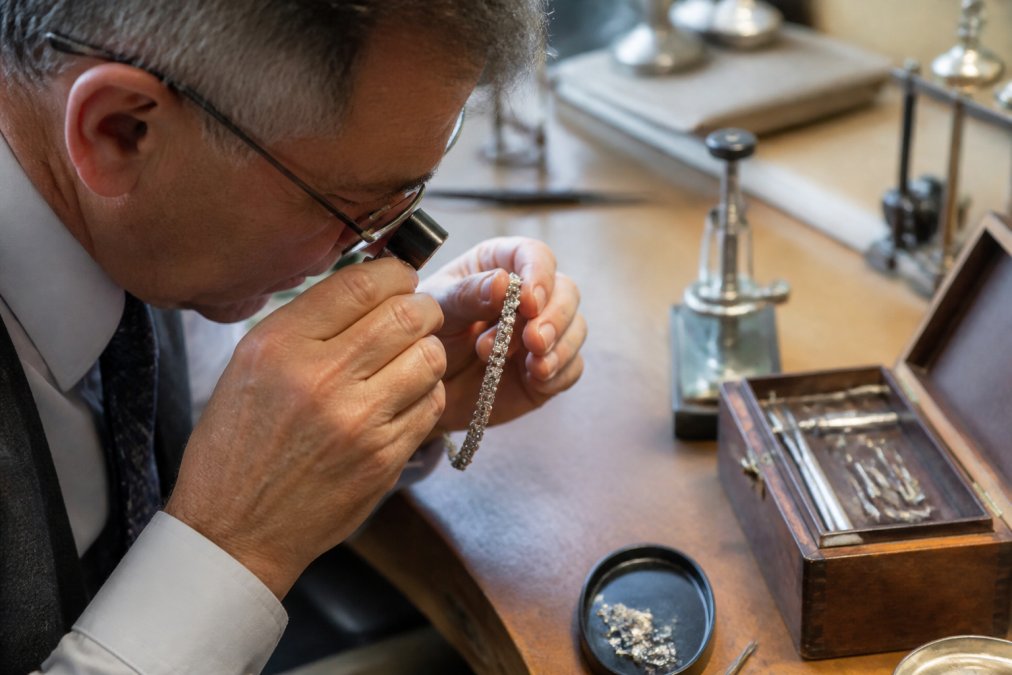
Hallmark Identification Guide for Establishing Period and Origin
Hallmarks are the official stamps struck into precious metal to certify purity and origin. They're the most reliable way to date and authenticate a piece.
In the UK, hallmarking has been standardised for centuries. Every precious metal item sold commercially must carry a hallmark including the assay office mark, purity mark, maker's mark, and often a date letter.
The date letter system is particularly useful.
Understanding hallmarks requires learning the symbols:
- Assay office marks: Lion passant (sterling silver), crown (gold), or other regional symbols
- Purity marks: Numerals (750 for 18ct gold) or symbols
- Maker's marks: Initials or symbols unique to the workshop
- Date letters: A-Z cycling through the alphabet, changing annually
Resources for hallmark identification:
- UK Assay Office records (Birmingham, London, Sheffield, Edinburgh)
- Hallmark date letter guides specific to each assay office
- Professional hallmark analysis services
- Gemological laboratories
Provenance Research Techniques for Estate Jewellery
When a piece has no documentation, detective work begins. Estate jewellery often carries clues, maker's marks, style elements, materials, construction techniques, that point toward its origin and age.
Research steps:
- Photograph all markings clearly
- Consult period jewellery references and style guides
- Search maker's mark databases online
- Contact assay offices for hallmark records
- Reach out to jewellery history societies and museums
- Consult specialist dealers and valuers
Identifying Forgeries, Reproductions, and Undocumented Pieces
Not every old-looking piece is old. Reproductions are common, and some are deliberately deceptive. Learning to spot fakes protects your investment and your reputation as a collector.
Red flags for forgeries:
- Hallmarks that don't match known assay office systems
- Maker's marks that don't appear in any historical records
- Inconsistent wear patterns (a piece claiming to be 100 years old but showing no age-related damage)
- Construction techniques that don't match the claimed period
- Gemstones that appear too perfect (modern brilliant cuts sold as old mine cuts)
- Suspiciously low prices for supposedly rare pieces
Legal and Ethical Considerations When Buying Antique Jewellery
The most critical concern is stolen goods. A piece might have been stolen decades ago or removed from a collection without permission. Knowingly buying stolen property is a crime; unknowingly buying it means losing both the piece and your money if the rightful owner claims it.
Key legal protections:
- Request full provenance documentation before purchase
- Commission an independent gemological report
- Verify hallmarks and maker's marks with assay offices
- Ask about any claims or disputes regarding ownership
- Obtain written confirmation of authenticity and materials
- Keep all documentation with your piece
Frequently Asked Questions
What exactly is provenance in the context of antique jewellery?
Provenance is the documented ownership history and chain of custody of an antique jewellery piece. It traces where the item has been, who owned it, and how it has been cared for over time. Strong provenance includes receipts, appraisals, auction records, and service documentation. Pieces with clear provenance command higher prices and are easier to sell because buyers gain confidence in authenticity and historical significance. Without provenance, even genuinely old pieces face valuation challenges and authentication questions.
How can I verify the history of an unmarked antique piece without formal documentation?
Start with archival research: examine auction house catalogues, museum records, and historical jewellery databases. Consult a qualified gemmologist who can assess the piece's construction, materials, and wear patterns to estimate its age and origin. Analyse hallmarks on any visible metal surfaces using a jeweller's loupe. Research the style characteristics (Victorian, Edwardian, Art Deco) to narrow the period. If the piece has a distinctive design, search historical jewellery journals and collector forums. Professional appraisers can often trace similar pieces and provide a detailed condition report that strengthens your ownership record going forward.
Why is provenance documentation essential for investment-grade jewellery?
Provenance documentation directly impacts resale value and marketability. Investment-grade pieces, such as the 3 Carat Old Mine Cut Diamond Ring or the Edwardian Platinum Graduated Old Cut Diamond Bracelet, command premium prices when their history, authenticity, and condition are verifiable. Buyers of high-value antique jewellery require proof of legitimacy before committing significant funds. Documentation also protects you legally by demonstrating the piece was acquired legitimately. Without it, you face difficulty selling to collectors, auction houses, or dealers, and you risk overpaying at purchase because the seller cannot justify the asking price.
What should I do if my antique jewellery lacks formal documentation?
Begin building a provenance record immediately. Obtain a professional gemological report from a qualified appraiser, which documents the piece's materials, condition, and estimated age. Photograph the item in detail, including hallmarks and any maker's marks. Create a written record of how you acquired it (seller's name, date, location, price paid). Store receipts and any correspondence related to the purchase. Have the piece professionally cleaned and inspected to rule out damage or undisclosed repairs. Moving forward, maintain service records if the jewellery is restored or cleaned. This documentation, though created after purchase, establishes a clear chain of custody and significantly improves the piece's value and saleability.


0 comments