

Table of Contents
- What a Gold IRA Is and How It Works
- Potential Benefits of a Gold IRA for Retirement Planning
- Gold IRA Pros and Cons
- Gold IRA Fees and Storage Costs Explained
- Physical Gold vs Gold IRA: Which Suits You?
- Holding Gold in a UK Pension: SIPP and SSAS Options
- Setting Up a Gold IRA: Step-by-Step
- Conclusion
- Frequently Asked Questions
Last Updated: October 18, 2026
What a Gold IRA Is and How It Works
A gold IRA is a self-directed individual retirement account that holds physical precious metals instead of stocks, bonds or cash. The structure is identical to a conventional IRA in tax terms; only the asset inside changes.
Gold2u works with collectors and investors who want tangible assets, and the questions we field most often are about the mechanics. You open a self-directed IRA with a custodian that permits alternative assets, fund it by contribution or transfer, instruct the custodian to buy eligible metal, and a specialist depository stores it.
The metal itself must meet HMRC's investment gold rules on purity, which is why most gold IRAs hold coins and bars of at least 99.5% fineness.
The Role of the Custodian and Approved Depository
The custodian is the regulated institution that administers the account, files paperwork and executes your instructions. The depository is a separate, insured vault that physically holds the metal. Splitting those roles stops any single party from controlling both the record and the asset. A common mistake is choosing a custodian on headline fees alone and later finding the depository sits in a jurisdiction you dislike, so check both before you sign.
Potential Benefits of a Gold IRA for Retirement Planning
The case for holding gold in a retirement account rests on three claims: diversification, inflation hedging and protection during market stress. Each deserves scrutiny rather than a sales pitch. Gold has behaved differently from equities, but "differently" cuts both ways: it can lag a rising market for years.
Diversification and Inflation Hedging
Gold is a portfolio diversifier because its price is driven by different forces than a company's earnings: currency weakness, real interest rates and demand from central banks and jewellers all move the metal in ways that have little to do with the FTSE.
On inflation, the evidence is more nuanced than the marketing suggests. Gold has preserved purchasing power across long horizons, but has also endured decade-long stretches where it did not. Treat it as insurance with a cost, not a guaranteed hedge.
What the Historical Record Actually Shows
Rather than rely on broad claims that gold always protects savings, look at how the metal has behaved against shares, bonds and inflation over different windows.
Over long periods, gold has roughly kept pace with inflation, but the path is uneven.
The practical lesson is to judge gold on its portfolio role, not standalone performance. A 5% to 10% allocation is typically held to reduce drawdown risk and correlation, not to beat equities.
Suitability by Retirement Timeline and Risk Profile
Whether a gold IRA suits you depends on your time horizon and tolerance for volatility.
- Near-retirees (within five years): A small gold allocation may appeal as a stabiliser, but liquidity matters. Selling physical metal held in an account takes days to weeks, so keep near-term spending needs in cash or liquid assets.
- Long-horizon savers (10+ years): A modest allocation can be held through gold's flat periods without forcing a sale at the wrong time. The tax-deferred wrapper is most valuable here, because gains compound without an annual tax drag.
- Low risk tolerance: Gold's price swings can be sharp. If a 20% drawdown in the metal would prompt you to sell, a gold IRA is likely unsuitable.
- High risk tolerance with a speculative view: Some investors use gold as a tactical position, where the fees and slower liquidity of an IRA wrapper may outweigh the tax benefit versus direct physical or exchange-traded exposure.
Gold works best as a satellite holding alongside a diversified core, not as a replacement for equities or bonds. If your plan depends on steady growth to hit a target, a large gold allocation introduces sequencing risk: a poor decade for the metal at the wrong time can leave a shortfall.
Gold IRA Pros and Cons
The gold IRA pros and cons come down to tax efficiency versus cost and complexity. On the positive side, gains grow tax-deferred, contributions may attract relief depending on the wrapper, and you remove the storage and insurance burden from your home.
The negatives are real. Fees run higher than a standard stocks-and-shares account, you cannot touch the metal, and the range of permitted coins is narrower than most collectors assume.
| Factor | Gold IRA | Physical Gold Held Directly |
|---|---|---|
| Tax treatment | Tax-deferred growth | No relief; capital gains may apply |
| Storage | Insured depository, included in fees | Your responsibility |
| Access to metal | No delivery while active | Immediate |
| Eligible coins | Restricted by purity rules | Any coin or nugget |
| Annual cost | Custodian plus storage fees | Insurance and safe costs only |
| Selling speed | Days to weeks | Same day possible |
Gold IRA Fees and Storage Costs Explained
Gold IRA fees and storage costs typically come in four layers, and the total matters far more than any single line. Expect an account setup charge, an annual administration fee from the custodian, a storage fee charged by the depository, and transaction costs each time you buy or sell. Insurance is usually bundled into storage rather than billed separately.
A Realistic Total-Cost Example
Consider a hypothetical account holding £50,000 of gold. A typical setup charge might be £100 to £300; annual administration £100 to £250; storage and insurance 0.5% to 1% of the metal's value, or £250 to £500 on this balance.
On those assumptions, the all-in annual cost could fall anywhere from roughly £350 to £750, or about 0.7% to 1.5% of the balance.
1871 Queen Victoria Full Gold Sovereign →
The Break-Even Question Most Guides Skip
The break-even question is the one most guides skip. If your annual fees total a few hundred pounds and your holding is small, the drag on returns is proportionally larger.
Compare that with a conventional stocks-and-shares ISA or SIPP, where platform charges of 0.2% to 0.5% a year are common and dealing costs modest.
A simple rule of thumb: if the all-in annual cost exceeds the tax you would otherwise pay on gains, the wrapper is not earning its keep.
Selling Costs and Exit Charges
The costs do not stop at the annual fee. When you sell, expect a dealer spread, possible assay or verification charges, and a custodian processing fee. Some depositories also charge a release fee for an in-kind distribution. These exit costs are rarely quoted upfront, so ask for them in writing: a gold IRA that looks cheap to run can be expensive to leave.
Physical Gold vs Gold IRA: Which Suits You?
Physical gold vs gold IRA is a question of control against tax efficiency. Direct ownership gives you the coin in your hand, no custodian, no annual administration and the ability to sell the same afternoon.
The account route trades that control for deferred growth and institutional safekeeping. If your goal is to hold a specific collectable coin, an IRA is usually the wrong vehicle because purity rules exclude much of what collectors want.
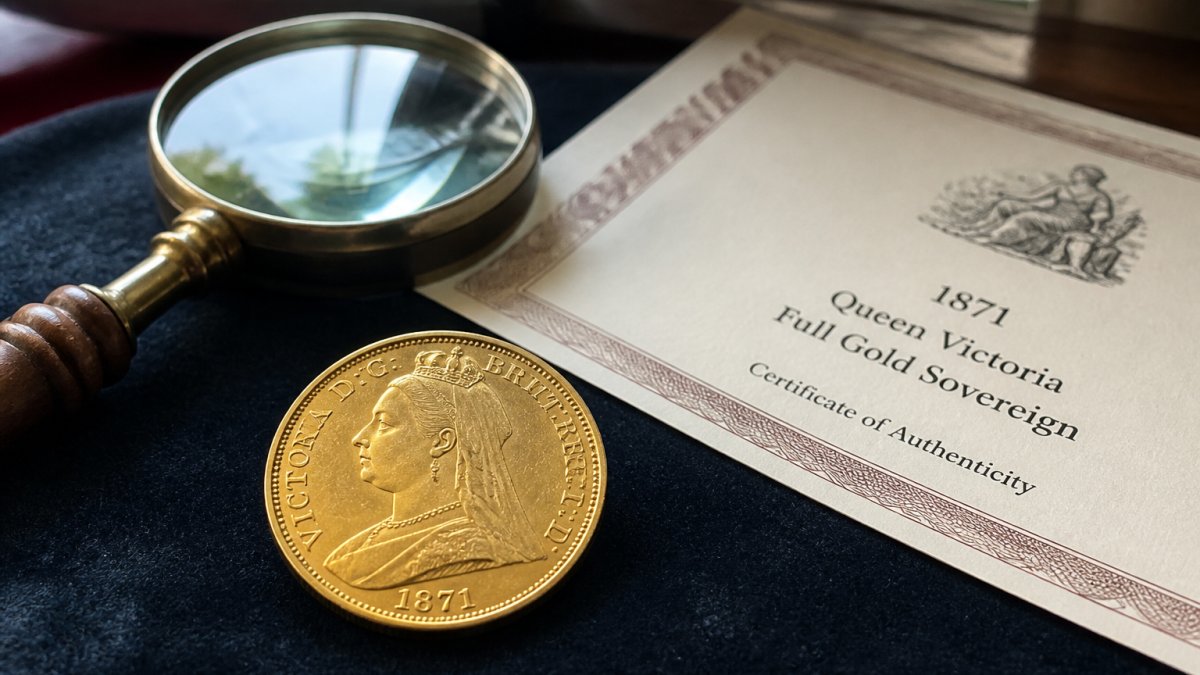
For collectors, the distinction is sharper still. Our 1871 Queen Victoria Full Gold Sovereign, struck at the London Mint with a die number for quality control, is exactly that kind of piece: 7.32 grams of fine gold inside a coin whose value reflects its history as much as its bullion content.

Holding Gold in a UK Pension: SIPP and SSAS Options
Holding gold in a UK pension is possible through a self-invested personal pension or a small self-administered scheme, and the rules differ from the US-style IRA structure most guides describe. A SIPP can hold physical gold that meets the investment gold test, but trustees must arrange insured storage with an approved vault; the metal cannot be kept at your home.
The practical constraints are tighter than they first appear. HMRC's guidance on pension scheme investments sets out what trustees may and may not hold.
For a SSAS, the same principles apply, with the added layer that the scheme is employer-sponsored and trustees carry more direct responsibility. In both cases, tax relief on contributions is the attraction, and storage and administration costs are the price.
Setting Up a Gold IRA: Step-by-Step
Setting up a gold IRA follows a predictable sequence, and each step has a failure point worth watching.
- Confirm your eligibility and wrapper. Decide whether a traditional or Roth-style structure fits your tax position, and check whether your existing provider permits alternative assets.
- Select a custodian that allows precious metals. Ask directly which depositories it uses and whether the two are independent businesses.
- Complete the account application and identity checks. Expect anti-money-laundering verification; this is normal and not a red flag.
- Fund the account by contribution or transfer. A transfer from an existing pension or retirement account avoids triggering a taxable event, so instruct it as a transfer rather than a withdrawal.
- Choose eligible metal and instruct the purchase. Confirm purity and that the specific coin or bar meets the investment gold test before the order is placed.
- Arrange insured storage with the depository. Get the storage agreement in writing, including the insurance basis.
- Reconcile your first statement. Check that the metal recorded matches what you instructed, and diarise the annual fee review.
Conclusion
The hardest part of gold investing is not choosing the metal, it is deciding which wrapper genuinely fits your goals. A retirement account suits a long horizon and a tax-efficient allocation; a collection suits the collector who wants the coin in hand and the history behind it. Gold2u supplies authenticated historical gold coins, natural Australian nuggets and antique old mine cut diamond jewellery, each listed as the actual piece you will receive and sent with free insured delivery.
Frequently Asked Questions
What are the main advantages of a gold IRA?
A gold IRA lets you hold physical gold inside a tax-advantaged retirement account, so any growth stays sheltered until you withdraw. It adds diversification away from stocks and bonds, and gold has historically acted as an inflation hedge during market volatility. You also benefit from secure storage in an approved depository rather than keeping bullion at home. For collectors, certain gold coins such as the 1871 Queen Victoria Full Gold Sovereign can combine investment value with numismatic appeal, provided they meet eligible purity standards.
Is it better to hold physical gold or a gold IRA?
It depends on your goals. A gold IRA offers tax-deferred growth and secure storage but comes with annual fees, storage costs and withdrawal restrictions. Holding physical gold directly gives you immediate access and no custodian fees, though you are responsible for insurance and safe storage. Many investors split their allocation: a gold IRA for long-term retirement savings, and physical coins or nuggets for liquidity and collecting. Compare total costs carefully before deciding which route fits your retirement portfolio.
What fees and storage costs does a gold IRA involve?
Typical gold IRA costs include an account setup fee, an annual administration fee from the custodian, and storage fees charged by the approved depository, often based on the value of metals held. You may also pay transaction costs when buying or selling, plus shipping and insurance on metal transfers. These charges erode returns, so add them up over your expected holding period. A low-cost account with modest balances can see fees consume a meaningful share of gains, so check the full fee schedule before opening.
Can you hold physical gold in a UK pension?
Yes, through a self-invested personal pension (SIPP) or small self-administered scheme (SSAS). HMRC rules require the gold to meet purity standards, typically 995 fineness for gold bars and certain investment-grade coins, and it must be held in an approved depository by a professional trustee. You cannot store it at home. Not all SIPP providers permit physical gold, so confirm eligibility and fees with your provider. Holding gold this way can diversify your pension, but it carries the same market risk as any single asset.
Disclaimer: This article is general information, not regulated financial or tax advice. Pension and tax rules change, and individual circumstances vary. Take advice from an authorised adviser before making retirement decisions.


0 comments