

Table of Contents
- How Antique Jewellery Prices Are Determined
- Metal Type, Purity, and Weight
- Gemstone Quality and Rarity
- Age, Era, and Historical Significance
- Antique Jewellery Hallmarks and Maker's Marks
- Condition, Damage, and Restoration Impact
- Antique Jewellery Valuation: Different Markets and Purposes
- Antique Gold Jewellery Scrap Value vs Collector Value
- Frequently Asked Questions
Last Updated: October 18, 2026
How Antique Jewellery Prices Are Determined
At Gold2u, clients often ask why two similar pieces carry vastly different price tags. The answer is logical once you understand the mechanics.
Antique jewellery prices reflect material value, craftsmanship, historical importance, and market demand. Unlike modern jewellery, where pricing centres on metal weight and stone carat, antique pieces command premiums, or sometimes discounts, based on factors beyond raw materials.
Value depends on who's buying and why: a collector hunting a specific era will pay far more than a scrap-metal buyer.
Metal Type, Purity, and Weight
Gold, platinum, and silver form the base value of any antique jewellery valuation, and understanding purity is essential.
Gold purity is measured in fineness, marked on jewellery as hallmarks. Common standards include:
- 22ct (916 fineness): Nearly pure gold, soft and prone to damage
- 18ct (750 fineness): The most common antique standard, durable and valuable
- 14ct (585 fineness): Slightly less gold content, still highly collectible
- 9ct (375 fineness): Lower purity, common in Victorian and Edwardian pieces
Weight determines gold content: a 10-gram 18ct ring holds roughly 7.5 grams of pure gold. That metal has intrinsic value, but antiques typically sell for multiples of scrap value.
Platinum is rarer and heavier than gold, so platinum antiques often command a premium. Edwardian jewellery frequently used platinum, signalling both age and quality to collectors.

Silver is trickier: sterling silver (925 fineness) oxidises, and restoration affects value. Some collectors prize patina, others prefer cleaned pieces, so silver antiques have wider price ranges than gold.
Gemstone Quality and Rarity
Gemstones are evaluated like modern stones, but antique cuts differ and affect desirability.
Diamond quality follows the four Cs, but antique diamonds, especially old mine and old European cuts, are graded differently than modern brilliants. An old mine cut with slightly lower clarity might fetch more than a perfect modern stone because collectors seek that distinctive warm glow and chunky faceting.

Coloured gemstones introduce additional variables:
- Rubies and sapphires: Heat treatment affects value dramatically. Untreated stones command significant premiums. Provenance matters here more than in diamonds.
- Emeralds: Naturally included, so clarity expectations differ. Oil treatment is standard and accepted, but the degree and type influence price.
- Pearls: Antique pieces often contain natural pearls, which are rarer and more valuable than cultured pearls introduced in the 20th century.
Rarity amplifies value: a fine Burmese ruby or untreated Colombian emerald can double or triple the price of a similar design with common gemstones.
Age, Era, and Historical Significance
Age is one of the strongest price drivers, but not always as people expect. A piece must be at least 100 years old to qualify as antique, but age alone doesn't guarantee value.
Desirable eras command premiums:
- Georgian (1714-1830): Highly sought, rare to find intact. Prices reflect scarcity.
- Victorian (1837-1901): Abundant, diverse styles, widely collected. Mid-range to high prices depending on quality.
- Edwardian (1901-1910): Peak craftsmanship, platinum use, fine detail. Often the highest prices in the antique market.
- Art Deco (1920s-1930s): Geometric designs, bold stones. Strong collector demand keeps prices elevated.
Historical significance beyond era matters too: a piece tied to a notable figure or event can command extraordinary premiums, so provenance documentation is essential.
Some eras are less desirable: late Victorian pieces sometimes sell below material value as tastes shift, creating opportunities for patient buyers.
Antique Jewellery Hallmarks and Maker's Marks
Hallmarks and maker's marks prove authenticity and often determine value. The practical skill is reading them in sequence and knowing what their absence means.
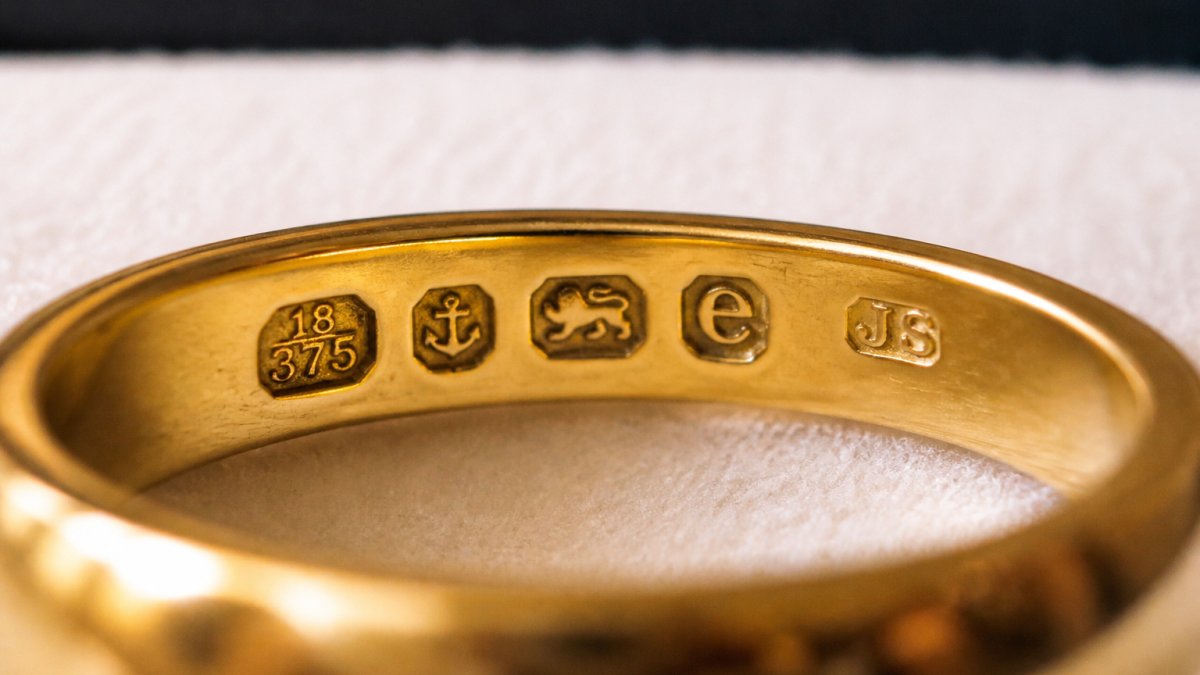
The four marks to look for, in the order they usually appear:
- Sponsor's (maker's) mark: The registered mark of the person or workshop that submitted the piece for assay, in the UK, typically initials within a shaped outline. It identifies responsibility, not necessarily the designer.
- Assay office mark: Confirms where the piece was tested, London, Birmingham, Sheffield and Edinburgh each have a distinct symbol. It doesn't change metal value but can corroborate a claimed origin.
- Date letter: A single letter in a specific typeface, changed annually within a cycle. Because cycles repeat, match it to the assay office and cycle, never read it in isolation.
- Fineness (purity) mark: The numerical standard, 375 (9ct), 585 (14ct), 750 (18ct) or 916 (22ct), often with traditional carat notation. This mark anchors the metal-value calculation.
How to verify a hallmark step by step:
- Clean only the surface, never the mark. Use a soft cloth and a 10x loupe. Abrasive polishing can wear away a shallow stamp and destroy the evidence.
- Record every mark with a macro photograph under raking light so the relief is visible. Photograph the whole piece first, then each mark.
- Match the date letter to the assay office and cycle. Reference tables published by assay offices and standard UK hallmark guides let you narrow the year. If the letter and office do not correspond to a known cycle, treat the mark as suspect.
- Check consistency across the piece. A ring should carry marks on the inner band; a brooch or pendant on the reverse or a detachable fitting. Marks on a later-added component suggest alteration.
- Look for import marks. Pieces made abroad and later brought into the UK were often assayed on import and carry a distinct import mark. This is common on Continental European and American antique pieces and affects how you read the maker's mark.
What absence tells you. Unmarked pieces aren't automatically worthless, but the burden of proof shifts to style, construction, gemstone cutting and documented history.
Maker's marks and reputation. A recognised maker's mark from a documented workshop can add a substantial premium. Lesser-known makers add value where recorded in jewellery history references or exhibition catalogues. A maker's mark only earns a premium when tied to a documented body of work, unidentified initials are not provenance.
Unmarked pieces rely more heavily on style, craftsmanship and materials to establish age and authenticity. That uncertainty typically reduces price versus fully marked equivalents, one reason a valuation should be a range, not a single figure.
Victorian-Era Old Cut Diamond Three Stone Ring – 1.75 Carats Total →
Condition, Damage, and Restoration Impact
Condition most directly affects whether a piece sells at premium or discount prices: two identical antiques in different conditions can have vastly different values.
Excellent condition means minimal wear, no cracks or chips, and original patina intact. These pieces command top dollar. Collectors prize originals, and restoration often reduces value, even when done expertly.
Light wear is expected: surface scratches, minor dents and slight fading are natural for 100-year-old jewellery and accepted as evidence of age.
Significant damage, broken prongs, missing stones, large cracks, or loose settings, dramatically reduces value. A missing gemstone in an otherwise fine piece might reduce the price by 30-50% or more, depending on the stone's importance to the overall design.
Restoration decisions are complicated. Cleaning and polishing are standard, but major work, re-tipping prongs, replacing stones, resizing bands, can reduce collector value because purists prefer originality.
Antique Jewellery Valuation: Different Markets and Purposes
The price of the same antique piece varies dramatically depending on the market and the buyer's intent.
Collector market: Collectors pay premiums for rarity, provenance and historical significance. A fine Edwardian diamond ring might sell for 5-10 times its gold and stone content value here.
Investment market: Investors focus on metal content and gemstone quality, not maker's marks or history, so prices reflect spot gold and current fine gemstone rates.
Auction market: Houses like Sotheby's and Christie's attract collectors worldwide, and competition often drives prices above retail. Documented results make valuable valuation benchmarks.
Scrap market: Dealers pay purely on metal weight and current spot prices, so a damaged piece with no collector appeal might sell at or slightly below intrinsic metal value.
The same antique piece could be valued at £500 by a scrap dealer, £2,000 by a retail jeweller, and £8,000 at auction. Context determines price.
Antique Gold Jewellery Scrap Value vs Collector Value
This distinction is one of the most important pricing concepts for antique jewellery, but it only becomes useful when you can put numbers to it and know which number answers which question.
Scrap value, worked through. Scrap value is the weight of pure gold multiplied by the current spot price, less the dealer's margin. Take a 10-gram 18ct gold ring.
Collector value, worked through. Collector value adds craftsmanship, design, age, rarity, condition and provenance on top of the metal.
A combined estimate, with a confidence range. Suppose the ring above is an Edwardian piece with a recognised maker's mark, good condition and an old European cut diamond. A specialist might frame it as:
- Floor (scrap): about £450 in metal, less dealer margin if sold for scrap.
- Likely resale range: a multiple of scrap, set by recent comparable auction results for similar era, maker and stone, for example a range rather than a single figure, because comparable sales vary.
- Ceiling: the best auction result achieved for an exceptional example of the same type, which is a benchmark, not a promise.
Which figure suits which decision:
- Insurance replacement: the cost to replace the piece with a comparable item at retail, which is usually the highest of the figures and should be reviewed periodically as metal and gemstone prices move.
- Auction estimate: a realistic range the auction house believes the piece will achieve, set from comparable sales and current demand, deliberately conservative to attract bidders.
- Resale or private sale: what a dealer or private buyer will actually pay, typically between scrap and retail, reflecting the buyer's need to resell at a margin.
- Scrap: metal content only, appropriate only when the piece has no collector appeal or is damaged beyond economic restoration.
The same ring could reasonably be described as £450 in scrap, a few thousand in a private resale range, and a higher retail replacement figure for insurance. None of those is wrong; they answer different questions.
At Gold2u, our expertise in antique old mine cut diamond jewellery means we understand how craftsmanship and historical significance drive prices beyond raw materials.

Frequently Asked Questions
How do I know if my antique jewellery is valuable?
Valuable antique jewellery combines several factors: precious metal content (gold, platinum, silver), gemstone quality and size, age and historical period, maker's mark or provenance, condition without significant damage, and rarity or collector demand. A piece with all these elements, such as a Victorian-era old mine cut diamond ring in original condition, commands premium prices. Conversely, a damaged piece made from base metal has minimal value. Professional appraisal by a qualified gemmologist or jeweller provides the most reliable assessment.
Does a maker's mark increase the value of antique jewellery?
Yes, a maker's mark can significantly increase value, particularly if it identifies a renowned jeweller, designer, or workshop. Hallmarks indicating precious metal purity also add credibility and value. However, unmarked pieces are not necessarily worthless, many antique items lack marks due to age or origin. The absence of a mark means valuation relies more heavily on materials, craftsmanship, design, and condition. A maker's mark provides documented provenance, which collectors actively seek and pay more for.
How does gold purity affect the value of antique jewellery?
Gold purity, measured in carats or fineness, directly affects both the intrinsic metal value and the collector premium. 18ct (750 fineness) gold is more valuable per gram than 9ct (375 fineness), and platinum commands higher prices than gold. Higher purity means greater material worth at current spot prices. Additionally, higher-purity pieces often indicate superior craftsmanship and historical period, Edwardian and Victorian jewellery frequently used 18ct or platinum, enhancing their collector appeal. Always verify purity through hallmarks or professional testing.
Is antique jewellery worth more than its scrap value?
Often, yes, significantly more. Antique jewellery typically commands a premium above scrap value due to age, design, craftsmanship, historical significance, and gemstone quality. A Victorian-era old mine cut diamond ring, for example, may be worth several times its metal and stone scrap value because collectors seek the rarity and character of the original piece. However, damaged or common pieces may sell close to scrap value. The key difference: collectors pay for history, provenance, and design; scrap dealers pay only for metal weight and gemstone carat.


0 comments