

Table of Contents
- Should You Clean Gold Coins at All?
- Common Gold Coin Cleaning Mistakes
- Safe Handling Before You Start
- Step-by-Step: How to Clean Vintage Gold Coins Safely
- Cleaning Gold Coins With Distilled Water
- How to Store Gold Coins Safely After Cleaning
- When to Seek Professional Conservation
- Frequently Asked Questions
Last Updated: October 21, 2026
Should You Clean Gold Coins at All?
The most common mistake collectors make is assuming that cleaning a vintage gold coin will improve it. It won't. In fact, cleaning often destroys value. Before you pick up a cloth or brush, understand what you're risking.
Vintage and collectible coins versus bullion
Not all gold coins are created equal. The difference between a vintage collectible coin and a bullion coin determines whether cleaning makes sense.
Bullion coins are modern strikes valued primarily for their gold content. A 2017 Queen Elizabeth II Full Gold Sovereign, for example, contains 0.2354 troy ounces of fine gold. Its value tracks the spot price of gold. Light surface marks don't matter because collectors buy it for the metal, not the rarity.

Vintage and numismatic coins are different. An 1869 Queen Victoria Gold Sovereign holds value because of its age, rarity, and historical significance. Collectors pay premiums for coins in original condition. A coin graded by third-party certifiers like NGC commands higher prices than an identical coin without certification.
When you clean a vintage coin, you erase that history. You remove the original surface. You risk scratching it. You eliminate the possibility of professional grading and certification. The collector who might have paid £1,500 for your coin in original condition will walk away from a cleaned version.
The value risk of cleaning
Understand the stakes. A vintage gold coin in original condition can be worth 20, 30, or 50 percent more than the same coin after cleaning. Sometimes the loss is even greater.
Here's why: professional numismatists and graders evaluate coins based on their original surface. They look for signs of authenticity. They assess wear patterns. A cleaned coin raises red flags. Even if the cleaning was gentle, the loss of original patina is permanent and obvious to experts.
Worse, once cleaned, a coin can never be restored. You cannot put back what you've removed. You cannot undo a scratch. This is irreversible damage.
The only coins worth cleaning are bullion coins, modern strikes where the gold content matters more than the historical surface. Even then, most collectors prefer to leave them alone.
Common Gold Coin Cleaning Mistakes
Most people who clean gold coins make the same errors. Learning what not to do is as important as learning the right method.
Using abrasive materials. Rubbing coins with cloths, brushes, or scouring pads scratches the surface. Even soft cloths can cause micro-scratches if you rub hard enough.
Using harsh chemicals. Acetone, vinegar, and commercial coin cleaners strip away the original surface. They're too aggressive. They leave residue. They can cause corrosion.
Soaking for too long. Extended soaking can trap moisture inside the coin's crevices. This leads to corrosion and spotting.
Handling coins with bare hands. Skin oils transfer to the coin's surface. Over time, these oils can cause tarnish and discoloration.
Drying with paper towels or regular cloths. These leave lint and fibers on the coin. They can also scratch if you rub. Use only lint-free cloths.
Polishing or buffing. This is one of the worst mistakes. Polishing removes a layer of the coin's surface. It creates an artificial shine that screams "cleaned" to any expert.
Safe Handling Before You Start
Before you even think about cleaning, establish proper handling practices. How you handle a coin matters as much as how you clean it.
Wear protective gloves. Cotton gloves or latex gloves prevent skin oils from transferring to the coin. These oils cause discoloration over time. Never touch a vintage coin with bare hands.
Prepare your workspace. Work on a clean, soft surface. Use a lint-free cloth or a padded mat. Keep your workspace free of dust, grit, and debris. Any particle that gets trapped between the coin and your cloth can scratch the surface.
Gather your materials in advance. Have everything ready before you start. You'll need distilled water, mild soap, soft brushes (optional), lint-free cloths, and cotton gloves. Don't improvise or substitute materials mid-process.
Separate coins if cleaning multiple. Never clean coins in contact with each other. They can scratch one another. Clean one coin at a time.
Work in good lighting. You need to see what you're doing. Use natural light or a bright lamp. Poor lighting leads to mistakes.
| Preparation Step | Why It Matters | What to Avoid |
|---|---|---|
| Wear cotton or latex gloves | Prevents skin oils from damaging the coin | Bare hands, wool gloves |
| Use a soft, clean workspace | Protects the coin from scratches and debris | Hard surfaces, dusty areas |
| Gather materials beforehand | Ensures you don't improvise with wrong supplies | Substituting materials mid-process |
| Separate coins | Prevents coins from scratching each other | Cleaning multiple coins together |
| Use good lighting | Lets you see the coin clearly | Poor lighting, shadows |
Step-by-Step: How to Clean Vintage Gold Coins Safely
If you've decided that cleaning is necessary, and for most vintage coins, it isn't, follow this method carefully. This approach minimizes risk while removing only loose surface contaminants.
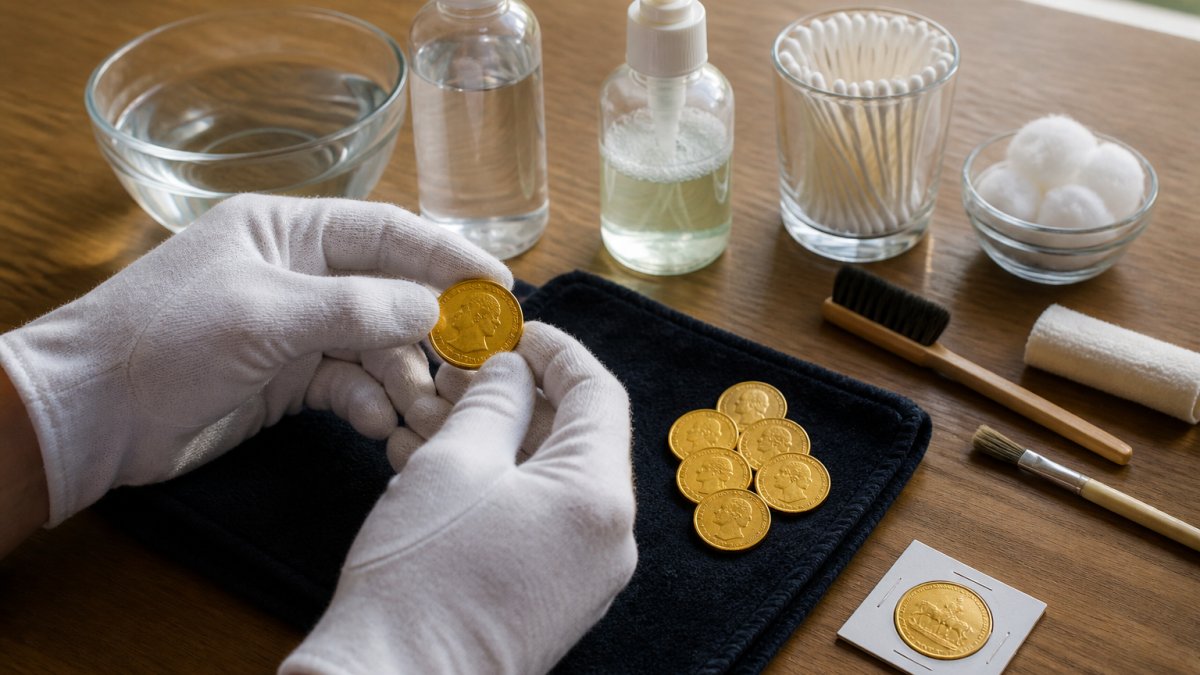
Preparing your workspace and gathering materials
Set up your cleaning area before you touch the coin. You'll need:
- Distilled water (not tap water, which contains minerals and impurities)
- Mild soap (plain dish soap is fine; avoid anything with additives or perfumes)
- Cotton gloves or latex gloves
- Soft lint-free cloths (microfiber cloths work well)
- A soft brush (optional; use only if absolutely necessary)
- A small bowl for soaking
Lay out your lint-free cloth on a clean, padded surface. Pour distilled water into the bowl. Add a tiny amount of mild soap, you want barely visible suds, not a soapy solution. Keep everything within arm's reach so you don't have to move the coin far.
Soaking and gentle removal of surface contaminants
Place the coin in the bowl of lukewarm distilled water with a trace of mild soap. Let it soak for 15 to 30 minutes. This softens surface dirt and grime without aggressive scrubbing.
After soaking, remove the coin carefully. Hold it by the edges only, never grip the face or reverse. Use a soft brush or your gloved finger to gently loosen any remaining loose dirt. Work slowly. Let the water do the work, not your effort.
Do not scrub. Do not rub hard. Apply only the gentlest pressure. If dirt doesn't come off easily, leave it. Forcing it risks scratching.
Rinsing thoroughly with distilled water
Rinse the coin under a gentle stream of distilled water. Use cool water, not hot. Tilt the coin so the water flows across its surface rather than pooling in the crevices.
1869 Queen Victoria Gold Sovereign →
Rinse for at least 30 seconds to ensure all soap residue is gone. Soap left on the coin will cause spotting and discoloration as it dries. Be thorough here.
Drying without rubbing or scratching
This is where most people fail. Drying is not optional, and it must be done correctly.
Place the coin on a clean, lint-free cloth. Do not rub it dry. Do not use a paper towel. Do not apply heat. Simply let it air dry in a clean environment.
If you must speed up the drying, you can gently pat the coin with a second lint-free cloth. Use minimal pressure. The goal is to absorb water, not to polish or rub.
Once dry, inspect the coin under good lighting. If you see water spots or residue, rinse again and repeat the drying process.
Cleaning Gold Coins With Distilled Water
Distilled water is your safest cleaning agent for vintage gold coins. It contains no minerals, no chemicals, and no additives that could harm the coin.
Tap water contains minerals that leave spots and residue. Mineral water is worse. Bottled water may contain additives. Only distilled water is pure enough for vintage coins.
For light surface dust, a brief rinse in distilled water alone, without soap, is often sufficient. Soak the coin for just 5 to 10 minutes, then rinse gently under a stream of distilled water. This removes loose particles without any chemical intervention.
For coins with more stubborn dirt or grime, add a single drop of mild soap to distilled water. The soap acts as a surfactant, helping water penetrate and lift dirt. But use it sparingly. More soap is not better. A tiny amount is all you need.
Never use vinegar, acetone, or commercial coin cleaners on vintage coins. These are too aggressive. They remove the original surface. They leave residue. They can cause corrosion.
How to Store Gold Coins Safely After Cleaning
After you've cleaned a coin, protect it from future damage. Proper storage prevents tarnish, corrosion, and contamination.
Use acid-free holders. Store vintage coins in acid-free plastic capsules or holders. Acid in regular plastic causes corrosion over time.
Keep coins in a cool, dry place. Moisture encourages corrosion. High temperatures accelerate chemical reactions. Store coins in a climate-controlled environment.
Avoid direct sunlight. Prolonged exposure to sunlight can fade the coin's appearance and encourage corrosion.
Never store coins in paper envelopes. Paper contains acid. It also absorbs moisture. Paper envelopes damage coins over time.
Handle infrequently. Every time you handle a coin, you risk damage. Store coins safely and handle them only when necessary. Wear gloves every time.
Keep detailed records. Document your coins with photographs and descriptions. Note where you acquired them, when, and for how much. This information helps with insurance and future sales.
If you've invested in a rare vintage gold coin from Gold2u, such as the 1869 Queen Victoria Gold Sovereign, treat it as the valuable asset it is.
When to Seek Professional Conservation
Some coins need professional help. Know when to call an expert rather than attempting cleaning yourself.
If the coin has significant corrosion or damage, a professional conservator can assess whether cleaning is safe. They have tools and expertise you don't have. They can stabilize corrosion without removing the original surface.
If the coin is extremely rare or valuable, professional conservation is worth the cost. A rare coin worth thousands of pounds deserves professional care.
If you're uncertain about the coin's composition or condition, a professional can help. They can identify the alloy, assess the original surface, and recommend whether cleaning is advisable.
If you're considering certification or grading, send the coin to a professional grader like NGC. They evaluate coins in their original condition.
When you're working with rare vintage coins, expert guidance is invaluable.
Cleaning a vintage gold coin is a high-stakes decision. Most collectors should leave their coins alone. The original surface is what makes a vintage coin valuable. Once lost, it cannot be recovered.
Frequently Asked Questions
Should you clean vintage gold coins?
Cleaning vintage gold coins carries significant risk. Collectible and numismatic coins lose value when cleaned, as buyers prefer original patina and surface character. Bullion coins are less sensitive to cleaning. Before cleaning any vintage gold coin, assess whether it's a rare collectible or investment bullion piece. When in doubt, consult a professional conservator. Many collectors recommend leaving vintage coins untouched unless they're heavily soiled with damaging contaminants.
Can cleaning a gold coin reduce its value?
Yes, cleaning can significantly reduce a vintage gold coin's collector value. Numismatic coins are graded partly on surface condition and original patina. Aggressive cleaning removes these qualities, lowering grading scores and resale value. Even gentle cleaning can affect perceived authenticity. Bullion coins and newer investment pieces are less sensitive to cleaning. If you own a rare or vintage piece like the 1869 Queen Victoria Gold Sovereign, professional assessment before any cleaning is essential to protect its value.
What's the safest way to clean gold coins with distilled water?
Soak coins in warm distilled water mixed with mild soap for 10-15 minutes to loosen dirt. Use only distilled water, never tap water, which contains minerals that leave residue. Gently agitate the water with your fingers; never scrub. Rinse thoroughly under running distilled water until all soap is gone. Dry immediately with a soft, lint-free cloth without rubbing. Avoid acetone and abrasive materials entirely, as these cause permanent surface damage.
How should you handle and store vintage gold coins safely?
Always wear cotton or latex gloves to prevent oils from your skin transferring to the coin surface. Handle coins over a soft cloth to cushion any accidental drops. Store in a cool, dry place away from moisture and humidity. Use acid-free holders or capsules; avoid PVC, which causes corrosion over time. Keep coins separated so they don't rub together and scratch. Store in a secure location, such as a home safe or safety deposit box. Check periodically for signs of tarnish or corrosion, but avoid handling unnecessarily.


0 comments