

Table of Contents
- Why Testing Gold Nuggets at Home Matters
- What You'll Need Before You Start
- The Gold Nugget Magnet Test: A Quick First Check
- Water and Float Tests for Initial Screening
- Gold Nugget Specific Gravity Test: Measuring Density for Accuracy
- The Gold Nugget Streak Test: Identifying Surface Characteristics
- Acid Testing: The Most Reliable Method (With Safety Precautions)
- How to Tell Gold from Pyrite and Other Look-Alikes
- Frequently Asked Questions
Last Updated: October 20, 2026
Why Testing Gold Nuggets at Home Matters
When you test gold nuggets, you'll discover that natural specimens hold genuine value, but so do convincing counterfeits. Before you invest in a specimen, you need to know what you're actually holding.

At Gold2u, we work with collectors and investors who understand that authenticity matters. Whether you're examining a nugget before purchase or verifying something you already own, basic testing methods can reveal the truth without expensive laboratory fees. Some tests are quick and non-destructive.
The challenge is knowing which test to use and when. Each method has strengths and limitations. A magnet test takes seconds but won't catch all fakes. An acid test is reliable but damages the specimen. Density testing is accurate but requires precision equipment.
What You'll Need Before You Start
Gather your equipment before you begin testing. Some items are essential for specific tests, while others help you cross-check results.
Core equipment for basic testing:
- A strong neodymium magnet (at least 10mm diameter)
- A measuring cup or graduated cylinder (metric, marked in millilitres)
- A precision digital scale accurate to 0.01g
- A glass or ceramic testing stone (unglazed)
- Water in a bowl or container
- A notebook to record results
For advanced density testing:
- A second measuring cup or overflow vessel
- A string or thin wire
- A caliper or ruler for measuring dimensions
For acid testing (if you proceed):
- Gold testing acid kit (10K, 14K, 18K, 22K strength)
- Ceramic or porcelain testing plate
- Rubber gloves and safety glasses
- Vinegar (for cleanup and safety)
- Paper towels
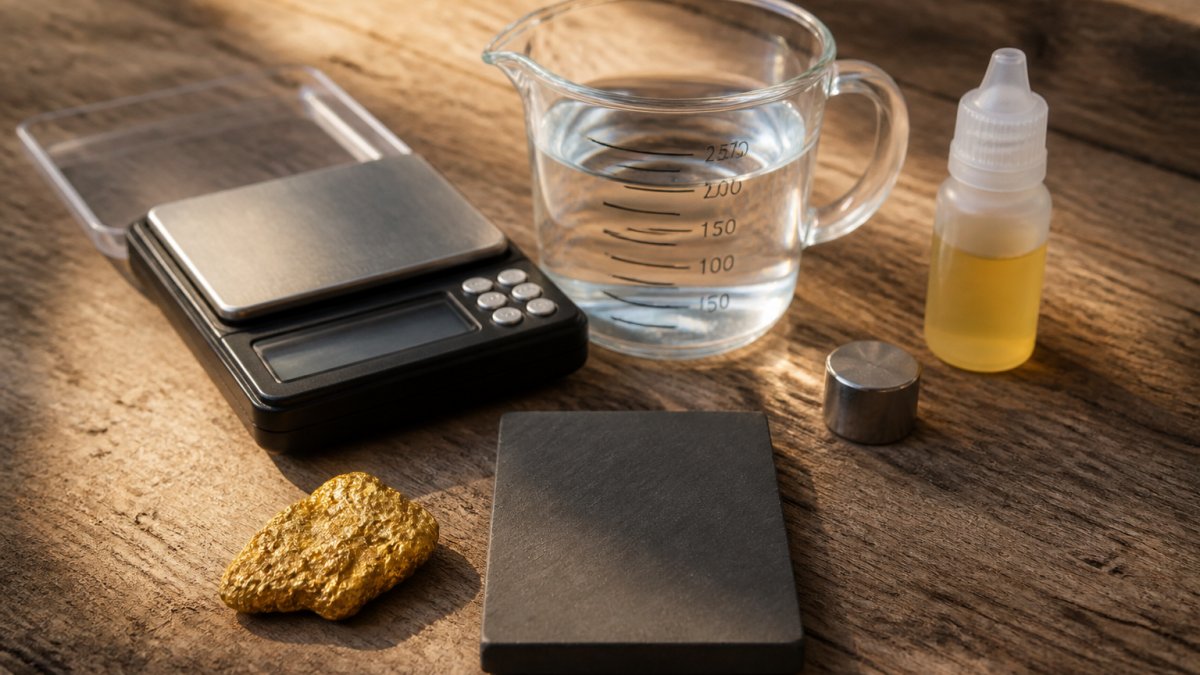
Most of these items cost under £50 combined. If you're serious about collecting natural gold nuggets, this investment pays for itself after one or two purchases where you avoid a mistake.

The Gold Nugget Magnet Test: A Quick First Check
The magnet test is your fastest screening tool. Real gold is non-magnetic. If a nugget sticks to a strong magnet, it contains significant iron or nickel, a red flag for authenticity.
How to perform the magnet test:
- Place the nugget on a smooth, level surface
- Hold the neodymium magnet 5-10cm above the nugget
- Slowly move the magnet closer
- Watch for any movement or attraction
A genuine gold nugget will not move. If the specimen slides toward the magnet or clings to it, the gold purity is questionable or the nugget is a fake.
Important limitations: This test catches obvious fakes but misses subtle problems. Some gold nuggets contain minor iron inclusions from their natural formation. These might show slight magnetic response without being counterfeit. Additionally, plated fakes with a non-magnetic base won't trigger the magnet test at all.
The magnet test works best as a quick elimination step. If the nugget fails (sticks to the magnet), investigate further before committing to a purchase. If it passes, move to the next test.
Water and Float Tests for Initial Screening
Water tests rely on density and weight distribution. Gold is dense, roughly 19 times denser than water. Most common fakes and look-alikes float or behave differently in water.
The float test (quick version):
- Fill a bowl or cup with water
- Gently place the nugget in the water
- Observe whether it sinks or floats
Real gold nuggets sink immediately. Most fakes float or sink slowly. Pyrite sinks but behaves erratically. Lightweight counterfeits made from brass, lead, or plating over light metals float noticeably.

The water displacement test (more reliable):
- Fill a measuring cup with water to a known level (e.g., 50ml)
- Record the starting water level
- Gently submerge the nugget
- Record the new water level
- The difference equals the nugget's volume
This test gives you data for the next step (density calculation). It's non-destructive and works on nuggets of any shape.
Why this matters: Irregular nugget shapes make weight-to-size judgment difficult by eye. A small, dense nugget looks different from a large, less-dense one. Water displacement removes guesswork.
| Test Type | Time Required | Damage Risk | Accuracy | Best Used For |
|---|---|---|---|---|
| Magnet Test | 30 seconds | None | 70% | Quick screening |
| Float Test | 1 minute | None | 65% | Initial filtering |
| Water Displacement | 3 minutes | None | 85% | Preparing for density test |
| Density Calculation | 5 minutes | None | 90% | Confirming authenticity |
Gold Nugget Specific Gravity Test: Measuring Density for Accuracy
The specific gravity test compares your nugget's density to the known density of pure gold. This is one of the most reliable at-home methods and completely non-destructive.
How specific gravity works:
Gold has a specific gravity of approximately 19.3. This means gold is 19.3 times denser than water. If your nugget's specific gravity falls between 18 and 20, it's likely genuine. Lower readings suggest alloys or fakes. Higher readings are nearly impossible without laboratory conditions.
Step-by-step density test:
- Weigh the nugget on your precision scale. Record the weight in grams.
- Fill a measuring cup with water to a known starting level (e.g., 50ml).
- Gently submerge the nugget completely.
- Record the new water level.
- Calculate volume: new level minus starting level equals volume in millilitres.
- Calculate specific gravity: weight in grams divided by volume in millilitres.
Example calculation:
- Nugget weight: 10 grams
- Starting water level: 50ml
- Final water level: 50.5ml
- Volume: 0.5ml
- Specific gravity: 10 ÷ 0.5 = 20
A result of 20 indicates genuine or near-pure gold.
Accuracy considerations: This test works well for smooth, compact nuggets. Irregular shapes with deep cavities can trap air bubbles, skewing results. If your nugget has visible pockets or rough surfaces, repeat the test carefully and average your results.
Natural Australian Gold Nugget - Pilbara Specimen - Lot 63 →
The Gold Nugget Streak Test: Identifying Surface Characteristics
The streak test examines the mark a nugget leaves on an unglazed ceramic surface. Real gold leaves a distinctive gold or yellow-gold streak. Pyrite leaves a greenish-black mark. Other fakes leave different colours.
How to perform the streak test:
- Use an unglazed ceramic plate or testing stone (the back of a ceramic tile works)
- Rub the nugget firmly across the surface at a slight angle
- Examine the mark left behind
- Compare the colour to known gold samples if possible
Real gold leaves a bright yellow or gold-coloured streak. The mark should be consistent along its length. Pyrite leaves a dark greenish streak. Brass leaves a lighter yellow but with a different tone than gold.
Why this test matters for nuggets: Nuggets often have surface oxidation or patina. The streak test cuts through surface discolouration to reveal the true metal underneath.
Limitations: The streak test works best on smooth surfaces. Rough, pitted nuggets may not leave clear marks.
Acid Testing: The Most Reliable Method (With Safety Precautions)
Acid testing is the most definitive at-home method. It directly reacts with gold and reveals purity levels. However, it damages the nugget's surface, so reserve this test for specimens where non-destructive methods are inconclusive.
How acid testing works:
Gold testing acid kits contain solutions of different strengths (10K, 14K, 18K, 22K). Each strength reacts differently to genuine gold of that purity. Real gold produces a specific colour reaction. Fakes and base metals either don't react or react incorrectly.
Safe acid testing procedure:
- Wear rubber gloves and safety glasses throughout
- Work in a well-ventilated area or outdoors
- Place the nugget on a ceramic testing plate
- Apply one drop of the weakest acid (10K) to an inconspicuous area
- Observe the reaction for 15-30 seconds
- Wipe clean with vinegar immediately
- If no reaction, try the next strength (14K)
- Continue until you see a colour change
Real gold produces a specific colour reaction depending on purity. Consult your acid kit's colour chart to interpret results.
Safety precautions (non-negotiable):
- Never touch acid without gloves
- Never inhale fumes
- Always have vinegar nearby to neutralise acid immediately
- Test on an inconspicuous spot first
- Never mix different acids
- Store acid in a cool, dark place away from children and pets
- Dispose of used acid according to local hazardous waste guidelines
This test is worth the caution because it delivers near-certain results. A genuine gold nugget will react consistently with the acid strength matching its purity. Fakes either won't react or will produce incorrect colour changes.
How to Tell Gold from Pyrite and Other Look-Alikes
Pyrite is the most common natural gold imposter. However, several other minerals can resemble gold nuggets, especially to untrained eyes.
Pyrite identification:
Pyrite is iron sulphide. It's metallic and shiny, but it has distinct differences from gold:
- Colour: brassy yellow (slightly different tone than gold)
- Crystal form: often cubic or geometric shapes (gold is amorphous)
- Streak: greenish-black (gold is yellow)
- Hardness: harder than gold (scratches differently)
- Density: lower than gold (approximately 5.0 vs. 19.3)
- Magnetic response: non-magnetic (like gold)
The density test is your best tool for distinguishing pyrite from gold. A pyrite specimen of the same weight as a gold nugget will occupy much more volume.
Other look-alikes:
Chalcopyrite (copper-iron sulphide) appears brassy and metallic but has a lower density and different streak colour (greenish-black). Mica can look shiny but is much lighter and flakes easily.
Quick differentiation checklist:
- Weight-to-size ratio: gold feels surprisingly heavy for its size
- Malleability: gold bends slightly under pressure; pyrite is brittle
- Streak colour: gold leaves yellow; pyrite leaves dark greenish
- Specific gravity: gold is 18-20; pyrite is around 5
When in doubt, run multiple tests. A specimen that passes the density test, magnet test, and streak test is almost certainly genuine gold.
Finding authentic natural gold nuggets requires confidence in what you're examining. The testing methods in this guide give you that confidence without expensive laboratory fees.
When you're ready to acquire authenticated specimens, Gold2u offers natural Australian gold nuggets with verified authenticity. Our collection includes pieces like the 4.407g Natural Gold Nuggets - Premium Australian Specimen and the 8.055g Natural Gold Nugget - The Boss, each selected for genuine character and investment potential.
Frequently Asked Questions
How can you tell if a gold nugget is real?
Real gold nuggets respond predictably to multiple tests. A magnet test shows no attraction (gold is non-magnetic). In water, genuine gold sinks rather than floats. The density test reveals gold's weight: at approximately 19.3 g/cm³, gold is significantly heavier than pyrite or other imitations. Acid testing provides the most reliable confirmation, real gold resists dilute acid, whilst false gold corrodes. Combining three or more tests dramatically reduces false positives and gives you confidence in authenticity.
What household items can I use to test gold nuggets?
You can test gold using items already in your home. A kitchen magnet performs the magnet test. A measuring cup or graduated cylinder filled with water enables the water displacement density test. A ceramic plate or unglazed porcelain tile works as a streak test surface. A precision kitchen scale helps measure weight. However, for conclusive results, purchasing a proper gold testing kit (including testing stone and appropriate acid) is worthwhile.
Can a magnet test tell you if a gold nugget is real?
The magnet test is a useful first screening but not definitive on its own. Real gold is non-magnetic, so a strong magnet should show no attraction. If your nugget is strongly magnetic, it's definitely not pure gold. However, some natural gold nuggets contain small iron mineral inclusions and may show weak magnetism. Additionally, pyrite (fool's gold) is also non-magnetic, so a negative magnet result doesn't prove authenticity. Use the magnet test as your first step, then confirm with density, streak, or acid testing for certainty.
How can you tell natural gold from pyrite?
Pyrite and gold look similar but differ in critical ways. Pyrite is brittle; gold is malleable. When scratched on a ceramic plate, pyrite leaves a greenish-black streak, whilst gold leaves a golden-yellow streak. Pyrite floats in water; gold sinks. Pyrite is much lighter, its density is around 5.0 g/cm³ versus gold's 19.3 g/cm³. Pyrite also forms perfect cubic crystals with sharp edges; natural gold nuggets show rounded, organic shapes. Acid testing confirms the difference: pyrite corrodes in dilute acid; real gold does not. Testing multiple characteristics eliminates confusion.


0 comments