

Table of Contents
- Understanding Gold Purity and Carat Grades
- UK Gold Hallmark Identification Guide
- How to Test Gold at Home Safely
- Distinguishing Solid Gold from Plated and Filled Jewellery
- Grading Condition and Wear in Antique Pieces
- Antique Gold Jewellery Valuation Tips
- A Practical Grading Workflow for Antique Gold Jewellery
- Frequently Asked Questions
Last Updated: October 7, 2026
Understanding Gold Purity and Carat Grades
Gold purity measures how much actual gold is in a piece versus other metals, affecting value and durability. Carat (karat in older texts) is the standard unit: one carat equals 1/24th of pure gold by weight, so 24-carat gold is pure.
Common carat grades in antique jewellery
Antique jewellery rarely comes in 24-carat gold because pure gold is too soft for everyday wear, so jewellers mixed it with other metals.
9-carat gold (9 parts gold, 15 parts other metals) is durable but lower in purity; many British Victorian and Edwardian pieces were made in it.
14-carat gold (14 parts gold, 10 parts other metals) was popular in American and European antique jewellery.
18-carat gold (18 parts gold, 6 parts other metals) is richer in colour and more valuable, often made for wealthy clients.
22-carat gold is rare in antique Western jewellery but appears in Indian and Middle Eastern pieces; softer but prized by collectors.
Converting fineness numbers to carats
Antique gold is often marked with fineness numbers (parts per thousand) instead of carat grades.
- 375 fineness = 9-carat gold (375 parts gold per 1,000)
- 585 fineness = 14-carat gold
- 750 fineness = 18-carat gold
- 916 fineness = 22-carat gold
- 999 fineness = 24-carat gold
To convert fineness to carats, divide by 41.67 (585 ÷ 41.67 = 14 carats), verifying what the hallmark claims.
UK Gold Hallmark Identification Guide
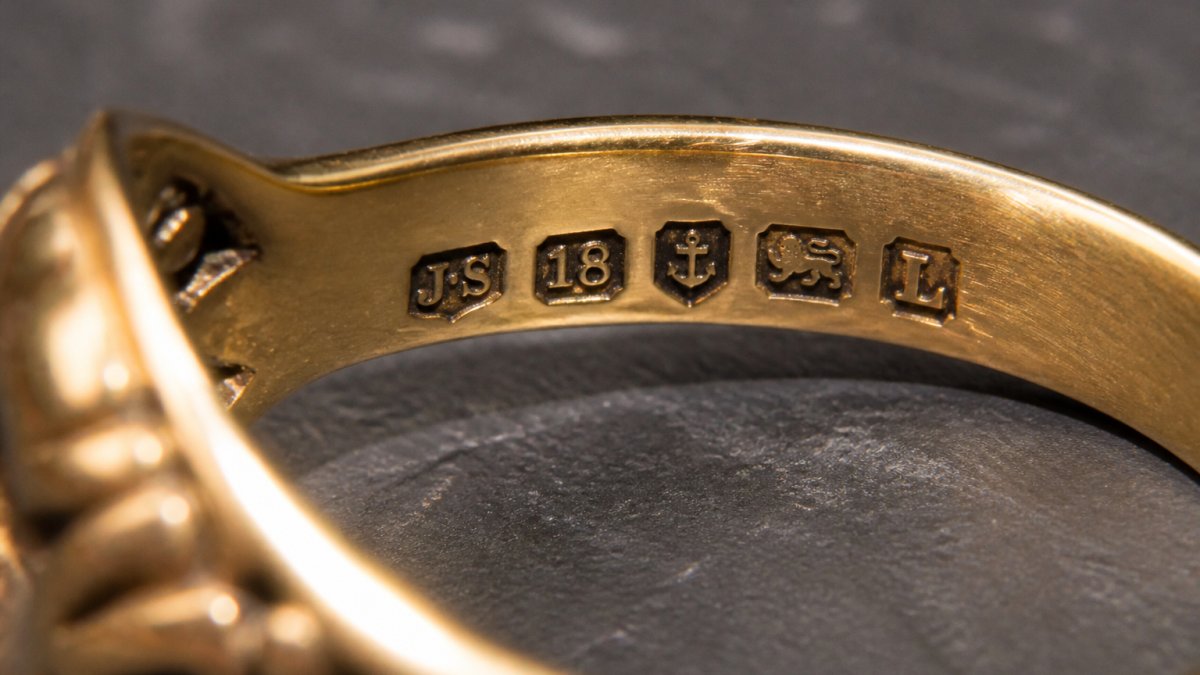
A hallmark is an official stamp proving gold purity. UK hallmarks are legally required above a certain weight, and reading them is essential for grading grade antique gold jewellery. They contain four components: the maker's mark, the assay mark, the fineness mark, and the date letter.
Reading maker's marks and assay marks
The maker's mark shows who made or sold the piece, usually initials inside a shield or cartouche; identifying the maker can date the piece and add value.
The assay mark shows which assay office tested the gold. UK city symbols:
- London: A leopard's head
- Birmingham: An anchor
- Sheffield: A rose
- Edinburgh: A thistle
- Dublin: A harp
The fineness mark shows the purity. On antique pieces, you might see:
- A crown above 375 (for 9-carat)
- A crown above 585 (for 14-carat)
- A crown above 750 (for 18-carat)
The date letter changes annually and pinpoints when the piece was hallmarked. Each assay office used its own letter sequence, so you must know which office marked it.
Antique hallmark exceptions and regional variations
Not all antique gold jewellery has hallmarks: pieces made before hallmarking laws were enforced, or outside the UK, may have no marks, and continental Europe used different systems. French and German pieces use different symbols and assay marks, so research that country's system, many pieces were made in Paris or Geneva and never hallmarked in the UK.
Some very old pieces, especially pre-1500, have maker's marks but no fineness marks, since standardised hallmarking evolved over centuries. A piece with only a maker's mark is likely medieval or very early Tudor.
How to Test Gold at Home Safely
You can test gold at home, but no single test proves purity with certainty, home tests give clues only.
Visual inspection and weight assessment
Real gold doesn't tarnish or discolour like other metals; a dark or patchy surface may indicate plated or filled gold underneath. Weigh the piece on a digital scale accurate to 0.1 grams, gold is dense, so a piece lighter than expected for its size may be hollow or lower in gold than the hallmark claims. Check the hallmark: worn marks suggest age, which is good, but blurry or poorly stamped marks on a claimed antique are a warning sign.
Non-destructive testing methods and their limits
The magnet test is simple but limited: real gold isn't magnetic, so movement toward a magnet means iron or nickel is present.
The acid test is more reliable but requires care: scratch the piece slightly and apply testing acid.
The sound test works for coins and solid pieces: pure gold makes a dull thud when dropped, while lower-carat or plated pieces sound higher-pitched.
None of these tests are perfect: magnets reveal magnetic content, not purity; weight and volume assume a solid piece; acid damages the item.
Distinguishing Solid Gold from Plated and Filled Jewellery
For antique jewellery, this distinction matters enormously: solid gold has intrinsic metal value, while plated pieces have almost none.
UK hallmarks on solid gold show fineness (375, 585, 750).
Examine edges and wear points: on a ring, look inside the band; on a brooch, check the back. A different colour of metal showing through means it's plated.
Plated pieces often feel lighter than solid gold of the same size, not proof alone, but a useful clue.
Antique gold-filled jewellery is more valuable than plated because the gold layer is thicker and wears more slowly, but it's still not solid gold.
Grading Condition and Wear in Antique Pieces
Condition is separate from purity: a 9-carat piece in excellent condition can be worth more than a damaged 18-carat piece.
Assessing wear patterns and structural integrity
Antique jewellery should show signs of age, light scratches and patina are normal, but deep gouges, dents, or thin gold are damage.
Gently wiggle any gemstones: if they move, the setting needs repair, and loose stones are a major devaluation factor.
Check the setting: worn prongs that no longer grip the stone need re-tipping, which costs money.
For rings, check the shank: antique rings often have thin shanks from decades of wear and sizing, and a cracked shank significantly reduces value.
Check clasps, hinges, and moving parts: a broken clasp on a bracelet or necklace makes the piece unwearable.
Victorian-Era Old Cut Diamond Three Stone Ring – 1.75 Carats Total →
How condition affects value beyond metal purity
A piece with original patina and no damage is worth more than a heavily restored one, collectors value authenticity, and heavy restoration hides age and history.
Light cleaning is fine, but heavy polishing that removes patina or engraving detail reduces value. Note any re-plating, re-sizing, or heavy repair in your grading.
Pieces with maker's marks, date letters, and clear provenance are worth more than unmarked pieces of the same purity, documented history, such as a dated receipt, adds value.
Antique Gold Jewellery Valuation Tips
Valuation requires separating metal value, antique value, and condition, a piece might have high metal value but low antique value, or vice versa.
Separating metal value from antique and craftsmanship value
Metal value is straightforward: calculate the pure gold weight (a 5-gram 18-carat ring contains 3.75 grams, or 5 × 0.75) and multiply by the current spot price per gram.
Craftsmanship value reflects work quality: hand-engraved details, fine gemstone setting, and intricate design add value beyond material cost.
We evaluate antique gold jewellery using all three factors: a 9-carat piece with modest metal value but rare Victorian design and excellent provenance could far exceed its scrap value.
Understanding scrap value versus resale and collector value
Scrap value is what a refiner pays for the metal alone if melted down, the floor price, unless the piece is damaged.
Resale value is what a retail buyer pays for the piece as wearable jewellery: a beautiful antique ring in good condition might sell for two to three times scrap value.
Collector value is what a serious collector pays for a rare or historically significant piece, a documented piece by a famous maker, or a rare style, might command five to ten times scrap value.
A Practical Grading Workflow for Antique Gold Jewellery
A step-by-step method to grade an antique piece systematically:
Step-by-step inspection and documentation
Step 3: Assess the metal. Run the magnet test, weigh the piece, check colour and surface finish, and look for plating or filling at wear points.
Step 5: Identify the maker. Research any visible maker's mark in reference books or online databases, a known maker adds value.
Step 6: Calculate metal value. Multiply the pure gold weight by the current spot price for scrap value.
Step 7: Assess antique value. Consider age, style, rarity, and provenance, historical significance, desirable style, and documented history all count.
Step 8: Estimate total value. Combine metal value with antique and craftsmanship premiums, a piece might be worth 1.5x to 10x scrap value.
Worked example with calculations
Let's grade a Victorian ring, Piece A.
Piece A: Victorian Three-Stone Ring

Documentation: yellow gold ring with three small gemstones, 18mm diameter, 2.5mm band width.
Hallmark: clear London leopard's head, 375 fineness mark, date letter "P" (1880).
Maker: maker's mark illegible from wear; no documented maker identified.
Metal value: 3.2 grams × 0.375 (fineness) = 1.2 grams pure gold.
Antique value: Piece is 146 years old with clear London hallmark and date letter. Victorian three-stone rings are desirable.
Craftsmanship: simple Victorian design, well-executed but not exceptional. Estimated premium: 50% above scrap.
Total estimated value: £78 (scrap) + £234 (antique) + £39 (craftsmanship) = approximately £351.
Grading antique gold jewellery becomes easier with practice.
We specialise in authenticated antique gold jewellery with documented provenance. Our pieces, like the Victorian-Era Old Cut Diamond Three Stone Ring, are graded for purity, condition, and craftsmanship.
| Grading Element | What to Check | Why It Matters |
|---|---|---|
| Hallmark | Fineness number, assay mark, date letter | Confirms purity and age |
| Metal test | Magnet response, weight, colour | Identifies solid vs. plated gold |
| Condition | Wear, damage, loose stones, repairs | Affects resale and collector value |
| Maker's mark | Research the maker's identity | Documented makers increase value |
| Scrap value | Weight × purity × spot price | Establishes minimum value |
| Antique premium | Age, rarity, style, provenance | Often exceeds metal value |
Frequently Asked Questions
How do I tell if antique jewellery is real gold?
Check the hallmark first, look for stamps showing carat grade (9ct, 14ct, 18ct, 22ct) or fineness numbers (375, 585, 750, 916). Real gold will not tarnish or discolour when exposed to air or moisture, whereas gold-plated or filled jewellery often shows wear revealing base metal underneath. Weight is another clue: solid gold feels substantially heavier than gold-plated pieces of the same size. For antique pieces, professional testing via X-ray fluorescence (XRF) or acid testing by a qualified jeweller provides definitive confirmation without damaging the piece.
What are the common UK gold hallmarks to look for in antique jewellery?
The UK hallmarking system includes a purity mark (showing carat or fineness), an assay office mark (identifying where it was tested), a maker's mark, and a date letter. Common carat marks are 375 (9ct), 585 (14ct), 750 (18ct), and 916 (22ct). Assay office marks vary by location, London uses a leopard's head, Birmingham uses an anchor, Sheffield uses a crown, and Edinburgh uses a thistle. Antique pieces made before 1975 may lack full hallmarks, so look for partial stamps or maker's initials. Regional variations exist, especially for older pieces, so consult a hallmarking reference guide or jeweller if stamps are unclear or worn.
Can I test gold purity at home without damaging antique jewellery?
Yes, several non-destructive methods work well. Visual inspection of hallmarks is the safest first step. Weight testing using a precision scale can indicate purity if you know the piece's dimensions and material composition. Magnet tests reveal whether the piece contains ferrous metals (which would suggest plating or filling). Colour and patina assessment, genuine gold develops a distinctive warm tone and patina over decades, can support your findings. However, these methods have limits and cannot definitively confirm purity. For valuable antique pieces, professional XRF analysis or testing by a qualified jeweller is worth the cost, as it provides a certificate of authenticity and precise purity reading without any risk to the piece.
How do I calculate the value of antique gold jewellery?
Separate metal value from antique and craftsmanship value. First, determine the gold weight in grams and multiply by the current spot price per gram to find scrap value. However, antique jewellery, especially pieces with historical significance, maker provenance, or exceptional craftsmanship, typically sells for well above melt value. Check auction results and specialist dealer listings for comparable pieces to estimate resale value. Condition, rarity, age, and provenance significantly impact price. A piece worth £500 in scrap gold might fetch £2,000-£5,000 if it's a documented Victorian ring or has strong maker credentials. Obtain a professional appraisal for insurance or sale purposes; reputable jewellers charge £50-£150 and provide detailed documentation supporting their valuation.


0 comments