

Table of Contents
- Understanding What Makes Historical Coins Valuable
- Where to Buy Rare Coins: Comparing Your Options
- Researching Coin Types and Historical Context
- How to Authenticate Ancient Coins and Spot Counterfeits
- Verifying Rare Coin Provenance Before Purchase
- Assessing Condition, Grade, and Historical Coin Valuation
- Building Your Sourcing Workflow: A Practical Process
- Frequently Asked Questions
Last Updated: October 5, 2026
Understanding What Makes Historical Coins Valuable
A historical coin is currency from a past era that holds value beyond its face denomination due to age, rarity, historical significance, or precious metal content.
Rarity matters most: limited-quantity coins command higher prices than common issues.
Historical context shapes desirability too. Coins marking significant events, featuring important rulers, or struck during pivotal moments attract collectors willing to pay premiums.
Condition dramatically affects price: a pristine coin costs far more than a worn example of the same date and mint.
Understanding these value drivers helps you make informed purchasing decisions when building your collection.
Where to Buy Rare Coins: Comparing Your Options
Finding rare historical coins requires knowing where collectors and investors source authentic pieces. Each channel offers different advantages, risks, and price points.

Private dealers and coin specialists
Private dealers are independent specialists or small numismatic firms. They maintain collector relationships and often source coins directly from estates, collections, and other dealers.
Advantages of private dealers:
- Personal expertise and detailed knowledge of specific coins
- Often willing to source hard-to-find pieces on request
- Flexible pricing and negotiation possible
Disadvantages:
- Limited inventory compared to larger operations
- Prices can vary widely between dealers
- Requires building trust before large purchases
When working with private dealers, ask for references, authentication certificates, and clear provenance documentation. Reputable dealers welcome questions about sourcing and history.
Auction houses and specialist sales
Auction houses hold regular rare-coin sales, often grouping similar items for competitive bidding. Specialist firms focus exclusively on numismatics and precious metals.
How auctions work:
- Coins are catalogued with detailed descriptions and estimates
- Buyers compete in real-time or through absentee bidding
- Hammer price plus buyer's premium determines final cost
Key considerations:
- Buyer's premiums add 15-25% to the hammer price
- Estimates can be conservative or aggressive
- Condition reports are detailed but you cannot handle coins beforehand
Auction houses attract serious collectors and investors. Prices often reflect true market value. However, competition drives costs up, and total acquisition cost includes significant premiums.
Online marketplaces and direct listings
Online platforms connect buyers and sellers globally, from general marketplaces to specialist numismatic sites.
Types of online channels:
- Specialist coin dealer websites with curated inventories
- Auction aggregators showing live and ended sales
- Peer-to-peer marketplaces for direct sales
Online advantages:
- Access to vast inventories without geographic limits
- Price comparison across multiple sellers
- Often lower prices than physical shops
Online risks:
- Counterfeits and misrepresented coins are common
- No physical inspection before purchase
- Seller reputation varies widely
When buying online, verify seller credentials, read descriptions carefully, request extra photographs, and confirm authentication guarantees before committing funds.
Researching Coin Types and Historical Context
Before you source rare historical coins, research what you're seeking: the coin's history, mintage figures, and collector demand inform realistic pricing and help identify authentic examples.
Start with reference materials:
- Coin catalogues list dates, mint marks, and estimated values
- Numismatic journals cover recent discoveries and market trends
- Museum collections provide historical context and visual references
Key research questions:
- What years and mint locations produced this coin?
- How many were struck originally?
- How many survive in collectible condition today?
Specialised reference books remain invaluable: catalogues like the Standard Catalogue of World Coins provide comprehensive mintage data and historical notes.
Online databases allow rapid cross-referencing, so compare multiple sources and join collector forums where experienced numismatists share knowledge freely.
How to Authenticate Ancient Coins and Spot Counterfeits
Counterfeits threaten collectors and investors. Spotting fakes requires knowing genuine coin characteristics, production methods, and common deception tactics.
Visual authentication checks:
1917 King George V Full Gold Sovereign – Perth Mint →
- Weight and dimensions should match published specifications exactly
- Metal colour and lustre vary by alloy and age but should be consistent
- Strike characteristics show the unique marks of genuine dies
Red flags for counterfeits:
- Suspiciously perfect condition for an ancient coin
- Weight significantly off from standards
- Dies showing no wear or variation between examples
Professional graders examine coins under magnification with angled light and compare suspected coins against authenticated examples and reference databases.
Reputable sellers provide third-party authentication certificates with detailed photographs, condition assessments, and expert conclusions.
Request authentication before purchase. Legitimate dealers welcome scrutiny. If a seller refuses professional grading or documentation, treat that as a warning sign.
Verifying Rare Coin Provenance Before Purchase
Provenance is the documented ownership history of a coin. Clear provenance establishes authenticity, legal ownership, and often increases value.
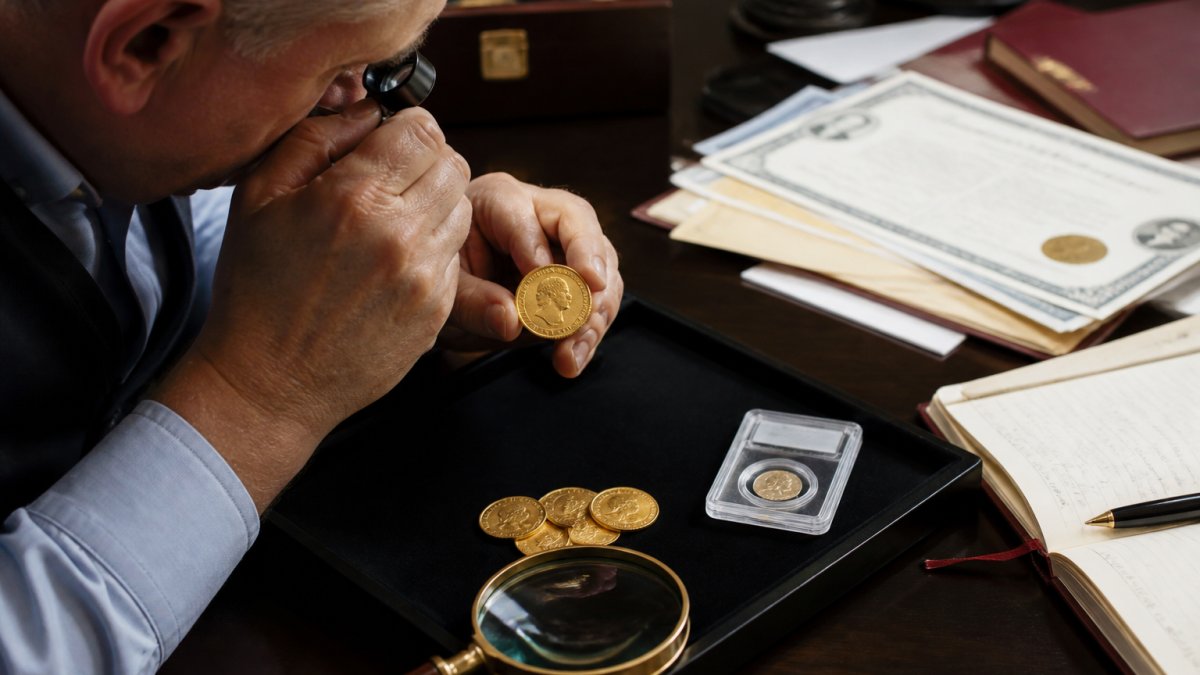
Coins with known histories command premiums over undocumented examples: a coin from a famous collection or with published numismatic references carries credibility that uncertain provenance cannot match.
What counts as good provenance
Strong provenance usually includes at least two of the following:
- A named previous owner or collection, ideally one recorded in numismatic literature
- An auction catalogue entry with a lot number and sale date
- A dealer invoice or receipt showing the chain of sale
A single receipt from an unknown seller is weak. A receipt plus an auction catalogue reference plus a named collection is strong.
The due-diligence checklist
Work through these questions before committing funds, especially for coins above a few hundred pounds or any ancient or foreign-origin coin:
- Who owned it, and can that be shown? Ask for a written ownership history. If the seller cannot provide one, ask why and record the answer.
- Is the coin recorded in any stolen-property or lost-art database? Reputable dealers check national and international stolen-property registers as a matter of routine. Ask whether this has been done.
- Does the coin fall under any export or import restriction? Coins from certain countries and periods require an export licence to leave their country of origin (Exporting or importing objects of cultural interest). Importing them without the correct paperwork can lead to seizure. Ask the seller to confirm the coin can be lawfully exported and imported.
- Is it cultural property? Some countries treat archaeological finds and ancient coins as national cultural property. If the coin was found rather than collected, the find may belong to the state. Ask how and where the coin was discovered and whether any find was reported.
- Is there a clear title? The seller should confirm they have the right to sell and that no third party has a claim. Get this in writing.
- Are the documents consistent? Dates, names, and descriptions should match across receipts, certificates, and catalogue entries. Inconsistencies are a warning sign.
Red flags in provenance claims
- A "collection" that cannot be named or dated
- Documents that look freshly printed for an allegedly old coin
- A price far below market for a supposedly well-provenanced piece
When to bring in an independent expert
For significant purchases, hire an independent expert to verify provenance claims. Verification costs little compared to the risk of acquiring stolen, smuggled, or misrepresented coins. An expert can check databases, read documents critically, and confirm whether the coin matches its stated history.
Gaps in ownership history don't necessarily indicate problems. Coins held privately for decades may lack documentation. However, transparent sellers acknowledge gaps rather than inventing histories.
Assessing Condition, Grade, and Historical Coin Valuation
Coin condition describes the state of preservation. Grading assigns a numerical score reflecting condition.
Grading scales:
- Circulated coins: Poor, Fair, Good, Very Good, Fine, Very Fine, Extremely Fine
- Uncirculated coins: Mint State 60-70, with higher numbers indicating fewer imperfections
A coin graded Mint State 65 costs significantly more than the same coin graded Extremely Fine 45.
Condition factors affecting value:
- Surface marks and scratches reduce appeal
- Lustre and original finish command premiums
- Centring of the design on the blank affects eye appeal
Professional graders use standardised criteria and consistent lighting, providing objective benchmarks for comparison shopping.
Market value reflects recent sales of comparable coins.
For lower-grade coins, condition differences matter less.
Building Your Sourcing Workflow: A Practical Process
Successful sourcing requires a systematic approach, random searching wastes time and money. A structured workflow ensures you find appropriate coins at fair prices and understand the true cost and risk before committing.
Step 1: Define your collecting goals
- Decide what you're seeking (specific dates, types, metals, eras)
- Set a budget for acquisitions, including fees and shipping
- Establish quality standards for condition and authenticity
- Determine how much you'll spend per coin
Step 2: Research thoroughly
- Study reference materials and catalogues
- Examine recent sales and pricing data
- Join collector groups and forums
- Build a wish list of target coins
Step 3: Identify potential sources
- Research private dealers in your area and online
- Monitor auction house catalogues
- Set up alerts on specialist websites
- Connect with other collectors
Step 4: Evaluate offerings, and calculate the true cost
The hammer price or list price is rarely the full cost. Before you bid or buy, work out the total acquisition cost:
- Buyer's premium: auction houses typically add a percentage on top of the hammer price. Confirm the rate before bidding.
- Taxes: VAT may apply to the premium, the hammer price, or both, depending on the sale and the seller's status. Check the auction terms.
- Shipping and insurance: specialist coin shipping is insured and priced accordingly. Ask for a quote before committing.
- Currency conversion: if the seller prices in another currency, your card provider's rate and fees apply.
A coin that looks cheap at auction can end up costing significantly more once these are added. Compare the total cost across channels, not just the headline price.
Step 5: Verify before purchase
- Confirm seller credentials and reputation
- Review return policies and guarantees
- Check authentication certificates
- Understand total cost including shipping and insurance
Step 6: Bid and buy with a strategy
- Set a maximum total cost before bidding, not just a maximum hammer price
- Understand the reserve: if the reserve is not met, the lot may not sell
- Know the post-sale terms: payment deadlines, collection windows, and storage charges
- For private sales, agree inspection and return terms in writing before paying
Step 7: Document your purchase
- Keep all certificates and documentation
- Record provenance information
- Photograph your coins professionally
- Maintain detailed records for insurance and future sales
This systematic approach reduces mistakes and builds a collection with confidence. Taking time at each step prevents expensive errors.
Whether you're adding to an existing collection or starting fresh, having expert guidance simplifies the sourcing process.
| Step | Focus | Key Questions |
|---|---|---|
| Define Goals | Collecting direction | What coins? What budget? What condition? |
| Research | Market knowledge | What are fair prices? What's rare? |
| Identify Sources | Finding coins | Where do dealers source? What auctions? |
| Evaluate | Due diligence and total cost | Is this authentic? Fair priced? What are the fees? |
| Verify | Risk control | Certificates? Return policy? Reputation? Escrow? |
| Bid/Buy | Acquisition strategy | What's my maximum total cost? What are the terms? |
| Document | Record keeping | Provenance? Insurance? Future reference? |
Frequently Asked Questions
How do I verify whether an ancient coin is authentic before buying?
Examine weight, dimensions, and metal composition against known specifications. Check for uneven wear patterns, die characteristics, and patina consistency. Request third-party grading certificates from recognised certifiers. Ask the seller for provenance documentation showing the coin's ownership history. Reputable dealers provide detailed authentication information and offer video viewings so you can inspect coins closely before purchase.
What should I check about rare coin provenance before making a purchase?
Verify the complete ownership chain, including where the coin came from, who held it, and for how long. Request documentation such as auction catalogues, previous sale receipts, or expert appraisals. Check whether the coin has been professionally graded and certified. Confirm the seller's credentials and track record. Legitimate dealers maintain detailed records and can explain the coin's history transparently, which protects your investment.
How can I get a rare historical coin valued accurately?
Consult multiple independent sources: coin catalogues, recent auction results for comparable pieces, and professional appraisers specialising in numismatics. Consider condition, rarity, historical significance, and current market demand. Compare valuations from different dealers to establish a fair range. Professional grading services provide certified valuations. Gold2u offers transparent pricing based on market value.
Where can I find rare historical coins for sale?
Established dealers specialising in rare coins, auction houses holding numismatic sales, and reputable online marketplaces are primary sources. Join collector networks and attend coin fairs to build relationships with specialists. Verify seller credentials, check customer reviews, and confirm authentication guarantees before committing. Gold2u curates a selection of authenticated historical coins.


0 comments