

Table of Contents
- What Provenance Documentation Means for Antique Gold
- Why Provenance Matters: Authenticity, Value, and Legal Protection
- Building a Provenance File: Essential Records and Chain of Custody
- How to Research Antique Jewellery History and Previous Owners
- Antique Gold Hallmarks and Dating: Verification Through Maker's Marks
- Assessing Conflicting or Incomplete Records: Red Flags and Verification
- Creating a Provenance Record Template for Antique Jewellery
- Digital Documentation and Long-Term Record Preservation
- Frequently Asked Questions
Last Updated: October 5, 2026
What Provenance Documentation Means for Antique Gold
Provenance documentation for antique gold is the collection of records that trace a gold object's ownership, origin, and history from creation to the present day, the paper trail of receipts, auction catalogues, photographs, letters, and family records establishing what the piece is, where it came from, and who owned it before you.

This distinction matters. A hallmark proves the gold is real. Provenance documentation for antique gold proves the piece has a story worth protecting.
At Gold2u, we understand collectors and investors want authenticated, traceable objects with documented history. Without provenance, even exceptional antique gold sits in uncertainty; with it, a piece becomes an investment you can defend, sell, or pass forward with confidence.
For serious collectors, provenance documentation is the foundation of authenticity, value, and peace of mind.
Why Provenance Matters: Authenticity, Value, and Legal Protection
Provenance answers three critical questions: Is this piece genuine? Is it worth what I paid? Can I legally own and sell it?
Authenticity first. A gold object with a documented chain of custody is harder to counterfeit or misrepresent.
Value second. Collectors pay premiums for provenance. A Victorian-era gold ring with a bill of sale from 1890 and exhibition catalogue entry commands higher prices than an identical ring with no history.

Legal protection third. Objects stolen during wartime, smuggled across borders, or removed from archaeological sites carry legal risk.
Without documented history, you own a beautiful object. With it, you own an asset.
Building a Provenance File: Essential Records and Chain of Custody
A complete provenance file contains multiple layers of evidence. No single document proves history; overlapping records create a credible narrative.
Chain of custody is the documented sequence of owners: who owned the piece, when, and how it passed to the next owner.
Start by documenting what you have now. If you purchased the piece, keep the receipt, any certificates, and the dealer's letter of authentication. Photograph the object in natural light and close-up detail.
Then work backward. Ask the seller or dealer for their provenance file and how they acquired the piece.
Receipts, invoices, and bills of sale
These are the clearest evidence of ownership transfer: a receipt shows who sold the piece, to whom, when, and for how much.
Original receipts are ideal, often including descriptions that verify the piece's identity. Auction house invoices are especially valuable, tying the object to a specific lot, catalogue entry, and sale date.
Bills of sale, formal or informal, establish ownership transfer.
Keep receipts in acid-free folders. Photograph them. Store originals in a safe place and keep digital copies. If you're buying antique gold, keep the documentation provided with every piece permanently.
Auction catalogues and dealer records
Auction house catalogues are gold-standard provenance documents, with lot numbers, detailed descriptions, estimated values, and sale results. Appearing in a Christie's, Sotheby's, or specialist catalogue is powerful evidence of authenticity and prior ownership.
Dealer records serve a similar function. Reputable dealers keep detailed notes on pieces they sell, including acquisition source, condition, and any known history.
These documents matter because auction houses and dealers have reputations to protect and authenticate pieces before cataloguing them. A piece that passed through a respected house or dealer has survived expert scrutiny.
Photographs, letters, and family documentation
Family letters, diaries, and photographs provide narrative context. A 1950 letter mentioning "grandmother's gold locket" connects the piece to a specific person and time, and photographs of it being worn or displayed add credibility.
Family documentation is less formal than auction records but valuable: it establishes long-term ownership within a family line, and multiple family members mentioning the same piece across letters or photographs strengthens the case.
Collect these materials carefully: photograph originals, note dates, names, and context, and photograph entire letters, context matters.
How to Research Antique Jewellery History and Previous Owners
Researching antique gold history requires patience and systematic detective work.
Start with what's in hand. Read any inscriptions inside the piece, initials, dates, jeweller marks, or hallmarks. These are clues.
Ask the seller for everything they know. How did they acquire the piece? How long did they own it?
Search auction records online. Christie's, Sotheby's, and Bonhams maintain searchable catalogues going back decades.
Document every source with dates, names, and where you found it. A research trail is itself valuable provenance.
Antique Gold Hallmarks and Dating: Verification Through Maker's Marks
Hallmarks are the jeweller's signature stamped into gold. They prove the gold's purity and often identify the maker.
UK hallmarks follow a standardized system. The assay office mark (Birmingham, London, Sheffield, or Edinburgh) identifies where the gold was tested.
3 Carat Old Cut Diamond Ring →
Research the maker's mark. Many UK jewellers have published histories or archive records.
Dating through hallmarks is precise. A ring hallmarked with the 1925 Birmingham date letter was made in 1925.
However, hallmarks prove manufacture date, not ownership history.
Assessing Conflicting or Incomplete Records: Red Flags and Verification
Most antique gold has incomplete provenance.
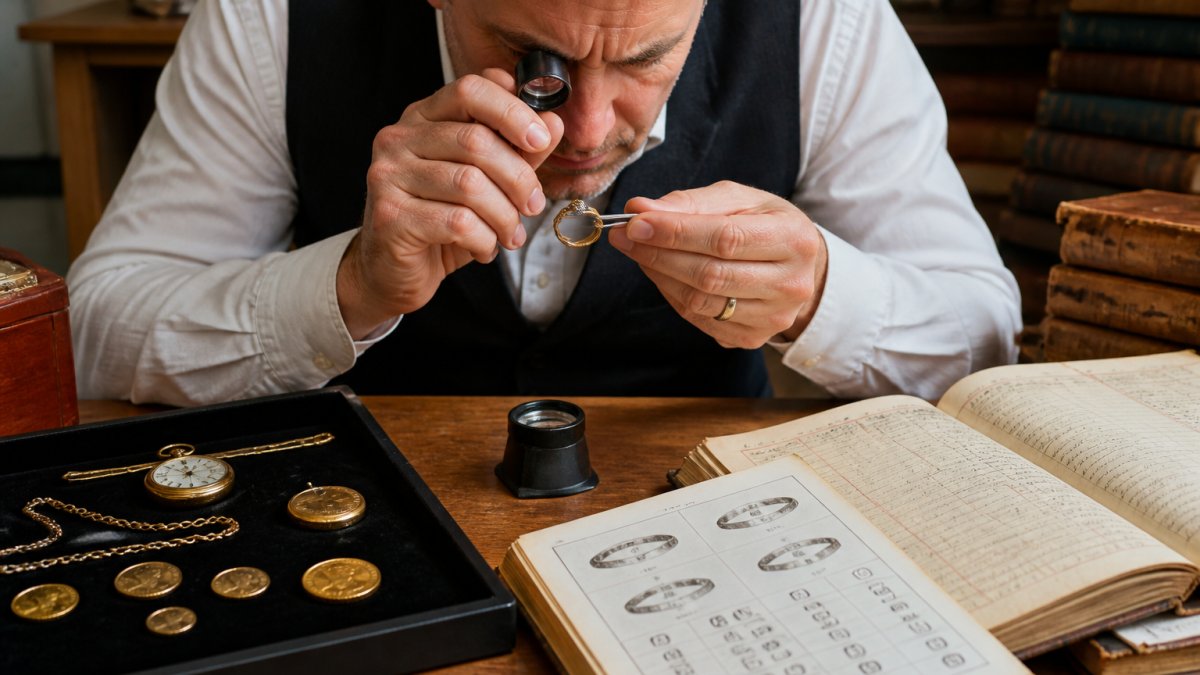
Missing early history is expected. If you can document ownership from 1950 onward but nothing before, that's acceptable for a piece made in 1920.
Gaps in ownership during sensitive periods raise questions. If a piece disappears from documented ownership between 1940-1945, that gap deserves explanation.
Forged or altered documentation is possible. If a bill of sale looks suspiciously new or the handwriting seems inconsistent, be cautious.
When assessing conflicting or incomplete records, ask: Does this make sense? Are gaps explainable? Is the narrative consistent? Do multiple sources corroborate key facts?
Creating a Provenance Record Template for Antique Jewellery
A provenance record template organizes your documentation systematically. It becomes the master file for the piece, everything in one place, clearly labeled.
Create a physical folder (acid-free). Store originals of receipts, certificates, auction catalogues, letters, and photographs.
Create a digital backup. Photograph every document. Scan certificates and receipts at high resolution. Store digital copies in cloud storage with password protection.
Use a standardized template:
| Information | Details |
|---|---|
| Object Description | Metal type, weight, dimensions, distinctive features, condition |
| Hallmarks/Maker's Marks | Exact marks, assay office, date letter, purity mark, maker identification |
| Acquisition Date | When you purchased or acquired the piece |
| Acquisition Source | Dealer name, auction house, private seller, or family |
| Purchase Price | Amount paid (for insurance and valuation purposes) |
| Current Valuation | Professional appraisal date and appraiser name |
| Documented Ownership History | Previous owners with dates of ownership |
| Supporting Documents | List of receipts, certificates, auction catalogues, letters, photographs |
| Authentication | Any professional certificates, GIA reports, or expert assessments |
| Known Alterations | Any repairs, resizing, or modifications with dates |
| Storage Location | Where the piece is kept for insurance purposes |
| Insurance Details | Policy number, coverage amount, insurer |
This template becomes your master reference. Update it as you discover new information or acquire additional documentation.
For pieces, include any detailed documentation provided with each purchase in your provenance file.
Digital Documentation and Long-Term Record Preservation
Physical documents degrade. Paper yellows, ink fades, photographs fade. Digital preservation ensures your provenance file survives decades.
Photograph all physical documents. Use natural light and a high-resolution camera or smartphone.
Scan certificates and auction catalogues. Use a document scanner at 300 DPI minimum.
Store digitally with redundancy. Use cloud storage (Google Drive, OneDrive, Dropbox) as your primary backup.
Preserve original formats. Don't convert old photographs or documents to formats that might become obsolete.
Digital preservation is not optional for serious collectors.
Provenance documentation transforms an antique gold object from a beautiful curiosity into a defensible, valuable asset. At Gold2u, every antique piece, from our Victorian-era old mine cut diamond rings like the 3 Carat Old Cut Diamond Ring to our vintage and antique selections, comes with authentication details that form the foundation of your provenance file.
Frequently Asked Questions
What does provenance mean for antique gold?
Provenance is the documented history of ownership and origin for an antique gold object. It traces the chain of custody from creation through each previous owner to the present day. For antique gold, provenance includes receipts, auction records, family documentation, and maker's marks that establish authenticity and historical context. Strong provenance increases collectability, market value, and buyer confidence. Without it, even genuine pieces carry uncertainty and may command lower prices at auction or sale.
What documents can prove the history of antique gold?
Multiple document types build a credible provenance chain: original purchase receipts and invoices; auction house catalogues and sale records; gallery or dealer labels; photographs showing the piece in historical settings; letters or written accounts from previous owners; family records and wills; appraisals and valuations; certificates of authenticity; and exhibition catalogues. Each document strengthens the chain of custody. Auction records from reputable houses carry particular weight because they document verified sales with dates, seller information, and lot descriptions.
How can you verify the provenance of an antique gold item?
Verification involves cross-checking multiple evidence types. Examine hallmarks and maker's marks to confirm origin and period. Compare documented dates against the piece's style and construction. Contact previous owners or dealers named in records to corroborate their involvement. Verify auction house records through published catalogues or their archives. Assess whether records are contemporaneous (created at time of sale) or retrospective (created later), as contemporaneous records carry more weight. Look for gaps in ownership history and investigate whether they can be reasonably explained. Professional appraisers and gemmologists can authenticate materials and construction.
What are warning signs of unreliable provenance for antique gold?
Red flags include missing documentation for extended periods; vague ownership claims without names, dates, or locations; undated photographs or letters; records that contradict the piece's physical characteristics; handwriting or printing that appears forged or inconsistent; sudden appearance of an item without explanation of where it came from; sellers unwilling to provide documentation; and conflicting narratives about the item's history. Gaps of decades without records, especially in high-value pieces, warrant scepticism. Beware of provenance that relies entirely on oral history or single-source claims. Forged certificates, altered documents, or records from unreliable dealers should trigger professional authentication.
How should you preserve provenance records for long-term storage?
Store original documents in acid-free folders and boxes in a climate-controlled environment away from direct sunlight, moisture, and temperature fluctuations. Create digital scans of all records, receipts, certificates, photographs, and letters, and store copies on multiple devices or cloud services with backup. Photograph the antique gold piece from multiple angles in natural light to document its current condition. Maintain a written inventory listing acquisition date, source, price, condition notes, and any relevant historical information. Consider a safe deposit box for original certificates and high-value documentation. Update your records whenever new information emerges or the piece changes hands.
Do antique gold items need a certificate of authenticity?
A professional certificate adds credibility but is not strictly essential if comprehensive provenance documentation exists. Certificates from recognised bodies (such as AnchorCert for jewellery) verify material composition and can confirm age through testing. However, a certificate alone does not establish ownership history or chain of custody. The strongest approach combines a professional certificate with supporting provenance documents: receipts, auction records, photographs, and family documentation. When purchasing antique gold jewellery, such as the 3 Carat Old Cut Diamond Ring from Gold2u, which includes AnchorCert verification, ensure the seller provides the certificate and any available historical records to build a complete provenance file.
What should a provenance record template include for antique jewellery?
A comprehensive template captures: item description (type, materials, weight, dimensions, distinctive features); acquisition details (date purchased, seller name and contact, purchase price); current valuation and insurance value; maker's marks, hallmarks, and assay marks with interpretation; photographs from multiple angles; ownership chain (all known previous owners with dates and circumstances of transfer); supporting documents (receipts, certificates, auction records, letters); condition notes and any repairs or restoration; historical significance or cultural context; storage and insurance information; and date the record was created and last updated. Organise this in a single document, digital or printed, alongside scanned copies of all supporting evidence. This template becomes your complete provenance file.
Can hallmarks prove where and when antique gold was made?
Hallmarks provide strong evidence of origin and approximate date, though not absolute proof. UK hallmarks indicate the assay office (London, Birmingham, Sheffield, Edinburgh, or Dublin mark), fineness of gold (375, 585, 750, 916, or 990), date letter, and maker's mark. Each assay office used unique symbols and changed date letters annually, allowing precise dating within a year or narrow range. However, hallmarks can be altered, removed, or faked. Professional hallmark guides cross-reference symbols with dates and locations. Combining hallmark evidence with style analysis, construction techniques, and documented provenance creates a reliable authentication chain. Pieces without hallmarks, particularly those predating UK hallmarking law (1300s for silver and gold), require additional documentation and expert assessment.


0 comments