

Table of Contents
- Historical Timeline and Context
- Key Design Characteristics of Victorian Jewellery
- Key Design Characteristics of Edwardian Jewellery
- Materials and Precious Metals
- The Role of Platinum in Edwardian Jewellery
- Identifying Antique Jewellery Hallmarks and Dating Methods
- Victorian vs Edwardian Engagement Rings: What Collectors Should Know
- Investment, Valuation, and Authentication
- Frequently Asked Questions
Last Updated: September 23, 2026
Historical Timeline and Context
Victorian and Edwardian jewellery represent two distinct eras of design, each shaped by its own cultural, technological, and artistic influences. The Victorian era spans roughly 1837 to 1901, named after Queen Victoria, whilst the Edwardian period follows from 1901 to 1910, during the reign of King Edward VII.
Victorian jewellery became increasingly ornate and symbolic, drawing inspiration from archaeological discoveries and nature. The rise of the middle class drove innovation in production techniques. Queen Victoria's preference for dark mourning jewellery after Prince Albert's death in 1861 profoundly influenced the era's aesthetic.
The Edwardian period brought a dramatic shift. Where Victorian design embraced excess and symbolism, Edwardian jewellery pursued elegance and refinement. The introduction of platinum as a viable precious metal transformed what jewellers could achieve. Lighter, more delicate designs became possible. The Belle Époque movement in continental Europe influenced British jewellery makers, resulting in pieces that emphasised graceful lines and intricate, almost ethereal craftsmanship. This era valued precision engineering alongside artisanal hand-work, a balance the Victorians rarely attempted.
Victorian jewellery tells stories through weight, colour, and symbolic motifs. Edwardian jewellery whispers through filigree, millegrain detail, and the play of light through platinum settings. Victorian vs Edwardian jewellery characteristics reveal each era's distinct priorities and possibilities.
Key Design Characteristics of Victorian Jewellery
Victorian design embraced complexity, colour, and narrative. If you're examining a piece and wondering whether it's Victorian, look first for ornate, densely packed designs that seem to celebrate abundance rather than restraint.
The hallmark of Victorian jewellery is its sentimentality. Pieces often carried meaning through symbolic motifs: serpents represented eternity, forget-me-nots symbolised remembrance, and acrostic jewellery, where gemstones spelled hidden messages, became fashionable. Lockets held portraits or locks of hair. Mourning jewellery, typically crafted from jet, onyx, and gold, became mainstream after Prince Albert's death, with intricate black designs dominating the 1860s and 1870s.
Early Victorian pieces (1837-1860) featured scrollwork and hand-engraving creating busy surfaces. Mid-Victorian designs (1860-1880) grew darker with enamel, pearls, and asymmetrical gemstone arrangements. Late Victorian jewellery (1880-1901) incorporated Art Nouveau influences with fluid, nature-inspired forms.
Closed-back settings dominated Victorian jewellery, with metal backings concealing the underside and light entering only from above. This allowed jewellers to colour-enhance stones using foil backings, a common practice affecting gem valuation.
Yellow gold dominated, often combined with silver for contrast. Gemstones ranged widely: diamonds, rubies, sapphires, emeralds, pearls, and semi-precious stones appeared regularly, often mixed in single pieces.
Key Design Characteristics of Edwardian Jewellery
Edwardian jewellery represents a deliberate rejection of Victorian excess. Where Victorians celebrated ornament, Edwardians pursued restraint and precision. The shift wasn't accidental, it reflected changing aesthetic values and, critically, the introduction of platinum.
Edwardian design features delicate openwork with intricate pierced galleries, lace-like filigree, and hand-applied millegrain beading. Platinum's strength made these techniques possible; earlier metals couldn't support such intricate designs without breaking.
Geometric patterns and symmetry characterise Edwardian jewellery, favouring balanced compositions over Victorian asymmetry. Garland styles with swags, laurel wreaths, and ribbon motifs became popular, rendered with mathematical precision.
Edwardian jewellery emphasises the cool brilliance of diamonds and platinum, preferring a monochromatic aesthetic. Sapphires and pearls appear as secondary stones or central engagement ring stones.
Openwork settings replaced closed-back designs, allowing light to pass through and dramatically increasing diamond brilliance. The collet became smaller and more precise, showcasing the diamond rather than framing it.
Hand-engraving and chased metalwork continue in Edwardian pieces with greater delicacy, where every detail serves the design's geometry and light-play.
Materials and Precious Metals
The choice of materials fundamentally distinguishes Victorian from Edwardian jewellery. Examining what metals and gemstones a piece contains tells you not only about its era but also about the jeweller's technical capabilities and aesthetic priorities.
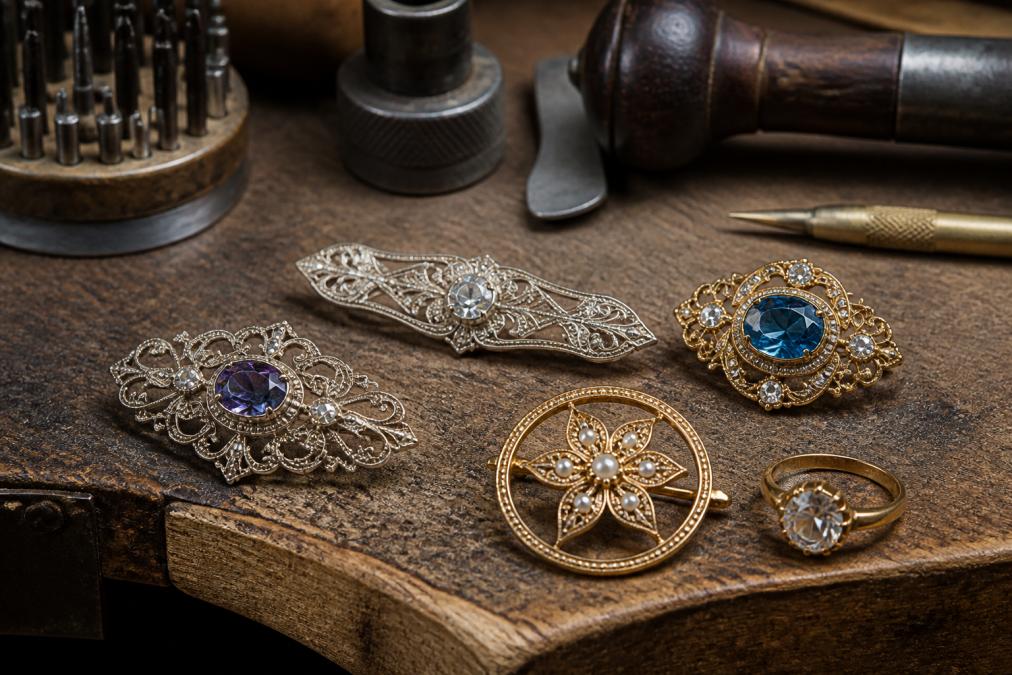
Victorian jewellery relied on yellow gold, sometimes combined with silver or rose gold. Gemstone choices were varied: diamonds, rubies, sapphires, emeralds, garnets, amethysts, and pearls appeared equally, often mixed in single pieces.
Edwardian jewellery introduced platinum as the dominant metal. Its extreme durability, natural white colour, and ability to hold intricate detail made it transformative for jewellers pursuing precision and elegance.
Platinum changed gemstone selection. Diamonds became the stone of choice, prized for their brilliance in transparent settings. Sapphires and pearls appeared as secondary stones or accents.
6.5 Carat Edwardian Platinum Graduated →
Many Edwardian pieces feature a platinum head paired with a yellow gold shank, combining platinum's strength with gold's warmth and comfort.
Understanding material choices is essential when comparing Victorian vs Edwardian jewellery characteristics. A piece set in yellow gold with closed-back settings almost certainly dates to the Victorian era. A piece in platinum with openwork and filigree almost certainly dates to the Edwardian period.
The Role of Platinum in Edwardian Jewellery
Platinum's emergence in the late 19th century fundamentally changed jewellery design. By the early 1900s, improvements in metallurgy made platinum accessible to fine jewellers.
Platinum's strength allowed jewellers to create delicate filigree and millegrain work that would be impossible in gold or silver, as platinum wouldn't bend or break under everyday wear.
Platinum's natural white colour develops a subtle patina over time, unlike white gold which requires replating. It doesn't tarnish or fade.
Platinum's high density meant pieces felt substantial, conveying quality through weight and presence, a tactile luxury central to Edwardian appeal.
For collectors evaluating pieces, platinum presence is a strong indicator of Edwardian dating. Victorian jewellery occasionally incorporates small amounts of platinum, but platinum-dominant pieces are almost exclusively Edwardian. If you're examining a piece and wondering about its era, checking for platinum is one of the most reliable dating methods available.
Identifying Antique Jewellery Hallmarks and Dating Methods
Hallmarks are the jeweller's signature, literally stamped into the metal. Learning to read them is essential for dating pieces accurately and verifying authenticity.
British hallmarks include the maker's mark, fineness mark, assay office mark, and date letter, allowing precise dating and authentication.
Victorian hallmarks: Look for caratage marks (18ct, 15ct, 9ct) and date letters from London, Birmingham, or Sheffield assay offices, allowing precise annual dating.
Edwardian hallmarks: Platinum pieces carry "PLAT" or "PT" marks. Platinum hallmarks suggest Edwardian or later dating. Design style and craftsmanship distinguish Edwardian gold pieces from late Victorian work.
Dating without hallmarks: Design features, materials, and construction techniques provide dating evidence when hallmarks are absent or worn.
Victorian vs Edwardian Engagement Rings: What Collectors Should Know
Engagement rings offer the clearest comparison between Victorian and Edwardian design philosophies. These pieces were made with intention, often representing significant investment, and they survive in relatively large numbers, making them ideal for study.
Investment, Valuation, and Authentication
For collectors considering Victorian vs Edwardian jewellery as investment pieces, understanding valuation and authentication is essential. These are not merely decorative items; they represent tangible assets with real market value.
| Feature | Victorian Jewellery | Edwardian Jewellery |
|---|---|---|
| Primary Metal | Yellow gold | Platinum |
| Setting Style | Closed-back | Openwork |
| Design Aesthetic | Ornate, asymmetrical | Geometric, symmetrical |
| Dominant Motifs | Nature, symbolism, sentiment | Garland, filigree, millegrain |
| Gemstone Choices | Varied (diamonds, rubies, pearls) | Primarily diamonds and sapphires |
| Craftsmanship Focus | Hand-engraving, chasing | Filigree, precision engineering |
| Light Behaviour | Limited brilliance | High brilliance and fire |
| Best For | Collectors valuing narrative and history | Investors seeking rarity and refinement |
Frequently Asked Questions
How can I tell if jewellery is Victorian or Edwardian?
Victorian jewellery (1837-1901) features heavier designs, darker gemstones, and symbolic motifs like mourning jewellery and acrostic pieces. Edwardian pieces (1901-1910) are lighter, more delicate, and favour platinum with openwork filigree and millegrain detailing. Check hallmarks for the era, examine setting techniques, and assess metal weight. Victorian designs often use yellow gold and rose gold; Edwardian predominantly uses platinum.
What are the defining characteristics of Edwardian era jewellery?
Edwardian jewellery is defined by graceful, fluid lines and intricate openwork designs. Platinum became the metal of choice for its strength and malleability, allowing delicate filigree and millegrain borders. Designs feature geometric patterns, garland styles with laurel wreaths and bows. Old European and old mine cut diamonds were favoured for their warm fire. The craftsmanship emphasises hand-engraving and chased metalwork, creating pieces that appear weightless despite their precious metal content.
Did Edwardian jewellery use platinum more than Victorian jewellery?
Yes, platinum became the dominant metal during the Edwardian era (1901-1910), whereas Victorian jewellery primarily used yellow gold and rose gold. Platinum's strength allowed craftsmen to create the delicate, intricate designs characteristic of Edwardian pieces, particularly filigree galleries and thin collets, without sacrificing durability. Victorian jewellery, being heavier and more substantial, relied on gold's malleability and colour. The shift to platinum marks one of the clearest distinctions between the two eras and directly influenced design aesthetics and construction techniques.
What should I look for when identifying antique jewellery hallmarks?
Hallmarks indicate metal purity, maker's mark, and assay office. On Victorian and Edwardian pieces, look for the lion passant (sterling silver), crown symbols for gold fineness, and date letters specific to the assay office. British hallmarks include the maker's initials and town mark. Platinum pieces often carry specific platinum hallmarks. Absence of hallmarks or poorly struck marks may indicate reproduction or forgery. Examine hallmarks under magnification; authentic antique hallmarks show wear patterns consistent with age. Professional gemmologists can verify authenticity through hallmark analysis combined with construction technique and metal composition testing.
Are Victorian and Edwardian pieces good investments?
Both eras offer strong investment potential, but for different reasons. Victorian jewellery appeals to collectors seeking historical narrative and symbolic meaning, particularly mourning jewellery and sentimental pieces. Edwardian pieces, especially those with substantial platinum content and quality old mine cut diamonds, hold steady value due to rarity and craftsmanship. Authentic pieces with verified hallmarks and provenance appreciate over time. Condition, carat weight, and historical significance affect valuation. Pieces from established makers or with documented provenance command premium prices. Liquidity is generally strong for authenticated, well-documented pieces from reputable dealers.


0 comments