

Table of Contents
- Antique Diamond Jewellery vs Lab-Grown Diamonds: Key Differences at a Glance
- How Diamond Formation Sets Antique and Modern Stones Apart
- Old Mine Cut Diamond vs Modern Brilliant Cut: The Visual Difference
- Price and Value: Antique Diamonds Against Lab-Grown Alternatives
- How to Identify an Antique Diamond: Provenance and Certification
- Ethical Sourcing and Environmental Impact
- Antique Diamond Ring Care and Long-Term Ownership
- Which Choice Is Right for Your Engagement Ring?
- Frequently Asked Questions
Last Updated: October 12, 2026
Antique Diamond Jewellery vs Lab-Grown Diamonds: Key Differences at a Glance
When comparing antique diamond jewellery vs lab-grown diamonds for an engagement ring, the choice involves far more than price. The choice shapes what you're buying: a piece of history or a laboratory creation optimised for visual uniformity.
The two stones are chemically identical but optically, emotionally, and financially distinct. Antique diamonds carry over a century of wear and character; lab-grown diamonds offer predictable quality and lower environmental impact. Neither is objectively "better", but one will suit your values, budget, and vision better.
Below, we cover how each forms, how they look, what they cost, and how to identify authentic antique diamonds.
Quick Comparison Table
| Factor | Antique Diamond Jewellery | Lab-Grown Diamonds |
|---|---|---|
| Formation Time | 1-3 billion years underground | 2-4 weeks in a lab |
| Cut Style | Old Mine, Old European, cushion | Modern brilliant, emerald, oval |
| Light Performance | Warm fire, soft flashes, candlelit glow | Sharp brilliance, consistent sparkle |
| Price (per carat) | £3,500-£60,000+ | £1,000-£5,000 |
| Resale Value | High (rarity premium) | Declining (market saturation) |
| Provenance | Documented, traceable history | Laboratory certified, no history |
| Environmental Impact | Zero (already mined) | Low (no mining, energy-intensive lab) |
| Rarity | Extremely rare (original cuts) | Mass-producible |
| Durability | Identical to natural diamonds | Identical to natural diamonds |
| Best For | Collectors, heirloom seekers, investors | Budget-conscious couples, ethical concerns |
How Diamond Formation Sets Antique and Modern Stones Apart
A diamond's origin determines its character, availability, and long-term value.
Natural diamond formation over billions of years
An antique diamond began forming 1 to 3 billion years ago, deep beneath the Earth's surface. Carbon atoms crystallised under extreme pressure and temperature, building the lattice structure we see today.
This history shapes the stone's optical personality. Natural diamonds often contain trace elements and structural quirks, nitrogen inclusions, growth patterns, subtle colour variations, that give them character. A gemologist can read these signatures like fingerprints, confirming authenticity and age.
For an antique engagement ring, you're wearing something that survived planetary forces for billions of years before humans cut it.
Lab-grown diamond creation in weeks
A lab-grown diamond forms in a controlled environment over 2 to 4 weeks using High Pressure High Temperature (HPHT) or Chemical Vapour Deposition (CVD). Both recreate the conditions that form natural diamonds, but in a factory setting.
The result is chemically and optically identical to a mined diamond; a gemological report cannot distinguish them by composition alone.
Lab-grown diamonds offer consistency: manufacturers control colour, clarity, and cut to near-perfect standards. There are no geological quirks, which is precisely why some buyers love them and others find them sterile.
Old Mine Cut Diamond vs Modern Brilliant Cut: The Visual Difference
A diamond's cut determines how it catches light. Antique and modern cuts were designed for different lighting conditions and aesthetic priorities.
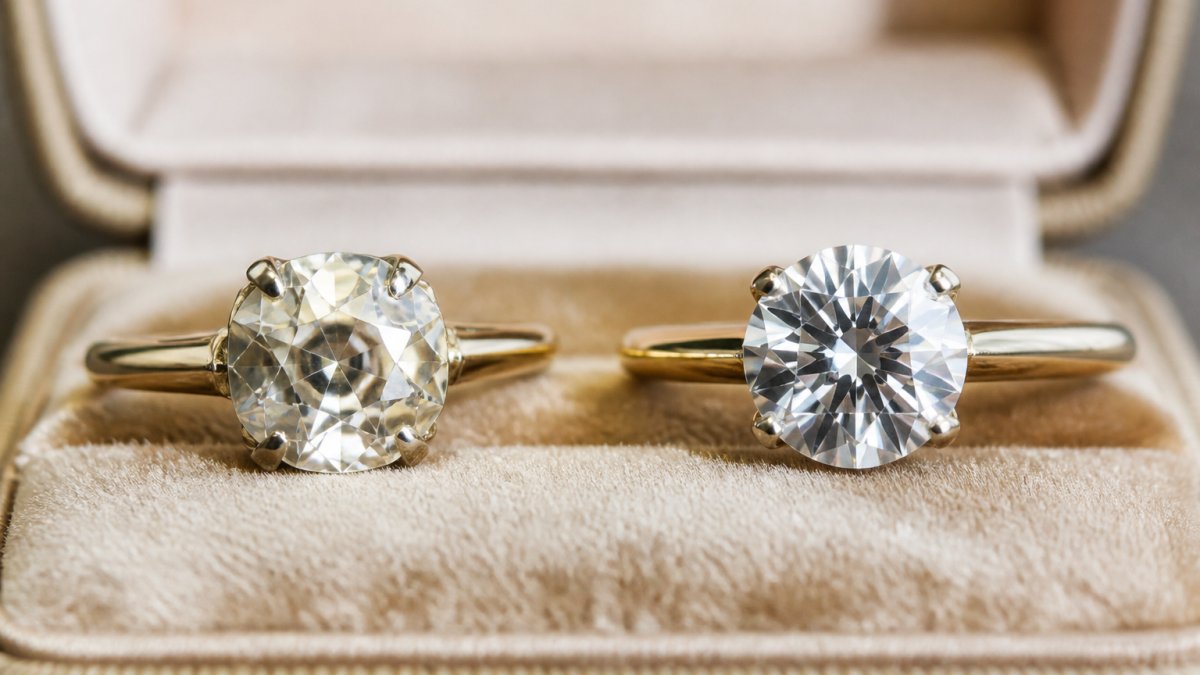
Faceting patterns and light performance
An old mine cut diamond was hand-cut by artisans working by candlelight, who prioritised fire, those dramatic flashes of rainbow colour, over uniform brilliance.
The result is distinctive: broad flashes of rainbow fire, soft glowing reflections, and a warm candlelit sparkle.
A modern brilliant cut was engineered with mathematical precision to maximise light return, aiming for brightness and scintillation, the rapid flashing of light as the stone moves.
Under electric light, a modern brilliant cut appears brighter and more uniformly sparkly, engineered for showroom conditions, with less colour flash and more white light return.
Fire, brilliance, and personal preference
"Fire" and "brilliance" are different optical properties: fire is rainbow colour dispersion, brilliance is white light return. Old cuts prioritise fire; modern cuts prioritise brilliance.
Which is "better" is purely personal preference. Collectors seek old mine cuts for their romantic, candlelit glow; couples wanting maximum sparkle under electric light prefer modern cuts. Neither is objectively superior.
In a showroom under bright electric lights, an antique diamond ring may appear darker than a modern diamond beside it.
Price and Value: Antique Diamonds Against Lab-Grown Alternatives
Cost per carat and long-term investment potential are where the two paths diverge most.
Lab-grown diamonds cost significantly less upfront. An equivalent antique old mine cut diamond can cost more, depending on provenance, cut quality, and rarity.

The price gap reflects scarcity.
Resale value tells a different story.
If you view your engagement ring as an heirloom investment to pass down or sell in decades, antique diamond jewellery makes financial sense.
Gold2u's Victorian-Era Old Cut Diamond Three Stone Ring is priced at £3,500. For those seeking a statement piece, the 3 Carat Old Cut Diamond Ring is available at £25,000.

How to Identify an Antique Diamond: Provenance and Certification
Buying an antique diamond requires confidence in authenticity. Provenance and certification are your safeguards.
Gemological reports and diamond grading
A gemological report from an accredited laboratory documents the diamond's carat weight, colour, clarity, cut, and whether it's natural or lab-grown.
The report should include a laser inscription on the diamond itself, a microscopic identifier linking the stone to its certificate and preventing switching and fraud.
For antique diamonds, the report confirms age and authenticity.
When purchasing antique diamond jewellery, always request the gemological report; if the seller cannot provide one, ask why. Reputable dealers provide certification for significant pieces.
Provenance documentation and authentication
Provenance is the documented history of ownership. For truly rare antique diamonds, provenance can trace the stone back decades or even a century.
Victorian-Era Old Cut Diamond Three Stone Ring – 1.75 Carats Total →
Provenance adds value and confidence. A diamond with documented history commands a premium because its authenticity is independently verified; one with no provenance is harder to value and carries more risk.
When evaluating antique diamond rings, ask for documentation of previous ownership, auction house records, or estate history. Reputable dealers maintain detailed records and can explain how they acquired each piece.
Ethical Sourcing and Environmental Impact
Both antique and lab-grown diamonds claim ethical advantages. Understanding the real differences matters.
Conflict diamonds and mining concerns
Antique diamonds were mined decades or centuries ago, long before modern conflict diamond regulations. A stone purchased today is ethically "clean" because it's already been extracted, so no new mining is required.
Lab-grown diamonds avoid mining entirely, eliminating concerns about mining-related labour practices and land disruption, which is why they're marketed as "ethical".
However, lab-grown diamonds require significant energy input. The HPHT and CVD processes consume substantial electricity, typically from conventional grids, so in fossil fuel-heavy regions their carbon footprint can be substantial.
Carbon footprint and sustainability claims
An antique diamond has zero current environmental impact: it's already mined and already cut, and the mining impact occurred decades ago.
A lab-grown diamond's environmental footprint depends on the energy source used in production: labs powered by renewable energy produce a lower carbon footprint than those on fossil fuels.
For environmentally conscious buyers, antique diamond jewellery requires no new resource extraction or energy consumption.
Neither option is perfect. The real difference is where your ethical priority lies: avoiding current mining impacts (favours lab-grown) or avoiding new resource extraction (favours antique).
Antique Diamond Ring Care and Long-Term Ownership
An antique diamond is durable, but its setting and condition require attention.
Cleaning, maintenance, and restoration
An antique diamond itself is as hard as any modern diamond, a 10 on the Mohs hardness scale. It won't scratch or degrade with normal wear.
Victorian and Edwardian settings often use delicate metalwork, thin bands, or antique prongs that weaken over time, so a ring worn for 80 years may need professional restoration before daily wear.
Cleaning is straightforward: warm soapy water and a soft brush remove dirt without damaging the stone or setting.
Have your antique ring inspected every 2-3 years by a jeweller experienced in vintage pieces, who can tighten prongs, reinforce the band, and catch problems early.
Durability and setting compatibility
An antique diamond is as durable as any natural diamond; the real question is the setting. A 100-year-old gold band may be thinner or more brittle than modern gold, and old prongs may not hold the stone as securely.
If you plan to wear your antique ring daily, consider professional restoration first. A jeweller can reinforce the prongs, strengthen the band, or create a protective setting around the original, preserving the ring's character while securing the stone.
For heirloom rings worn occasionally or displayed, restoration may be unnecessary; for engagement rings worn daily, it's often essential.
Which Choice Is Right for Your Engagement Ring?
The decision between antique diamond jewellery and lab-grown diamonds comes down to five factors: rarity, budget, values, aesthetics, and investment intent.
Choose antique diamond jewellery if:
- You value rarity and uniqueness above all else
- You want a piece with documented history and provenance
- You see the ring as a long-term investment or heirloom
- You prefer the warm, candlelit glow of old mine cuts
- You're willing to invest more upfront for a stone that will likely appreciate
- You prioritise avoiding new mining and resource extraction
Choose lab-grown diamonds if:
- Your budget is constrained and you want maximum carat weight
- You prefer the engineered consistency and sparkle of modern cuts
- You're concerned about mining practices in developing nations
- You want the ring as a personal symbol, not an investment
- You prefer the bright, uniform brilliance of modern brilliant cuts
- You value the lower current environmental footprint of lab production
There's no universally "right" choice; the right one aligns with your values, aesthetic preferences, and financial priorities. An antique old mine cut diamond from Gold2u carries history and rarity, while a lab-grown diamond offers affordability, consistency, and ethical peace of mind.
The real mistake is choosing without understanding the differences.
Choosing an engagement ring is deeply personal. Whether you're drawn to the romantic character of antique diamond jewellery or the ethical clarity of lab-grown stones, Gold2u offers authentic antique old mine cut diamond rings with certified provenance and professional documentation. Explore our selection of antique engagement rings.

Frequently Asked Questions
Can a jeweller tell the difference between an antique diamond and a lab-grown diamond?
Yes. Jewellers and gemologists use specialised equipment like diamond testers and spectroscopy to identify lab-grown diamonds, which contain nitrogen impurities or other trace elements absent in natural stones. Antique diamonds, whether mined decades or centuries ago, show characteristic wear patterns, faceting styles, and optical properties unique to their era. A gemological report from a certified lab provides definitive proof of origin and authenticity.
Why are antique diamonds more expensive than lab-grown stones of the same carat weight?
Antique diamonds command higher prices due to rarity, provenance, and investment value. Natural diamonds formed billions of years ago cannot be replicated; each antique stone carries historical significance and craftsmanship. Lab-grown diamonds, produced in weeks, are chemically identical to mined diamonds but lack scarcity and emotional resonance. Antique pieces like the 3 Carat Old Cut Diamond Ring (£25,000) reflect not just carat weight, but irreplaceable heritage and collector demand.
Are old mine cut diamonds less sparkly than modern brilliant cuts?
Old mine cuts prioritise fire and warmth over uniform sparkle. Their deeper pavilions and higher crowns create larger, slower flashes of rainbow light, ideal for candlelit settings. Modern brilliant cuts maximise brightness and rapid sparkle for daylight visibility. Neither is objectively 'better'; preference depends on aesthetic taste. Collectors seeking romantic, distinctive character favour old cuts, whilst those wanting maximum brilliance choose modern cuts.
How do I know if an antique diamond ring is a good investment?
Verify authenticity through a gemological report from a reputable lab (such as AnchorCert or IGI). Check provenance documentation and condition. Antique diamonds retain value better than lab-grown alternatives because scarcity increases over time. Factors like carat weight, colour, clarity, and cut quality determine resale potential. Rings with documented history, such as the Victorian-Era Old Cut Diamond Three Stone Ring, appeal to collectors and typically appreciate steadily.
Can an antique diamond be reset into a modern engagement ring setting?
Yes, antique diamonds can be reset, but care is essential. Older stones may be more fragile due to age and original cutting techniques. A skilled jeweller experienced with antique diamonds assesses the stone's condition, structural integrity, and any existing damage before resetting. Resetting preserves the diamond's history whilst updating its appearance. This approach combines the rarity and character of an antique stone with contemporary design preferences.


0 comments