

Table of Contents
- Why Antique Diamonds Look Different: Cut Geometry, Not Age
- Old Mine Cut vs Modern Cut Diamond: Key Proportion Differences
- Old European Cut vs Old Mine Cut: Understanding the Distinction
- Old Mine Cut Diamond Sparkle: Fire Over Brilliance
- How to Identify an Antique Diamond: Separating Cut from Condition
- History and Evolution of Diamond Cutting
- Buying Antique Diamonds: What Collectors Need to Know
- Frequently Asked Questions
Last Updated: October 20, 2026
Why Antique Diamonds Look Different: Cut Geometry, Not Age
The difference between an antique diamond and a modern one isn't age, it's cut.
An antique diamond looks different because of its proportions and facet arrangement, not because time has changed its optical properties. A 100-year-old diamond cut with Old Mine or Old European techniques will always display those cuts' characteristics: a smaller table, taller crown, deeper pavilion, and larger facets than a modern round brilliant.
At Gold2u, we specialise in antique old mine cut diamond jewellery, and this distinction explains why collectors actively seek these stones. Light behaves measurably differently inside an old-cut diamond, producing the softer, warmer glow and larger flashes of fire that define genuine antique diamonds.

Cut defines the look, not the era
The visual character of an antique diamond is entirely determined by its cutting style. Old Mine Cuts and Old European Cuts were hand-cut to different proportions than modern brilliants, and those proportions remain constant regardless of age.
What changed was cutting technology and philosophy. Early cutters prioritised fire and candlelit glow over uniform sparkle, working by eye with hand tools, so each stone received a unique interpretation of the cutting style.
Age and cut are separate variables. What you see under magnification is the result of intentional geometric choices made during cutting, not the passage of time.
How hand-cutting created variation
Hand-cutting introduced natural asymmetry that modern precision cutting has largely eliminated. When a craftsman cut diamonds by eye in the 19th century, no two stones emerged identical, even when attempting the same proportions.
This variation is a hallmark of authenticity. Modern diamonds are cut to strict tolerances, whilst antique stones show imperfect execution: facets that don't align perfectly, tables that vary slightly, crowns at slightly different angles.
These variations affect how light moves through the stone, creating the distinctive kozibe reflections (soft, rolling flashes) of genuine old cuts. The asymmetry is not a flaw but evidence of human craftsmanship.
Old Mine Cut vs Modern Cut Diamond: Key Proportion Differences
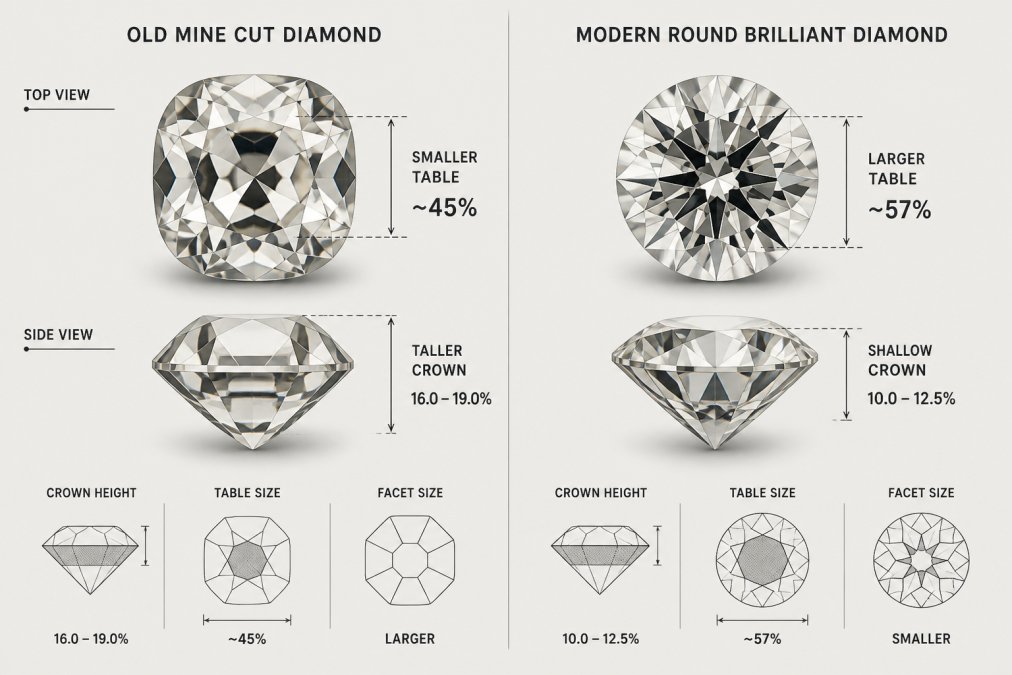
An Old Mine Cut diamond and a modern round brilliant differ fundamentally in their proportions, which are directly responsible for their different optical behaviour.
Crown height and table size
The crown is the upper portion above the girdle. Old Mine Cuts typically feature crowns measuring 16-20% of the diamond's diameter, whilst modern rounds average 12-14%, a taller crown immediately visible when comparing the two styles.
The table, the largest facet on top, follows the inverse pattern. Old Mine Cuts have tables measuring 50-65% of the stone's diameter, whilst modern brilliants range from 53-57%, so an Old Mine Cut appears to have a smaller, more defined top facet.
These proportional differences directly affect light return: the taller crown and smaller table refract light at different angles, producing the characteristic soft glow and larger coloured flashes (fire) rather than rapid white sparkle.
Facet size and light performance
Old Mine Cuts feature noticeably larger facets than modern round brilliants. Their crown facets are chunky and visible to the naked eye, whilst modern brilliants employ 58 facets arranged to maximise light return.
Larger facets mean fewer of them, creating larger, more distinct light reflections, the "flashes" of fire collectors describe. Modern diamonds produce more numerous, smaller reflections that blend into consistent sparkle.
The light performance difference is dramatic across lighting conditions. A modern brilliant maximises sparkle under bright light, whilst an Old Mine Cut performs better under softer, directional light, candlelight or the warm glow of traditional interiors.
Culet visibility and depth
The culet is the small facet at the bottom of the diamond. Modern round brilliants typically have a very small or pointed culet, whilst Old Mine Cuts feature a clearly visible culet, sometimes large enough to see through the stone.
The culet's size affects the diamond's depth percentage (table to culet, as a percentage of diameter). Old Mine Cuts typically measure 70-80% in depth, compared to 59-62% for modern rounds, a deeper profile that contributes to their distinctive appearance and light behaviour.
A visible culet also lets light leak through the bottom of the stone rather than reflecting back to the viewer's eye, contributing to the softer, less intense sparkle of old cuts.
Old European Cut vs Old Mine Cut: Understanding the Distinction
Both Old European and Old Mine Cuts are hand-cut antique styles, but they represent an evolution in cutting technique and proportions.
Shape and facet arrangement
Old Mine Cuts typically feature a cushion shape, rounded corners with a slightly squared outline from above. Old European Cuts are rounder, approaching the modern round brilliant shape.
Both styles have 58 facets, but Old European Cuts arrange their crown facets in a more circular pattern, reflecting the rounder overall shape.
These geometric differences reflect the evolution of cutting technique. Old Mine Cuts, predominantly from the 18th and 19th centuries, represent an earlier approach. Old European Cuts, more common from the late 19th century onwards, show refinement toward the modern brilliant: more precision, rounder proportions, better consistency.
Light reflection patterns
The rounder shape of Old European Cuts produces slightly different light reflection patterns. The cushion shape of an Old Mine Cut creates more directional light flashes, whilst the rounder Old European Cut distributes light more evenly.
Both styles still produce the characteristic soft glow and larger flashes of fire compared to modern brilliants, but Old European Cuts sparkle more uniformly, whilst an Old Mine Cut's fire is more dramatic and directional.
For collectors, Old European Cuts sit between Old Mine Cuts and modern brilliants in light performance, retaining the romantic, candlelit character of old cuts whilst offering slightly more brilliance.
Old Mine Cut Diamond Sparkle: Fire Over Brilliance
The sparkle of an Old Mine Cut diamond is fundamentally different from a modern stone, and understanding why requires distinguishing two optical properties: brilliance and fire.
Why old cuts produce larger flashes
Brilliance is the total amount of light reflected back to the viewer's eye, how bright the diamond appears. Fire is the separation of white light into colour components, creating rainbow flashes. Modern cuts prioritise brilliance; old cuts emphasise fire.
Victorian-Era Old Cut Diamond Three Stone Ring – 1.75 Carats Total →
The larger facets in Old Mine Cuts create larger, more distinct light reflections.
This is not a flaw but a deliberate design choice. Early cutters knew candlelight, their era's primary light source, would be scattered and diffused through an interior.
The role of lighting conditions
Lighting conditions dramatically alter how an Old Mine Cut diamond appears.
Under softer, directional light, a table lamp, window light, or candlelight, the same stone transforms. The large facets catch and reflect light in dramatic, slow-moving flashes.
This lighting dependency is crucial when evaluating an antique diamond. A stone that appears dull under showroom lights may display stunning fire where it will actually be worn, so specialists often photograph or display antique stones under appropriate lighting to show their true character.
How to Identify an Antique Diamond: Separating Cut from Condition
Identifying whether a diamond is genuinely an old cut requires distinguishing characteristics caused by cutting style from those caused by age, wear, or clarity issues. Many people mistake cloudiness, inclusions, or surface wear for evidence of age, but these are separate variables.
Proportion measurements that matter
The most reliable way to identify an Old Mine or Old European Cut is proportion measurement. A qualified gemmologist can measure table percentage, crown angle, pavilion depth, and culet size, the geometric characteristics that define each cutting style.
Old Mine Cuts consistently show:
- Table percentage: 50-65%
- Crown height: 16-20% of diameter
- Pavilion depth: 43-50%
- Culet: clearly visible, often 1-2mm across
Old European Cuts show:
- Table percentage: 53-62%
- Crown height: 14-16% of diameter
- Pavilion depth: 40-45%
- Culet: visible but smaller than Old Mine Cuts
Modern round brilliants show:
- Table percentage: 53-57%
- Crown height: 12-14% of diameter
- Pavilion depth: 42-43%
- Culet: pointed or very small
These measurements are objective and repeatable. They don't change with age or condition, they reflect the original cutting choices made during fabrication.
Distinguishing cut style from cloudiness and wear
Cloudiness, haziness, or a milky appearance is often misattributed to age. It usually results from heavy surface wear, internal fractures, or high fluorescence (a property that makes some diamonds glow under ultraviolet light).
Similarly, inclusions, internal particles or fractures visible under magnification, are not caused by age. They were present when the diamond formed, millions of years ago.
A genuine Old Mine Cut may have inclusions, surface scratches, or wear marks consistent with age and use, but its fundamental optical properties remain unchanged.
History and Evolution of Diamond Cutting
Diamond cutting has evolved dramatically over centuries, driven by technology, light physics, and aesthetic preferences. Antique cuts represent specific points in this evolution, and understanding the history helps explain why they look different.
The earliest diamond cuts, from the 15th and 16th centuries, were crude by modern standards, often the natural crystal shape with minimal modification.
The Old European Cut developed in the late 19th century as cutters experimented with rounder shapes and more consistent proportions.
Understanding this progression helps explain why antique diamonds look different: they were designed to look different, cut to serve the lighting conditions, aesthetic preferences, and technological capabilities of their time.
Buying Antique Diamonds: What Collectors Need to Know
Purchasing an antique diamond requires different considerations than buying a modern stone.
Assess the diamond's condition under appropriate lighting. View it under soft, directional light to evaluate its fire and glow.
Consider the setting as part of the package. At Gold2u, our antique old mine cut diamond jewellery pairs these distinctive stones with period-appropriate metalwork.
For serious collectors, authentication matters. Reputable dealers provide documentation of the diamond's characteristics, often including gemmological assessment, protecting your investment and ensuring you understand exactly what you're purchasing.
Antique diamonds command premium prices not because they're old, but because their distinctive optical character, the soft glow, the dramatic fire, the hand-cut variation, cannot be replicated by modern cutting techniques.
Frequently Asked Questions
Why do antique diamonds look different from modern diamonds?
Antique diamonds look different because they were hand-cut with higher crowns, smaller tables, and larger facets than modern brilliant cuts. These proportions create softer, broader flashes of rainbow fire rather than sharp white sparkle. The hand-cutting process also introduced asymmetry and variation between stones. Additionally, antique diamonds were designed to perform under candlelight, producing a warm glow that modern cuts, engineered for daylight and showroom lighting, do not replicate.
How can you tell if a diamond is antique?
Identify antique diamonds by examining their proportions: a crown height of 16-20%, a small table (under 53%), and a visible culet (the small flat facet at the bottom). Hand-cut asymmetry is also a hallmark, no two facets are perfectly identical. Look for chunky facets arranged in specific patterns typical of old mine or old European cuts. Cloudiness, fluorescence, or surface wear indicate age, but these are separate from cut style. Professional grading reports and documentation from reputable dealers provide certainty about authenticity and provenance.
What is the difference between an old mine cut and an old European cut diamond?
Old Mine Cuts (pre-1900) have a more cushion-like shape, higher crowns (often 18-20%), smaller tables, and a larger culet. Old European Cuts (1890s-1930s) are rounder, with slightly lower crowns (16-18%) and smaller culets, representing an evolution toward the modern round brilliant. Both feature hand-cut faceting and produce fire-dominant light performance. Old Mine Cuts appear warmer and more dramatic, while Old European Cuts offer a balance between fire and brilliance. Both are prized by collectors for their individual character and romantic aesthetic.
Do antique diamonds sparkle differently than modern diamonds?
Yes, antique diamonds produce larger, slower flashes of rainbow fire rather than the sharp white sparkle of modern brilliant cuts. This is due to their taller crowns and larger facets, which bend light differently. Under candlelight or warm indoor lighting, antique diamonds glow with a soft, romantic brilliance. Under bright daylight or showroom fluorescents, they may appear less sparkly than modern cuts. The difference is cut geometry, not quality; antique diamonds were simply optimised for a different light environment and aesthetic preference.


0 comments