

Table of Contents
- What Defines a Gold Sovereign and a Commemorative Coin
- Gold Sovereign Gold Content and Purity Standards
- Commemorative Coin Gold Content and Design Variations
- Understanding Gold Sovereign Value as an Investment
- Commemorative Gold Coin Value and Collector Appeal
- Rare Gold Coin Provenance and Authenticity
- Which Should You Choose: A Practical Comparison
- Frequently Asked Questions
Last Updated: October 11, 2026
What Defines a Gold Sovereign and a Commemorative Coin
A gold sovereign is a British legal tender coin struck in 22-carat gold, traditionally featuring the reigning monarch's portrait on the obverse and the iconic St George and the Dragon design on the reverse. A commemorative gold coin is a limited-edition issue minted to celebrate a specific historical event, person, or milestone, often featuring alternative designs and varying gold content.

Sovereigns are produced annually by the Royal Mint as standard bullion coins with consistent weight, purity, and design (except the monarch's portrait). Commemorative coins are issued sporadically in limited quantities to mark significant occasions, shaping their value, liquidity, and appeal differently.
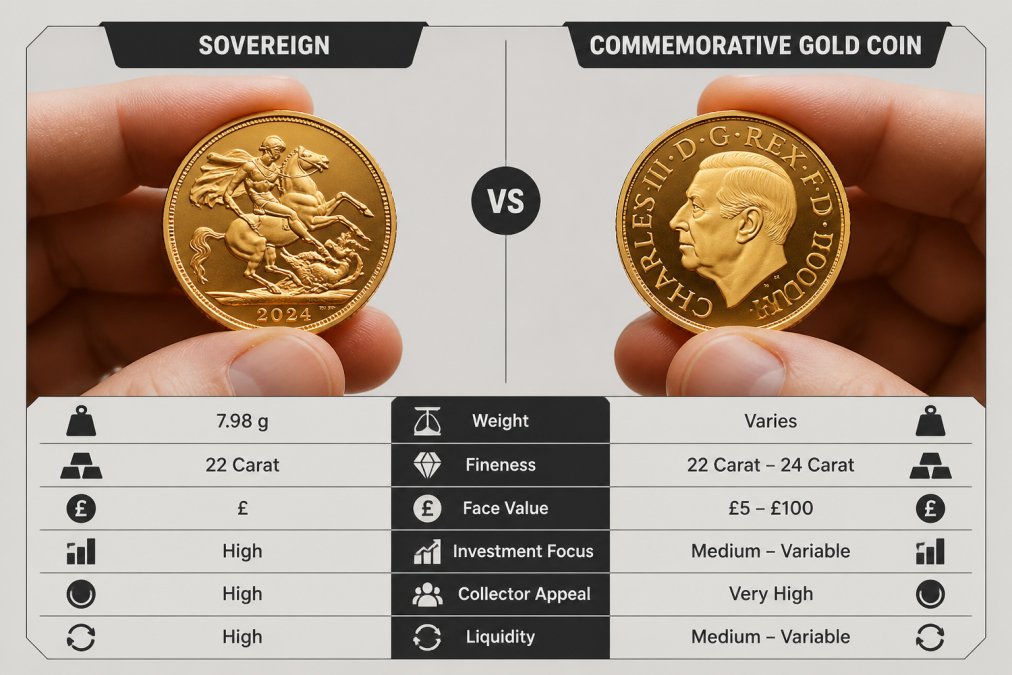
Sovereigns function primarily as bullion investments, valued for intrinsic gold content and exempt from capital gains tax in the UK. Commemorative coins straddle investment and collectible, where rarity, historical significance, and design appeal drive premiums above metal value.
Gold Sovereign Gold Content and Purity Standards
Each full sovereign contains exactly 7.98 grams of 22-carat gold, yielding 7.3224 grams of fine gold (916.7 fineness). This standardisation ensures every sovereign, whether minted in 1917 or 2017, contains the same precious metal quantity.
The 22-carat composition includes copper alloy for durability, allowing sovereigns to survive centuries with minimal wear, a quality appealing to investors and collectors.
Gold content remains consistent across denominations: full sovereigns contain 0.2354 troy ounces of fine gold, half-sovereigns half that, and quarter-sovereigns one quarter. This predictability favours investors seeking straightforward, transparent bullion.
Sovereigns are VAT-free and exempt from capital gains tax in the UK if legal tender and struck after 1837. This tax efficiency adds value beyond metal content, making them attractive to UK investors.
Commemorative Coin Gold Content and Design Variations
Commemorative coins vary significantly in composition, struck in different gold purities, weights, and fineness levels depending on the issuer's design brief.
The 2023 King Charles III Quarter Gold Sovereign and 2020 Winston Churchill Commemorative Gold Coin are both struck in 22-carat gold at 2 grams, allowing lower entry prices whilst maintaining gold prestige.

Commemorative coins vary significantly: some use 22-carat gold, others 18-carat or lower. Some are proof coins (mirror fields, frosted designs), others uncirculated bullion. Gold content must be verified for each issue.
Sovereigns feature consistent St George reverses with only the obverse changing per monarch. Commemoratives break this pattern with unique designs, Churchill portraits, coronation imagery, drawing numismatists and collectors but complicating comparisons.
Sovereigns are produced in millions annually; commemorative issues are restricted to tens of thousands or fewer, preserving scarcity and driving premiums above intrinsic gold value.
Understanding Gold Sovereign Value as an Investment
Sovereigns rest on three pillars: intrinsic metal value, tax efficiency, and legal tender status. A sovereign's floor value is its fine gold content at spot prices plus dealer margins. The 2017 Queen Elizabeth II Full Gold Sovereign at £1,050 reflects underlying gold value plus a modest premium.
Capital gains tax does not apply to sovereigns, meaning an investor buying at £1,000 and selling at £1,200 owes no CGT on the £200 gain. This exemption does not apply to most commemorative coins, making sovereigns more tax-efficient for UK buy-and-hold investors.
Legal tender status underpins recognition and liquidity. Banks, dealers, and buyers instantly recognise sovereigns as legitimate bullion. Nearly 200 years of minting history reinforces this trust.
Liquidity is strong but not instantaneous. Selling a sovereign to a dealer typically incurs a buy-sell spread (the difference between the dealer's buying and selling prices). This spread varies by dealer and market conditions.
Commemorative Gold Coin Value and Collector Appeal
Commemorative coins derive value from multiple sources beyond gold content. Historical significance, design artistry, limited mintage, and condition all influence price. A commemorative coin honouring a major historical figure or event can command a substantial premium, sometimes double or triple the intrinsic gold value.
The 2020 Winston Churchill Commemorative Gold Coin from Gold2u exemplifies this dynamic. Struck in 22-carat gold at 2 grams, its intrinsic value is perhaps £60-80 depending on the spot gold price. Yet it is priced at £450, reflecting the collector premium attached to Churchill's historical stature, the coin's limited issue, and its proof-quality finish.
Rarity is the primary driver of collector premiums. If a commemorative issue is minted in only 10,000 pieces worldwide, its scarcity is genuine. Contrast this with sovereigns, where annual mintages often exceed 100,000 or more. Over time, as commemorative coins age and some are lost or melted, the surviving population shrinks further, potentially driving premiums higher.
Condition matters enormously. A commemorative coin in pristine proof condition (never handled, housed in original packaging) commands a premium over one showing signs of wear. Grading services such as PCGS and NGC assign numerical grades that directly influence value. A proof-graded commemorative can be worth significantly more than an uncirculated example of the same issue.
2017 Queen Elizabeth II Full Gold Sovereign →
However, this collector premium is speculative. It depends on sustained demand from future collectors. A commemorative coin that seemed desirable in 2020 might find diminished interest a decade later if collector tastes shift or if the historical figure falls from public memory. Investors must accept this uncertainty when purchasing commemorative coins; they are not pure bullion plays.
Resale liquidity for commemoratives is typically lower than for sovereigns. A dealer will buy a commemorative coin, but often at a discount reflecting the narrower market. Sovereigns, by contrast, are instantly tradeable to any bullion dealer.
Rare Gold Coin Provenance and Authenticity
Authenticity is paramount when investing in historical or commemorative gold coins. A coin's provenance, its documented ownership history and origin, directly influences its credibility and value. A coin with clear provenance commands higher prices than an identical piece with an unknown background.
The 1917 King George V Full Gold Sovereign from Perth Mint at Gold2u illustrates the importance of provenance. The 'P' mintmark denotes its origin, allowing collectors to trace its production to a specific mint at a specific time. This mintmark is itself a form of provenance, confirming the coin's authenticity and historical context. Collectors value such documentation because it eliminates doubt about the coin's legitimacy and rarity.

Gold2u provides authentication through detailed specifications: weight, fineness, dimensions, and mint information. The 1917 Perth Mint sovereign is listed with exact specifications (7.98 grams, 916.7 fineness, 22.05 mm diameter), allowing buyers to verify the coin's authenticity against known standards. This transparency is a hallmark of reputable dealers and builds confidence in the purchase.
For commemorative coins, authentication is equally critical. Limited-edition issues carry serial numbers or certificates of authenticity that prove their official status. A commemorative coin without such documentation may be a counterfeit or an unofficial restrike, rendering it worthless as a collectible. Gold2u's practice of providing detailed information and offering video viewings of coins before purchase addresses this concern directly.
Historical coins present additional authentication challenges. A coin purporting to be from 1917 must be examined for wear patterns, die characteristics, and metal composition consistent with that era. Counterfeits do exist, particularly for high-value pieces.
Which Should You Choose: A Practical Comparison
The choice when comparing sovereign vs commemorative gold coins depends on your primary objective: investment, collecting, or a blend of both.
Choose sovereigns if you prioritise:
- Predictable bullion exposure with minimal premium above gold content
- Tax efficiency (capital gains tax exemption in the UK)
- Liquidity and ease of resale to any bullion dealer
- Consistency across purchases (every sovereign contains the same gold weight and purity)
- Long-term wealth preservation with minimal speculation
Choose commemorative coins if you prioritise:
- Historical or thematic significance tied to a specific event or figure
- Collector appeal and design artistry
- Potential for appreciation beyond intrinsic gold value as rarity increases
- Uniqueness and the satisfaction of owning a limited-edition piece
- Gifting or heirloom value that transcends pure metal content
| Criterion | Sovereign | Commemorative Coin |
|---|---|---|
| Gold Content | Standardised (7.98g, 22-carat) | Variable by issue |
| Annual Production | High volume (bullion) | Limited mintage |
| Design | Consistent (St George reverse) | Unique per issue |
| Premium Above Gold | Modest (2-5%) | Substantial (50-200%+) |
| Tax Status | CGT exempt (UK) | CGT applicable |
| Liquidity | Excellent (any dealer) | Good (specialist dealers) |
| Collector Appeal | Low | High |
| Investment Certainty | High | Moderate to low |
| Best For | Bullion investors | Collectors and numismatists |
A practical approach for many buyers combines both. A core holding of sovereigns, such as the 2017 Queen Elizabeth II Full Gold Sovereign at £1,050, provides stable, tax-efficient bullion exposure. Selective commemorative purchases, like the 2023 King Charles III Quarter Gold Sovereign at £450 or the 2020 Winston Churchill Commemorative Gold Coin at £450, add historical interest and diversify within the precious metals category.
Gold2u specialises in sourcing authenticated pieces across both categories, allowing collectors and investors to build balanced portfolios. Every coin listed comes with detailed specifications and the option for video viewing before purchase, ensuring confidence in authenticity and condition. This transparency removes guesswork from the buying process and aligns with best practices for high-value acquisitions.
The sovereign vs commemorative gold coins explained distinction ultimately reflects different investor philosophies. Sovereigns represent pure bullion efficiency, gold in its most straightforward, tax-advantaged form. Commemorative coins add narrative and rarity, appealing to those who view gold holdings as more than financial assets. Neither is objectively superior; the right choice depends on your portfolio goals, time horizon, and appetite for collector premiums.
At Gold2u, we help clients navigate this choice by offering authenticated examples of both categories, detailed specifications, and expert guidance. Whether you're building a bullion foundation with sovereigns or curating a collection of historically significant commemoratives, our selection of rare gold coins provides access to pieces that combine investment merit with enduring value.
Frequently Asked Questions
What is the difference between a gold sovereign and a commemorative gold coin?
Sovereigns are standardised British legal tender struck in 22-carat gold with consistent specifications: 7.98 grams, 0.2354 troy ounces of fine gold, and a diameter of 22.05 millimetres. They feature the reigning monarch and the classic St George and the Dragon design. Commemorative coins are limited-edition pieces issued to mark specific events or anniversaries, often with unique designs and varying gold content. Sovereigns prioritise consistent intrinsic value and bullion status, whilst commemoratives emphasise historical significance and collector appeal.
Are gold sovereigns worth more than their gold content?
Yes. Sovereigns command a premium above their intrinsic bullion value because they are British legal tender and exempt from capital gains tax. The premium reflects their historical continuity and liquidity. A 2017 Queen Elizabeth II Full Gold Sovereign, for example, is priced at £1,050, which exceeds the spot price of its 7.98 grams of 22-carat gold. This premium varies with market conditions and demand for bullion.
Do commemorative gold coins have investment value?
Commemorative coins can appreciate in value, but differently from sovereigns. Their worth depends on limited mintage, historical significance, condition, and collector demand rather than bullion content alone. A 2023 King Charles III Quarter Gold Sovereign commemorative coin, struck in 22-carat gold, appeals to collectors seeking limited-edition pieces tied to significant events. However, commemoratives are less liquid than standard sovereigns and their resale value depends more on finding the right collector than on gold prices alone.
How can I verify the authenticity and provenance of a gold coin?
Check for mint marks, weight, dimensions, and gold purity markings. Reputable dealers like Gold2u provide certificates of authenticity and documented provenance with each coin. For historical pieces, examine the die characteristics, surface wear patterns, and compare against reference catalogues. A 1917 King George V Full Gold Sovereign from the Perth Mint, for instance, bears a distinctive 'P' mintmark above the year. Always purchase from established dealers who guarantee authenticity and offer insured delivery with full documentation of origin and condition.
What makes a gold coin valuable to collectors?
Collector value stems from rarity, historical significance, condition, and mintage numbers. Limited-issue commemorative coins, such as the 2020 Winston Churchill Commemorative Gold Coin, gain value through their connection to notable figures or events. Sovereigns from specific years or mints become sought-after if mintage was low. Proof finish coins often command higher premiums than circulation strikes. Coins in exceptional condition, with clear provenance documentation and authentic certification, attract serious collectors willing to pay above bullion value.


0 comments