

Table of Contents
- What Rare Gold Coin Provenance Means and Why It Matters
- Essential Types of Provenance Evidence for Rare Gold Coins
- Gold Coin Certificate of Authenticity: What You Need
- Building and Documenting Your Coin's Ownership History
- Coin Authenticity Checks and Verification Methods
- Coin Cultural Heritage and Export Documentation
- Provenance Documentation for Resale, Inheritance, and Insurance
- Frequently Asked Questions
Last Updated: October 17, 2026
What Rare Gold Coin Provenance Means and Why It Matters
Rare gold coin provenance is the documented ownership history of a coin, tracing its journey from creation through every owner.
A coin can be authentic and graded yet lack clear provenance. Conversely, a coin with impeccable provenance documentation is more desirable, more valuable, and easier to sell or insure. Provenance answers a critical question: where did this coin come from, and can I verify that chain of ownership?
Provenance vs. Pedigree: Understanding the Distinction
These terms are often used interchangeably but mean different things. Pedigree is the complete ownership sequence of a coin. Provenance is the evidence that supports and documents that pedigree.
Pedigree is the story; provenance is the proof. Without provenance documentation, collectors will question even an impressive pedigree. The strongest coins have both: a notable ownership history supported by verifiable evidence at each step.
How Provenance Affects Value and Desirability
Rare gold coins with clear, documented provenance command higher prices than identical coins without it.
Provenance also affects liquidity. Dealers and collectors will ask for documentation, and gaps raise questions, was the coin stored improperly, or is something being hidden?
Insurers take provenance seriously too. Underwriters want evidence of value and authenticity, and coins with documented ownership history are easier to insure because the claim history is verifiable.
Essential Types of Provenance Evidence for Rare Gold Coins
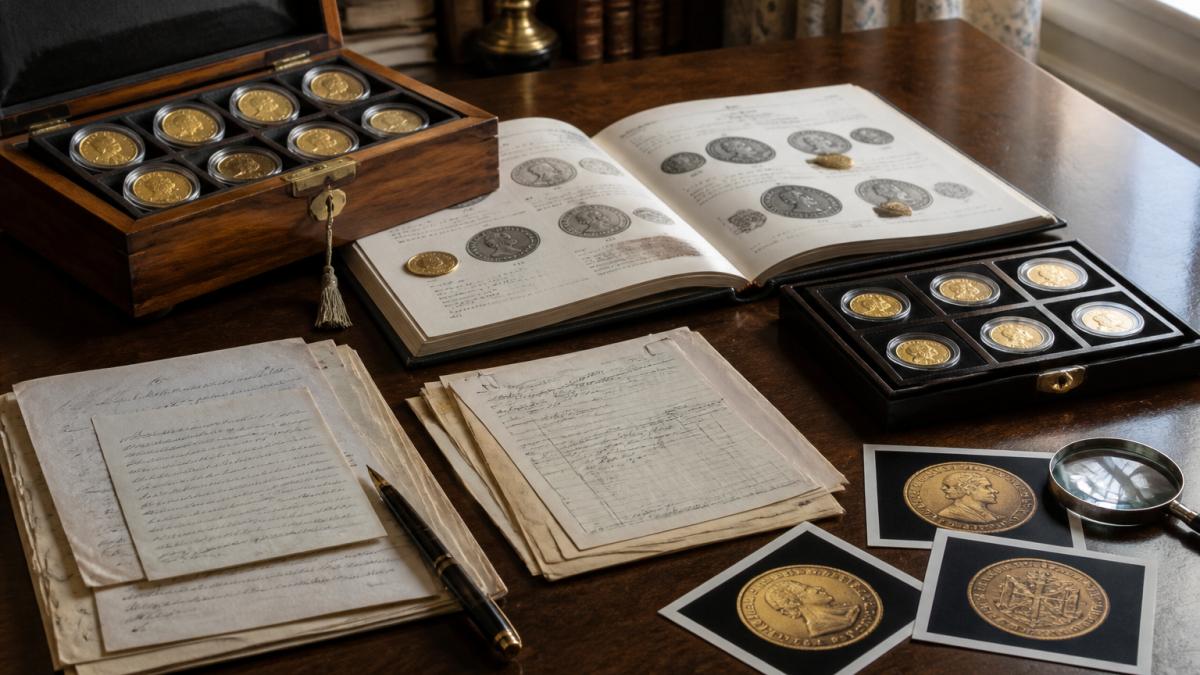
Provenance documentation comes in several forms. Each serves a specific purpose, and together they build a complete chain of ownership.
Invoices, Receipts, and Purchase Documentation
Every time a coin changes hands, there should be a record. A purchase invoice or receipt shows who sold the coin, who bought it, when, and ideally the price paid.
When you purchase a rare gold coin from a dealer like Gold2u, you receive documentation of that transaction. Keep these records permanently, they're your first-line proof of ownership.
Auction Records and Catalogue References
Auction house records are among the most credible provenance evidence. A catalogue entry is evaluated by professional numismatists and typically includes the coin's description, estimated value, and sometimes prior ownership.
Catalogues from major houses are dated, archived, and publicly available, third-party verification of your coin's existence and characteristics at a specific point in time.
Correspondence and Historical Letters
Personal correspondence adds narrative depth to provenance. A letter from a previous owner describing the coin, its condition, or its history provides context that cold transaction records cannot.
Correspondence might include a dealer's letter on the coin's rarity, a collector's acquisition note, or a family letter passing the coin down generations.
Photographs and High-Quality Images
High-quality photographs at different points in a coin's ownership history serve as visual provenance, helping verify its identity and condition over time.
Photographs are particularly useful for detecting condition changes: significant deterioration might indicate improper storage, while stable condition suggests careful stewardship.
Gold Coin Certificate of Authenticity: What You Need
A certificate of authenticity is not provenance, it's authentication. A certificate verifies a coin is genuine and grades its condition; provenance documents ownership history. Ideally a coin has both.
Grading Certificates and Numismatic Standards
Professional grading services like NGC (Numismatic Guaranty Company) and PCGS (Professional Coin Grading Service) issue certificates grading a coin's condition on a standardised scale, including specifications (weight, diameter, fineness), grade (e.g., MS-65, PF-69), and a certification number tied to the specific coin.
A grading certificate from a reputable service adds significant value through independent, professional authentication. It's a snapshot of the coin's condition at the time of grading.
What Distinguishes a Certificate from Provenance Documentation
The critical difference: a certificate tells you the coin is real and describes its condition; provenance tells you where it's been and who owned it.
The Royal Mint's numbered certificates, like those accompanying the 2025 Royal Mint Three-Coin Gold Proof Sovereign Set (Certificate 441), serve as authenticity proof and limited-edition verification.

Building and Documenting Your Coin's Ownership History
Creating a comprehensive provenance record requires organisation. Start the moment you acquire the coin and maintain records going forward.
Creating a Coin Purchase Receipt Template
When you buy a rare gold coin, retain detailed documentation. A proper receipt should include:
| Element | Details |
|---|---|
| Seller name and contact | Full business name, address, phone |
| Coin description | Denomination, date, mint mark, fineness |
| Condition/grade | If graded, include certification number |
| Price paid | In GBP, with any applicable VAT |
| Purchase date | Specific date of transaction |
| Certificate number | If applicable, from grading service |
| Seller signature/seal | Professional verification |
Keep the original receipt, from a dealer like Gold2u, your invoice is your first provenance document. Store it safely alongside the coin or in a separate secure location.
Recording Previous Owners and Collection History
Research your coin's history before you acquired it. If it came from an auction, obtain the catalogue. Document every owner you can identify in a simple chronological record:
- Year acquired by previous owner
- How they acquired it (auction, dealer, inheritance, etc.)
- Any documentation available from that period
This record becomes part of your documentation and, when you sell, makes the coin more attractive to the next buyer.
Maintaining Conservation and Condition Records
Document your coin's condition from the moment you acquire it. Take high-quality photographs under consistent lighting. Note any marks, discolouration, or wear. If you have the coin professionally graded, that grading certificate becomes a condition snapshot.
If you clean, restore, or have the coin conserved (which most serious collectors avoid), document that intervention. Record what was done, when, and by whom.
2025 Royal Mint Three-Coin Gold Proof Sovereign Set – Certificate 441 →
Coin Authenticity Checks and Verification Methods
Verifying a coin's provenance means checking the documents themselves and ensuring the ownership chain is continuous and credible.
Verifying Documents and Resolving Gaps in Ownership
Not every coin has a complete provenance record. Historical coins may have gaps, especially if they passed through private collections before modern record-keeping became standard.
Contact previous owners or their families if possible. A handwritten letter explaining the gap can add credibility.
If a coin has significant gaps in provenance, be honest about it when you eventually sell.
Identifying Red Flags in Provenance Claims
Be cautious of coins with provenance claims that cannot be verified.
Red flags include vague ownership claims ("it's been in a private collection"), missing documentation for recent decades, or provenance that jumps backward in time without explanation.
Conversely, strong provenance includes specific names, dates, and verifiable sources. "Acquired from Sotheby's London auction, 15 June 2015, Lot 342" is far more credible than "purchased from a collector."
Coin Cultural Heritage and Export Documentation
Rare gold coins, particularly ancient or historically significant pieces, may be subject to export restrictions or cultural heritage laws. Understanding these requirements protects you legally and ensures you can sell the coin without complications.
Understanding Legal Ownership and Export Requirements
In the United Kingdom, rare coins are generally treated as personal property and can be owned and exported freely, provided they don't fall under cultural property restrictions.
The UK Cultural Property Export List identifies items that may require an export licence. Coins aren't typically restricted unless they're of exceptional historical significance.
When you purchase a rare gold coin, ask the seller whether any export restrictions apply.
Digital Recordkeeping and Document Security
Maintain both physical and digital copies of all provenance documentation.
Digital storage protects against loss from fire, theft, or damage. If your home is damaged and physical documents are destroyed, you'll still have digital backups.
Organise your digital files clearly. Create a folder for each coin with subfolders for certificates, invoices, photographs, and correspondence.
Provenance Documentation for Resale, Inheritance, and Insurance
Your rare gold coin provenance documentation serves multiple purposes beyond establishing authenticity and value.
When you sell a rare gold coin, provide all documentation to the buyer.
If you're passing a coin to heirs, include comprehensive documentation explaining its history, value, and significance.
Insurance companies require provenance documentation to insure high-value coins.
For rare gold coins like the 1869 Queen Victoria Gold Sovereign or the 1/4 Ounce Libertad Proof - PF69 UC, comprehensive provenance documentation is essential.


At Gold2u, we understand that serious collectors and investors demand transparency. Whether you're acquiring a 1999 Queen Elizabeth II Gold Half Sovereign - Proof or a rare historical piece, we provide the provenance foundation you need.
Frequently Asked Questions
What documents should accompany a rare gold coin?
A rare gold coin should be accompanied by a certificate of authenticity from a recognised grading service, the original purchase invoice or receipt, auction records if applicable, photographs showing both obverse and reverse, any historical correspondence or provenance letters, and a documented ownership chain. These materials together form the provenance record that establishes the coin's authenticity, ownership history, and value. Without these documents, even genuine coins lose desirability and marketability among serious collectors and investors.
How do you verify the provenance of a rare coin?
Verify provenance by cross-referencing documents against established records: check auction catalogues for past sales, confirm grading certificates with the issuing service, examine signatures and letterheads on correspondence, and research previous owners through numismatic databases or dealer networks. Look for gaps in the ownership sequence and investigate unexplained breaks in documentation. Consult specialist dealers or authentication experts if documents appear inconsistent or if the coin's history contains suspicious gaps. Physical inspection of the coin itself should match descriptions in the historical record.
Can a rare gold coin be valuable without provenance documentation?
A rare gold coin may retain intrinsic gold value without provenance, but it loses significant collector premium and desirability. Coins with complete provenance documentation command higher prices at auction and appeal to serious investors. Without provenance, buyers cannot verify authenticity with confidence, making the coin harder to sell and potentially exposing you to legal or regulatory challenges if the coin's origin is questioned. For investment-grade rare coins, provenance documentation is essential to maximising value and ensuring liquidity.
What provenance red flags should coin collectors look out for?
Red flags include missing documentation for extended periods, inconsistent descriptions across different records, unsigned or undated letters, auction records that cannot be verified, sudden gaps in ownership history, coins offered at unusually low prices without explanation, and sellers unwilling to provide original documents. Be cautious of coins claimed to come from famous collections without supporting evidence, or those with vague descriptions of previous ownership. Always request original documents rather than photocopies, and verify the authenticity of any certificates through the grading service directly.
How much does it cost to get a coin certified and graded?
Certification costs vary by grading service and coin value, typically ranging from £50 to £200 for standard services, though rare or high-value coins may incur higher fees. Services like NGC and PCGS offer different tiers depending on turnaround time and coin value. The investment in professional grading is worthwhile for rare gold coins, as a recognised certificate significantly enhances marketability and buyer confidence. When purchasing from reputable dealers like Gold2u, coins often come with certificates already included, such as the Royal Mint certificate provided with the 2025 Three-Coin Gold Proof Sovereign Set.
Does a rare gold coin need a certificate of authenticity?
A certificate of authenticity is highly recommended for rare gold coins, particularly those intended for investment or resale. The certificate serves as third-party verification of the coin's grade, condition, and authenticity, protecting both buyer and seller. Whilst a coin may be genuine without a certificate, the lack of professional authentication reduces its appeal to collectors and investors, potentially lowering its resale value. For significant purchases, always request a certificate from a recognised grading service and verify its authenticity directly with the issuer.
How can you check whether a coin was legally exported or imported?
Check export documentation against the seller's records and verify compliance with cultural heritage regulations applicable to the coin's country of origin. For coins leaving or entering the territory, consult relevant government guidance on precious metals and cultural property. Research whether the coin's origin country has restrictions on historical artefacts; some nations require export licences for coins of significant cultural importance. Request bills of sale, customs declarations, and import records from previous owners. If purchasing internationally, verify that all legal requirements have been met before completing the transaction.


0 comments