

Table of Contents
- What Is Vintage Jewellery Appraisal and Why You Need One
- Understanding Different Types of Jewellery Valuation
- Step 1: Prepare Your Vintage Jewellery for Appraisal
- Step 2: Identify Vintage Jewellery Hallmarks and Maker's Marks
- Step 3: Find a Qualified Jewellery Valuer
- Step 4: Request Jewellery Appraisal for Insurance
- Step 5: Review the Appraisal Report and Understand Its Limitations
- Key Factors That Affect Vintage Jewellery Appraisal Value
- Frequently Asked Questions
Last Updated: October 15, 2026
What Is Vintage Jewellery Appraisal and Why You Need One
A vintage jewellery appraisal is a professional assessment of your antique piece's value, examining the metal, gemstones, condition, and craftsmanship.
Vintage jewellery appraisal is about protection, for insurance, selling, inheritance planning, or simply knowing what you own.
Market value is what someone would pay you right now if you sold it.
The difference between market value and replacement value
Market value reflects what a buyer will actually pay today, what you'd get selling to a dealer or at auction. It's typically lower than replacement value.
Replacement value is the cost to acquire an equivalent piece, what insurers pay if your jewellery is lost or damaged.
These numbers can differ significantly. A vintage engagement ring with a 1.5-carat old mine cut diamond might have a market value of £4,000, but replacing that exact piece could cost £6,500 or more.

When an appraisal matters most
You need a formal written appraisal for:
- Insurance coverage: Most insurers require a professional appraisal before they'll cover jewellery above a certain value (often £1,500-£2,000)
- Estate planning: If you're leaving jewellery to family members, an appraisal establishes its value for inheritance tax purposes
- Divorce settlements: Courts often require independent valuations for asset division
A professional appraisal is minimal compared to the protection it provides.
Understanding Different Types of Jewellery Valuation
The purpose determines the type of valuation you need.
Insurance valuations versus resale valuations
An insurance valuation estimates replacement cost, what it would cost to buy an equivalent piece today, and sets your coverage limit.
A resale valuation estimates what you'd receive if you sold now, typically 40-60% lower than replacement value because dealers and auction houses build in their margin.
Don't use a resale valuation for insurance (you'll be underinsured) or an insurance valuation when selling (dealers won't pay replacement value).
Fair market value and auction estimates
Fair market value is what a willing buyer and seller would agree on in an arm's-length transaction, the standard tax authorities and courts use.
Auction estimates are predictions based on comparable sales, not guaranteed values, a piece estimated at £3,000-£4,000 might sell for £2,500 or £5,500 depending on bidding.
Step 1: Prepare Your Vintage Jewellery for Appraisal
Before booking an appointment, prepare your piece properly, what you do beforehand affects the valuation.
Document condition and gather provenance
Write down everything you know:
- Where and when you acquired it (inheritance, purchase, gift)
- Certificates, receipts, or documentation
- Known repairs or restoration work
Take clear photographs from multiple angles in natural light, including close-ups of hallmarks, maker's marks, or engravings, these help with insurance claims.
Gather original documentation, certificates, receipts, previous appraisals, auction catalogues. Even incomplete documents add context.
Cleaning and handling before appraisal
Clean gently with lukewarm water, a drop of dish soap, and a soft brush; pat dry.
Handle minimally, skin oils obscure details. Wear clean cotton gloves if you must.
Don't attempt repairs before an appraisal, the valuer needs to see current condition, and incorrect repairs can lower value.
Store it in a clean, dry place in a soft pouch or padded box.
Step 2: Identify Vintage Jewellery Hallmarks and Maker's Marks
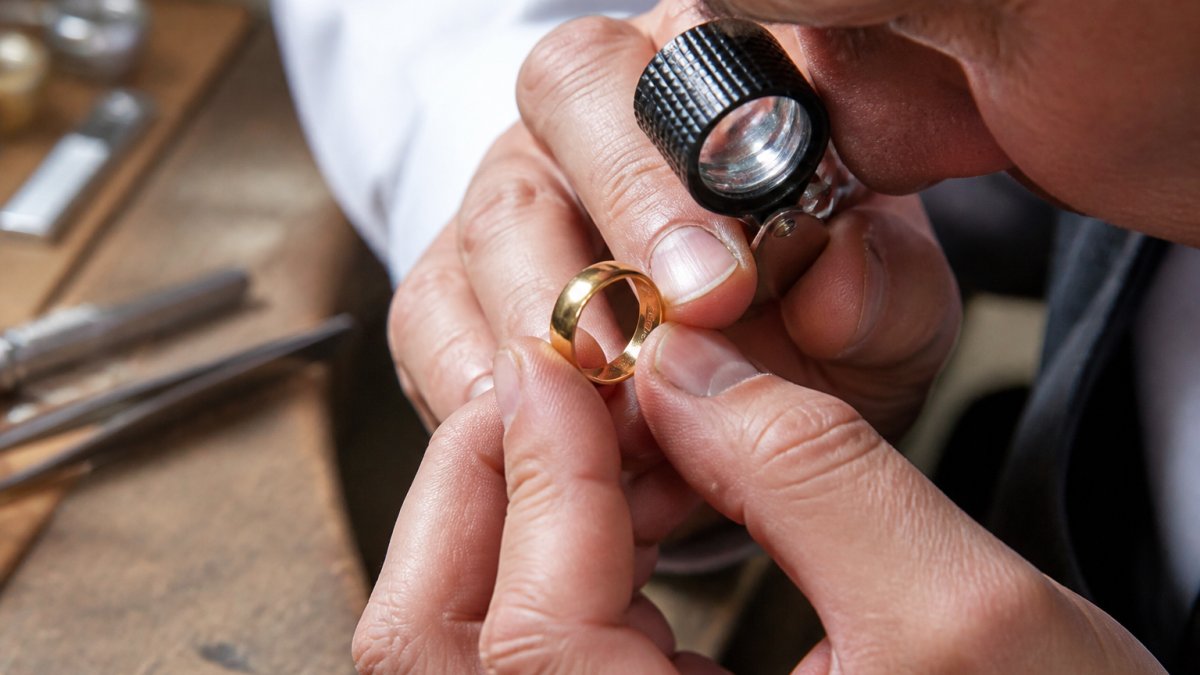
Hallmarks and maker's marks reveal when and where a piece was made, its metal content, and who crafted it.
Reading hallmarks and dating your piece
Hallmarks are stamped marks indicating metal purity and often the maker or assay office. In the UK they're legally required on precious metals and follow era-specific formats (Hallmarking: practical guidance - summary).
UK hallmarks typically show:
- Metal symbol (lion for sterling silver, crown for gold, etc.)
- Purity mark (750 for 18-carat gold, 925 for sterling silver)
- Date letter (a letter indicating the year of hallmarking)
A hallmark like "750 | Lion | A | Birmingham" means 18-carat gold, hallmarked in Birmingham, in a year starting with A (1934, 1959, 1984, etc.).
Spotting authenticity red flags
Red flags include:
- No hallmarks on precious metal jewellery (UK law required hallmarking since 1300)
- Inconsistent wear patterns (the back unworn but the front heavily worn suggests recent plating)
- Perfect condition on old pieces (genuinely old jewellery shows age)
The appraiser verifies authenticity through magnification, testing, and experience, but these basics help you spot obvious fakes before paying for an appraisal.
Step 3: Find a Qualified Jewellery Valuer
Not all valuers have equivalent credentials. Finding someone qualified, experienced, and independent matters enormously.
What credentials matter: registered valuers and professional standards
Look for valuers with professional qualifications:
- Member of the Institute of Professional Valuers and Auctioneers (IPVA) - carries professional standards and ethics codes
- Gemmology qualifications - diplomas from the Gemmological Association of Great Britain (Gem-A) or similar
- Jewellery appraisal certifications - specific valuation methodology training
These credentials mean the person has studied jewellery valuation, passed examinations, and agreed to professional codes of conduct.
Ask about qualifications before booking, a qualified valuer will proudly share their credentials; if they're vague, keep looking.
Avoiding conflicts of interest and bias
The best valuers are independent, they don't sell or repair jewellery, so they have no financial incentive in the outcome. Valuers who sell might inflate values; those who repair might overstate damage.
Avoid valuers who:
Victorian-Era Old Cut Diamond Three Stone Ring – 1.75 Carats Total →
- Work primarily as jewellery dealers or sellers
- Offer to buy your piece "at a special price" after valuation
- Won't provide written reports
Good valuers charge flat fees, spend adequate time examining the piece, provide detailed written reports, and won't pressure you to sell.
Step 4: Request Jewellery Appraisal for Insurance
An insurance valuation establishes replacement cost so your insurer knows how much to cover, and the format matters because insurers have specific requirements.
What an insurance valuation report must include
A proper insurance valuation report contains:
- Detailed item description - metal type and purity, gemstone types and approximate sizes, design and style, condition, any damage or repairs
- Photographs - clear images from multiple angles
- Hallmarks and maker's marks - documented and interpreted
The report should be detailed enough that someone unfamiliar with your piece understands exactly what it is. Vague descriptions like "vintage ring" aren't useful; specific ones like "18-carat yellow gold trilogy ring, circa 1950s, set with one old European cut diamond approximately 0.95 carats and two old cut diamonds approximately 0.40 carats each, VS clarity, colour H-I, good condition with minor surface wear consistent with age" give insurers what they need.
Replacement value versus current market value
Make sure your report specifies replacement value, not market value, the critical distinction for insurance.
If your insurer asks for "current value," clarify you're providing replacement value, the cost to acquire an equivalent piece today. Market value is typically 30-50% lower and won't cover your loss.
A Victorian-era three-stone ring with old mine cut diamonds (like our Victorian-Era Old Cut Diamond Three Stone Ring) might have a market value of £2,800 but a replacement value of £3,800, since finding an equivalent piece requires specialist dealers and months of searching.

Step 5: Review the Appraisal Report and Understand Its Limitations
Once you receive the appraisal report, review it carefully. Understand what it says and what it doesn't say.
What the written appraisal should contain
A complete report includes the valuer's methodology: how they determined value, comparable sales data, market conditions, rarity factors, and condition assessment.
The report should be specific about uncertainty, for example: "The diamond is estimated to be VS clarity based on visual examination.
Check the report addresses your purpose: insurance valuations emphasize replacement cost and condition, resale valuations emphasize market comparables, and inheritance valuations emphasize fair market value for tax.
How to evaluate the appraiser's reasoning
For a diamond, they should explain:
- How they assessed the four Cs (carat weight, cut, color, clarity)
- Recent comparable sales
- Why the setting adds or subtracts value
For precious metals, they should explain:
- Metal purity (carat, fineness)
- Weight in grams
- Current metal prices and how they applied them
If the report lacks this detail, ask the valuer to explain, a good one can justify every number.
Be skeptical of round numbers, exactly £5,000 or £10,000 suggests guessing. Realistic valuations end in specific figures like £4,850 or £9,275.
Key Factors That Affect Vintage Jewellery Appraisal Value
Several factors determine what your piece is worth, explaining why two similar-looking rings can have very different values.
Metal type, purity, and weight
Gold varies by purity:
- 24-carat (999 fineness) is pure gold
- 18-carat (750 fineness) is 75% gold, 25% alloy
- 14-carat (585 fineness) is 58.5% gold
Higher purity means higher value per gram, but lower purity is often stronger because alloys add durability.
Platinum is rarer and more valuable than gold, a 2-gram platinum ring might contain £80-£100 in metal value alone.
Silver has lower intrinsic value but still matters, a 15-gram sterling silver (92.5% pure) brooch contains roughly £6-£8 in silver value.
Gemstone quality, cut, and rarity
For diamonds, the four Cs matter:
- Carat weight - heavier stones cost exponentially more (a 1.5-carat diamond costs significantly more than a 1-carat, all else equal)
- Cut - affects brilliance and fire (old mine and old European cuts are prized by collectors)
- Color - colorless is most valuable; yellow or brown tints reduce value
For colored gemstones (sapphires, rubies, emeralds), additional factors apply:
- Origin - Burmese rubies command premiums over Thai rubies
- Treatment - natural untreated stones are worth more than heat-treated or irradiated
- Saturation - vivid colors beat pale or dull
Rarity matters enormously: a natural, untreated Burmese ruby is exponentially more valuable than a heat-treated one, and an 1880s old mine cut diamond beats a modern brilliant cut of identical specs.
Age, craftsmanship, and historical significance
Victorian jewellery (1837-1901) is highly collectible, lockets, mourning jewellery, and intricate filigree work command premiums among collectors.
Edwardian jewellery (1901-1910) is prized for delicate platinum work and the "river of light" aesthetic of graduated diamond settings. Our 6.5 Carat Edwardian Platinum Graduated Old Cut Diamond Bracelet exemplifies this craftsmanship and commands premium valuations because authentic pieces are increasingly rare.
Art Deco jewellery (1920s-1930s) features geometric designs and bold colors. Collectible examples appreciate significantly.
Historical significance can dramatically increase value, documented provenance, such as belonging to a famous collector or appearing in a significant auction, adds narrative value.
Condition, damage, and restoration
Condition profoundly affects value, two identical rings in different conditions can differ by 30-50%.
Excellent condition pieces show minimal wear, with secure stones, intact settings, and only light surface wear.
Good condition pieces show normal age wear, minor stone scratches, settings worn but secure.
Frequently Asked Questions
How much does a vintage jewellery appraisal cost?
Jewellery valuation cost varies depending on complexity and the appraiser's expertise. Simple pieces may cost £50-£150, while detailed appraisals of rare or valuable vintage jewellery can range from £200-£500 or more. Some appraisers charge hourly rates (typically £40-£100 per hour), whilst others quote a flat fee based on the item's estimated value or the time required for inspection and documentation. Always request a quote in advance and confirm whether the fee includes a written report.
What is the difference between an insurance valuation and a resale valuation?
An insurance valuation estimates the replacement cost of your vintage jewellery if it is lost, stolen, or damaged, typically the higher figure. A resale valuation reflects what you could expect to receive if you sold the piece today, which is usually lower because dealers and auction houses factor in their own margins. Insurance valuations use current market prices for materials and comparable pieces; resale valuations account for liquidity and market demand. Always clarify which type you need before commissioning an appraisal.
What should I bring to a vintage jewellery appraisal?
Bring the jewellery itself, any original documentation (certificates, receipts, provenance records), photographs of the piece from multiple angles, and a list of any known history or previous repairs. If you have information about the maker, era, or materials, include that too. Avoid cleaning the piece beforehand unless the appraiser instructs you to, as dirt or patina can sometimes aid dating and authentication. A written description of why you're seeking the appraisal (insurance, sale, inheritance) helps the appraiser provide the right valuation type.
Can a jewellery appraisal identify the age and maker of a vintage piece?
A qualified appraiser can often estimate the era and maker using hallmarks, design style, craftsmanship techniques, and gemstone cuts. Vintage jewellery hallmarks, maker's marks, assay office stamps, and date letters, provide strong clues to age and origin. However, appraisals have limits: unmarked pieces, heavily restored items, or rare designs may require specialist gemological or historical research. A professional written appraisal will clearly state what can and cannot be confirmed, and may recommend additional authentication if provenance is uncertain.


0 comments