

Last Updated: October 25, 2026
Quick Summary
Gold bullion preserves wealth better than diamond rings because it has a transparent spot price and a dealer market that buys it back the same day, while a diamond ring's resale value is decided by a jeweller and often recovers well under half of its retail price. Buy bullion for the part of your wealth that must stay liquid, and buy antique or vintage rings if resale matters.
- A sovereign or bar trades on recognised weight and fineness, so any dealer can quote a price within minutes.
- New retail diamond rings are the worst-performing format for wealth preservation because markup, setting, brand and VAT are not recoverable.
- Antique and vintage rings resell better than new ones because buying second-hand already removes most of the new-retail markup.
- The pound price of gold rose roughly 12.6% a year on a compound basis over the twenty years to 2025.
- Gains on gold bullion coins that are legal tender, such as sovereigns, are exempt from Capital Gains Tax for UK private individuals.
Table of Contents
- Diamond Rings vs Gold Bullion: The Core Trade-Off
- Liquidity of Physical Gold Coin Investments vs Diamond Rings
- Diamond Ring Resale Value: What You Actually Get Back
- How to Value a Diamond Ring Before You Buy or Sell
- Gold Bullion Premiums and Resale Prices Explained
- Historical Performance, Inflation Hedging and Market Stability
- Which Asset Fits Your Wealth Preservation Strategy?
- Building Your Position with Authenticated Physical Assets
- Frequently Asked Questions
Diamond Rings vs Gold Bullion: The Core Trade-Off
Gold bullion is a weight-priced, globally traded store of value; a diamond ring is a crafted retail product whose price depends on grading, setting and brand. That single difference explains almost everything that follows. At Gold2u, we hold both sides of this comparison in stock, so we have no reason to flatter either one.
The trade-off is simple. Bullion gives you a transparent spot price and a dealer market that will buy it back the same day. A diamond ring gives you something wearable, often antique, sometimes irreplaceable, but its resale value is decided by a jeweller with a loupe, not by a screen. Wealth preservation rewards the asset you can sell quickly at a predictable price.
Below, we compare liquidity, resale value, valuation, premiums, historical performance and tax treatment, then close with a decision framework you can apply to your own position.
| Question | Gold bullion | Diamond ring |
|---|---|---|
| Priced by | Live spot price plus premium | Grading, setting, retail margin |
| Resale speed | Same day to a few days | Weeks, often at a discount |
| Price transparency | High | Low to moderate |
| Best for | Capital preservation, liquidity | Wearable value, provenance, rarity |
Liquidity of Physical Gold Coin Investments vs Diamond Rings
Liquidity of physical gold coin investments is the practical test of wealth preservation, and it is where bullion wins clearly. A sovereign or a bar trades on a recognised weight and fineness, so any dealer can quote a price within minutes of seeing it.
Take our 1869 Queen Victoria Gold Sovereign, priced at £1,100.00. It contains 7.3224 grams of pure gold at 916.7 fineness. A dealer does not need to grade it to know what the metal is worth. That certainty is the whole point of a liquid asset.
Diamond rings are different. A ring must be inspected, the stones graded, the setting assessed and a buyer found. That takes time, and time is a cost. For a deeper look at how quickly physical gold converts to cash, read our guide on the liquidity of physical gold collectibles.
Diamond Ring Resale Value: What You Actually Get Back
Diamond ring resale value is almost always lower than the retail price paid, because retail includes the jeweller's margin, the setting and the brand. The second-hand market prices the stones and the metal, not the shopping experience.
A new diamond ring bought on a high street carries several stacked costs that vanish the moment you walk out of the shop:
- The diamond wholesale-to-retail markup. A stone that a trade dealer would sell to a jeweller at one price is marked up again for the retail customer. That markup is not recoverable on resale.
- The setting and design premium. The labour, CAD design, casting and finishing of a ring are craft costs. A second-hand buyer is purchasing a used setting, not a new one.
- The brand premium. A named retailer's box and paperwork add to the ticket price but not to the scrap or trade value of the components.
- VAT. Standard-rated retail purchases include VAT that a private seller cannot reclaim and a trade buyer will not pay twice for.
Our Vintage 18ct Gold Diamond Cluster Ring is listed at £2,500.00 with roughly 1.8 carats total and a Birmingham hallmark confirming 18ct gold. It was made in the late 1990s. Buying a piece like this second-hand already removes most of the new-retail markup, which is exactly why antique and vintage rings resell better than new ones. The buyer of a vintage ring is closer to the trade price from the outset, so the loss on a later resale is smaller in percentage terms.
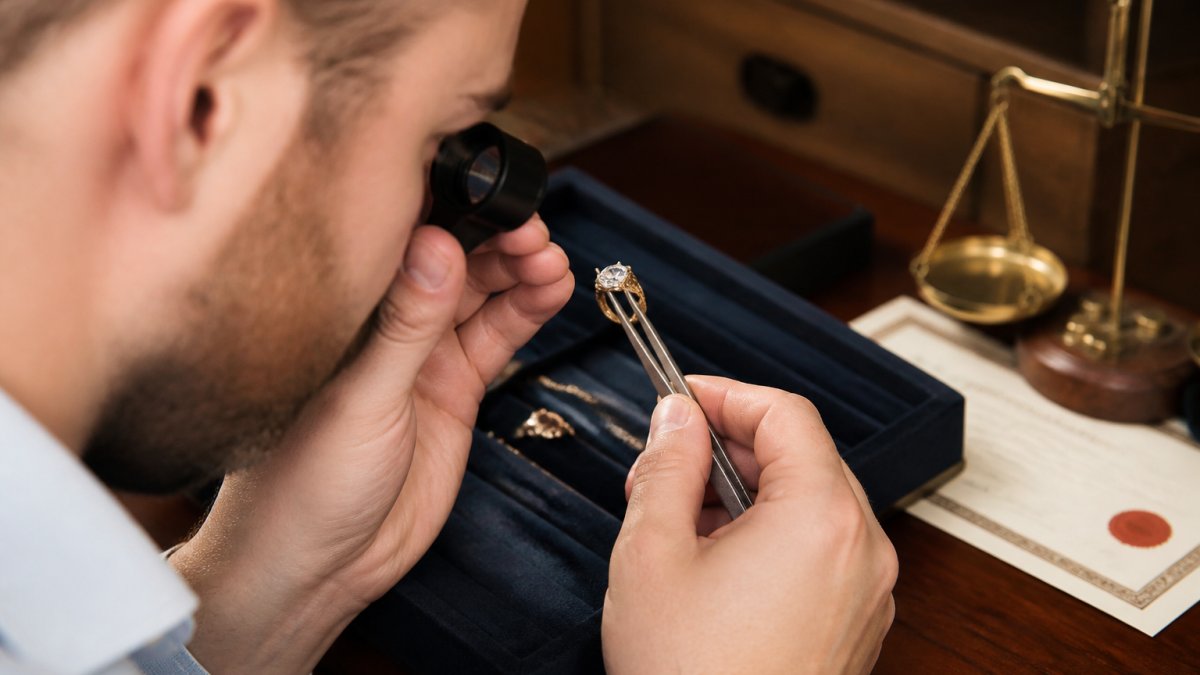
What most guides miss is that the metal still counts. An 18ct ring carries real gold weight, so even a weak diamond market leaves a floor under the price. That floor is set by the scrap value of the metal at the day's spot price, less the refiner's or dealer's margin.
For the grading and provenance side of antique stones, see our numismatic investment guide.
How to Value a Diamond Ring Before You Buy or Sell
Valuation starts with four factors: cut, colour, clarity and carat weight (Diamond Quality Factors). Add the metal, the setting and the paperwork, and you have a defensible number.
Our Victorian-Era Old Cut Diamond Three Stone Ring shows how this works in practice. It carries about 1.75 carats total, an estimated H to I colour and VS to SI clarity, assessed in the mounting by a jeweller. Old mine and Old European cuts were hand-cut for fire, not factory brilliance, and collectors pay for that character.
A workable checklist before you commit:
- Confirm the hallmark and metal purity
- Get colour, clarity and carat weight stated in writing
- Ask whether grading was done in the mounting or loose
- Check the setting is secure and the stones are original
- Compare against auction results for similar cuts and eras
- Confirm what documentation travels with the piece
Authentication matters as much as grading here, which is why we point buyers to our guide on gold coin grading and authenticity for the same discipline applied to coins.
1869 Queen Victoria Gold Sovereign →
Gold Bullion Premiums and Resale Prices Explained
Gold bullion premiums and resale prices sit either side of the spot price, and the gap is your real cost of ownership. You buy above spot and sell below it. The spread is the price of liquidity.
A coin like our 1917 King George V Full Gold Sovereign at £1,200.00 carries a premium over its pure gold content. Part of that is the Perth Mint mark, part is collectability, part is dealing cost. On resale, expect the dealer to quote closer to spot unless the coin has numismatic demand.
The lesson for wealth preservation is to buy the smallest premium you can justify for the certainty you want. Sovereigns are widely recognised and easy to sell. Natural nuggets, such as our Investor's Lot of Australian gold nuggets at £1,229.07, carry a collectability premium that can help or hurt depending on the buyer.
Historical Performance, Inflation Hedging and Market Stability
Gold has a long record as an inflation hedge and a store of value, though the path is never smooth.
Diamond prices behave differently. They are driven by grading, fashion and supply, and they are far less transparent. There is no live screen for a one-carat old mine cut.
The comparison most guides avoid is the like-for-like one. Gold has a single, widely quoted spot price in pounds per troy ounce, published continuously and used by every dealer.
On inflation hedging, the mechanism differs. Gold is priced in pounds and tends to respond to sterling weakness and to real-rate expectations, which is why it is often held as a monetary hedge. A diamond ring has no monetary role; its value is aesthetic and rarity-driven, so it hedges the specific risk of wanting a wearable, heirloom asset rather than the general risk of inflation. Market stability favours bullion on transparency; diamonds offer stability of a different kind, rooted in rarity and taste.
Tax and structural treatment. For a UK private individual, gains on gold bullion coins that are legal tender, such as sovereigns, are exempt from Capital Gains Tax, and investment-grade gold bullion is treated as a chargeable asset for CGT purposes where the exemption does not apply.
For the long-run evidence behind the bullion case, our guide to long-term gold price trends sets out the record in detail.
Which Asset Fits Your Wealth Preservation Strategy?
Neither asset wins outright, so match the choice to your goal. Use this framework:
- If you need to sell within weeks: gold bullion, full stop.
- If you want a hedge you can hold and insure: sovereign coins or bars.
- If you want wearable, heirloom value with provenance: antique diamond rings.
- If you want both: split the position, and keep the diamond share in pieces bought second-hand.
A common mistake is treating a new retail diamond ring as an investment. It is jewellery first. Buy antique or vintage if resale matters, and buy bullion for the part of your wealth that must stay liquid.
Building Your Position with Authenticated Physical Assets
Start with authentication, because provenance is what protects value on both sides. Every coin we list is the actual coin you receive, sent with free insured delivery, and you can book a video viewing before you order. If you are new to the market, our beginner's guide to buying physical gold walks through coins, bars, storage and tax.
The real challenge is not choosing between gold and diamonds. It is buying either one without verified authenticity, clear grading and a realistic exit plan. Gold2u addresses that with historical gold coins such as the 1869 and 1917 sovereigns, natural Australian gold nuggets with stated purity, and antique old mine cut diamond jewellery with hallmarks and grading notes. Get started with Gold2u and build a position you can value, hold and sell with confidence.
Frequently Asked Questions
Are diamond rings a good investment for preserving wealth?
Diamond rings rarely preserve wealth as efficiently as gold bullion. A large share of a new ring's retail price covers cutting, setting, hallmarking and dealer margin, and that premium is largely lost on resale. Antique and vintage pieces bought below modern retail can hold value better, particularly old mine cut stones with documented provenance. Treat a diamond ring as a wearable asset with aesthetic value, not as a substitute for a bullion position.
Is gold bullion easier to sell than a diamond ring?
Yes. The liquidity of physical gold coin investments is far higher because gold trades on a published spot price and any coin dealer can quote against it within minutes. A diamond ring needs grading, authentication and a buyer who wants that specific setting and stone. Expect a gold sovereign to sell in days, while a diamond ring may take weeks or longer and usually fetches less than the asking price.
What affects diamond ring resale value when you sell?
The four Cs (cut, clarity, colour and carat weight) set the baseline, but certification, provenance and setting style move the final figure. A ring with a recognised laboratory report and a documented antique origin attracts collectors and commands more than an uncertified modern piece. Metal content matters too: an 18ct gold band carries scrap value underneath the stone. Buyers also deduct for wear, resizing and outdated settings.
Should investors hold both gold bullion and diamond jewellery?
Holding both can make sense if you separate their roles. Gold bullion, such as a 7.32g fine gold sovereign, provides liquid, price-transparent capital preservation. Antique diamond jewellery provides aesthetic enjoyment, rarity and potential collector upside, but it is slower to sell and carries higher transaction costs. Weight the split toward bullion for capital preservation and toward diamonds only for the portion you would genuinely wear or collect.


0 comments